
01Writing Systems
Two Major Writing Systems
Simplified Chinese
Mainly used in Mainland China and Singapore.
Traditional Chinese
Mainly used in Taiwan, Hong Kong and Macau.

Professional Chinese translation for businesses communicating across Mainland China, Taiwan, Hong Kong, Singapore and other Chinese-speaking markets—using the right script, terminology and regional language conventions for every audience and content environment.
A project targeting Mainland China may require a very different linguistic approach from one intended for Taiwan or Hong Kong, even when all three audiences are simply described as “Chinese-speaking.”
The right choice depends on where the content will be used, whether it is written or spoken, who will read or hear it, and which regional terminology feels natural to that audience.
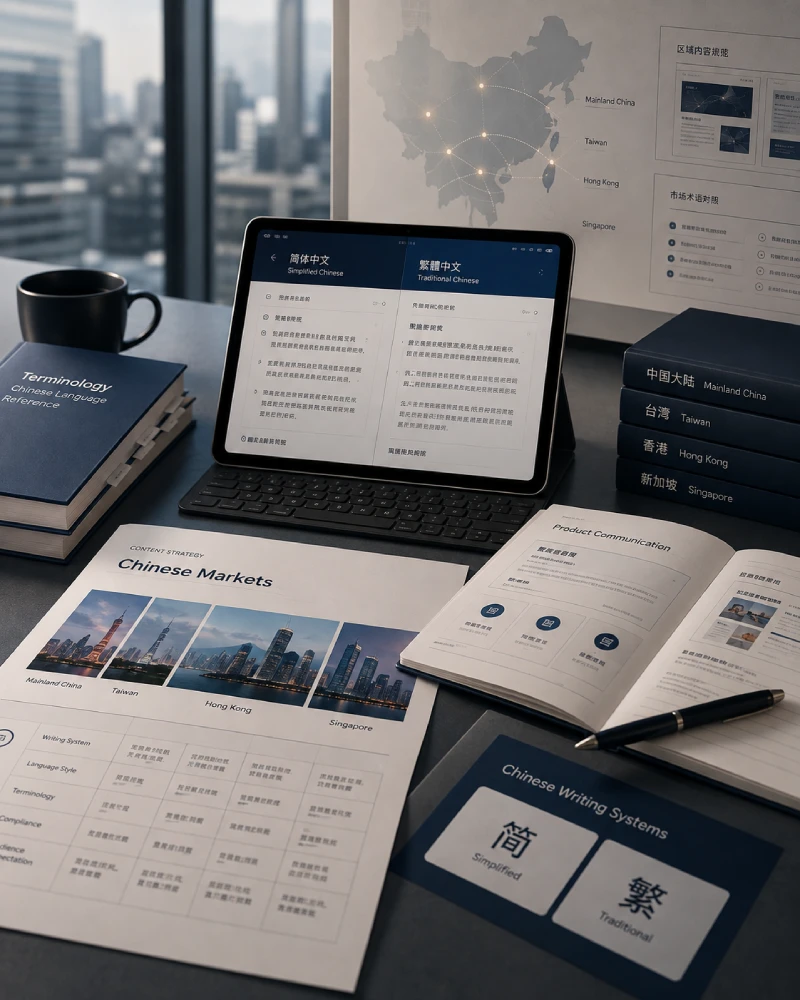
Mainly used in Mainland China and Singapore.
Mainly used in Taiwan, Hong Kong and Macau.
Mandarin is widely used across Mainland China and Taiwan, while Cantonese is especially important in Hong Kong, Macau and parts of southern China.
Traditional Chinese for Taiwan is not linguistically identical to Traditional Chinese for Hong Kong. Vocabulary, preferred expressions and local conventions can differ significantly.
Market, medium, audience, tone and final use all affect the Chinese variant, terminology and linguistic conventions that should be selected for a project.
Use Mainland terminology, familiar expressions and linguistic conventions expected by local audiences.
Taiwan uses its own vocabulary, terminology preferences and established written conventions.
Hong Kong terminology and its Cantonese-speaking environment differ from Traditional Chinese usage in Taiwan.
Chinese is used within a multilingual environment and should reflect Singapore-specific usage where appropriate.
Content may need to account for a Chinese-Portuguese multilingual environment and local language conventions.
Simplified Chinese describes a writing system. Mandarin describes a spoken variety.
Traditional Chinese describes a writing system. Cantonese describes a spoken variety.
The written form depends primarily on the market where your content will be read.
When content involves audio, video or spoken communication, pronunciation and regional language use become separate decisions.
One describes written characters; the other describes spoken language.
Taiwan commonly combines Traditional Chinese with Mandarin.
Chinese uses characters rather than an alphabet. This changes how information density, line length, visual hierarchy and text presentation behave compared with many Western languages.
Chinese often relies more heavily on surrounding context instead of repeatedly stating subjects, pronouns or other grammatical information.
The same concept may be expressed differently in Mainland China, Taiwan and Hong Kong, even when the underlying meaning remains the same.
Company names, product names and personal names may be translated, transliterated, retained in their original form or handled through an approved Chinese naming strategy.
Chinese can often communicate information more compactly than English, but shorter wording must still preserve meaning, readability and the intended tone.
Standard written Chinese should follow terminology and usage familiar to audiences in Mainland China.
Taiwan uses Traditional Chinese together with vocabulary and expressions that differ from those commonly preferred elsewhere.
Hong Kong also uses Traditional Chinese, but its terminology and Cantonese-speaking environment create a distinct language context.
Singapore uses Simplified Chinese within a multilingual environment, so content should not automatically mirror Mainland Chinese usage.
Traditional Chinese in Taiwan and Hong Kong is not interchangeable, just as Simplified Chinese in Mainland China and Singapore is not always identical in terminology or usage.
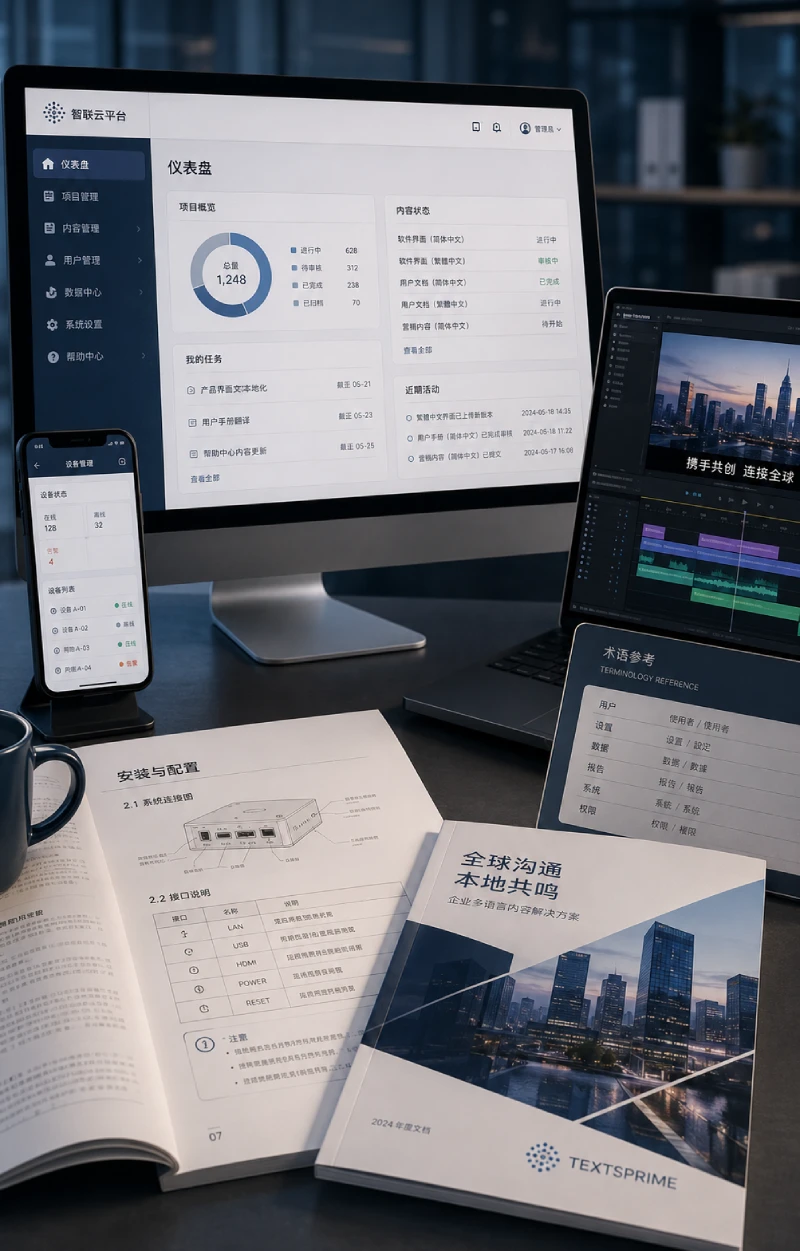
The final format changes what matters most—from interface terminology and information density to spoken delivery and subtitle readability.
Chinese interfaces require careful attention to navigation labels, terminology, character density and consistent wording across screens. Concise text still needs to remain clear and natural within the available interface space.
Technical Chinese depends heavily on controlled terminology, consistent product naming and clear treatment of units, abbreviations and technical concepts throughout the content.
Titles, professional terminology, levels of directness and audience expectations influence how business communication sounds in Chinese. Language that is accurate can still feel unnatural when the tone is wrong for the context.
Spoken content introduces decisions that written Chinese alone may not reveal. Mandarin or Cantonese may need to be selected, while subtitles must balance timing, readability and natural Chinese expression.
Explore the Textsprime capability that matches your project.
Changes the written character forms between Simplified and Traditional Chinese.
Adjusts vocabulary, preferred terms and expressions so the language reflects the conventions of the target market.
Aligns tone, naming conventions and language use with the actual audience, content environment and communication purpose.
A technically correct character conversion can still sound unfamiliar or inappropriate to readers in another Chinese market if terminology, tone and regional usage are not adapted as well.
A core language pair for global business, digital products, technical communication and multilingual content moving between Chinese-speaking markets and international audiences.
For regional business, product, technical and digital content between Chinese and Japanese-speaking audiences.
Suitable for cross-border technology, commercial and product communication across Chinese and Korean markets.
Common for industrial, engineering, manufacturing and business communication between Chinese and German-speaking markets.
Supports business and multilingual communication involving China, Europe, Canada and French-speaking international markets.
For multilingual business and content programs connecting Chinese-speaking audiences with Spain and Latin American markets.
Chinese can also be combined with other languages as part of a broader multilingual project. Tell us your source language, target market and Chinese variant, and we can help define the right setup.
Tell us where the content will be used so the Chinese version can follow the terminology and conventions expected in that market.
Confirm whether the project requires Simplified Chinese, Traditional Chinese or different written variants for multiple markets.
For audio, video or spoken communication, we also need to know whether Mandarin, Cantonese or another spoken variety is required.
Audience type affects tone, terminology and how much technical or contextual knowledge the language can assume.
Existing glossaries, approved Chinese product names and brand terminology help maintain consistency across new and existing content.
The place where Chinese appears affects wording, information density, formatting and the decisions needed before delivery.
Defining these details early helps avoid incorrect script choices, inconsistent terminology and unnecessary rework when content moves across Chinese-speaking markets.
The choice depends mainly on your target market. Simplified Chinese is generally used in Mainland China and Singapore, while Traditional Chinese is used in Taiwan, Hong Kong and Macau. Regional terminology should still be considered even when two markets use the same writing system.
No. Mandarin is a spoken variety of Chinese, while Simplified Chinese is a writing system. Mandarin can be represented using Simplified Chinese in Mainland China or Traditional Chinese in markets such as Taiwan.
No. Cantonese is a spoken Chinese variety, while Traditional Chinese describes written character forms. Traditional Chinese is used in both Hong Kong and Taiwan, even though Cantonese is especially important in Hong Kong and Mandarin is dominant in Taiwan.
Not always. Both markets use Traditional Chinese characters, but vocabulary, terminology, tone and common expressions can differ. Content intended specifically for either market should reflect its local linguistic conventions.
Simplified Chinese is generally used for written Chinese in Singapore, and Mandarin is widely used as a spoken Chinese variety. However, Singapore has its own multilingual context and some terminology may differ from Mainland Chinese usage.
In most market-specific projects, yes. Mainland China typically uses Simplified Chinese and Mainland terminology, while Taiwan uses Traditional Chinese together with its own vocabulary, naming preferences and linguistic conventions.
Names may be translated, transliterated, retained in their original form or adapted through an approved Chinese naming strategy. The right choice depends on brand requirements, existing market usage and audience expectations.
Character conversion can change Simplified forms into Traditional forms, but it does not automatically adapt terminology, tone or regional usage. Market-ready Chinese usually requires additional linguistic adaptation for the intended audience.