
01漢
One Language, Multiple Scripts
Standard Japanese combines Kanji, Hiragana and Katakana within the same sentence rather than relying on a single writing system.

Professional Japanese translation for businesses communicating with customers, partners and users in Japan—using the right writing conventions, terminology and level of formality for every audience and content environment.
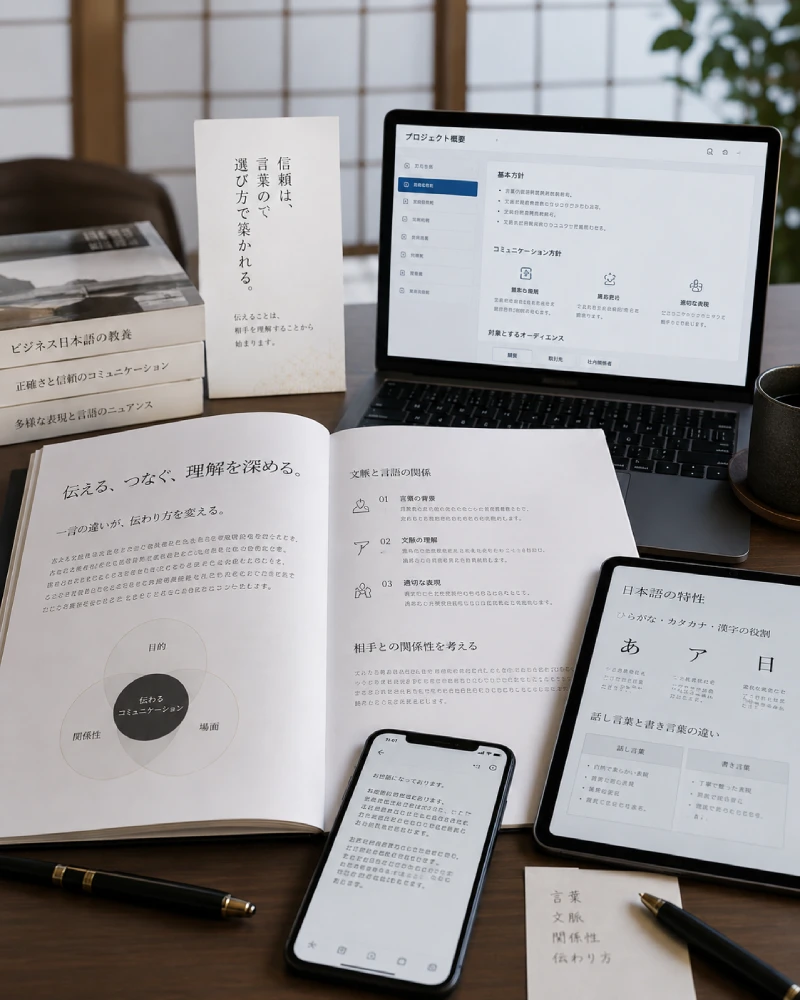
Standard Japanese combines Kanji, Hiragana and Katakana within the same sentence rather than relying on a single writing system.
Subjects and information that may be repeated in English are often omitted when Japanese readers can naturally infer them from context.
The language used for a customer, colleague, executive or general consumer may differ even when the underlying message remains the same.
Natural Japanese for a website, technical manual, presentation or spoken video script does not necessarily follow the same conventions.
Used extensively for lexical meaning, including many nouns, verb roots, adjective roots and specialized terminology.
Used for grammatical elements, inflections and many native Japanese words within natural sentence structures.
Commonly used for foreign loanwords, names, product terminology, technical vocabulary and selected forms of emphasis.
Japanese business and digital content frequently combines Latin letters, numbers, acronyms, units, model names and product codes.
Effective Japanese communication depends on using these systems together naturally rather than treating each script in isolation.
Is the message coming from a company, employee, specialist, executive or customer-facing representative?
Customers, colleagues, partners, senior stakeholders and general audiences may require different linguistic treatment.
Professional distance, hierarchy, familiarity and communication purpose all influence the appropriate register.
Appropriate for informational content, neutral instructions and communication where clarity and natural Japanese take priority.
Common in customer-facing and general business communication, where professional distance and appropriate politeness matter.
Sonkeigo may be used to show respect toward the actions, position or status of the other party.
Kenjōgo may be used when referring to the speaker's own actions in formal or relationship-sensitive communication.
The correct Japanese register depends on who is speaking, who is receiving the message and what relationship exists between them.
Japanese often omits subjects, pronouns and previously understood information when the surrounding context already makes the meaning clear.
Japanese organizes sentence information differently from English, with important grammatical relationships and predicates often appearing later.
Politeness is not simply added with formal vocabulary. Verbs, sentence endings and expressions may all change according to context.
Japanese content may combine full-width characters, half-width characters, Latin letters, numbers and punctuation.
Company names, people, products and specialized terminology may require decisions about Japanese form, pronunciation and approved usage.
Natural Japanese depends on more than vocabulary. Context, sentence structure, formality, typography and naming conventions all shape how content is understood by Japanese readers.
Consumer Japanese should feel approachable, readable and aligned with the personality of the brand rather than simply sounding formal.
Professional Japanese needs an appropriate level of politeness, awareness of role relationships and wording that feels measured rather than overly direct.
For technical and specialist audiences, terminology accuracy, clarity and controlled wording often take priority over expressive language.
Internal Japanese should prioritize clear instructions, organizational tone and role-specific communication rather than copying the formality of external customer messaging.
Good Japanese is not simply “formal Japanese.”It is Japanese that fits the audience, relationship and purpose.
Japanese interfaces require concise navigation labels, consistent terminology and careful decisions about mixed scripts and character density across screens.
Japanese technical content often combines local terminology, Katakana loanwords, English abbreviations, product names, model numbers and units within the same document.
Business Japanese needs the right balance of formality, professional restraint and relationship awareness. Direct English phrasing may require substantial adjustment to sound natural.
Spoken Japanese introduces additional decisions around sentence endings, speaker relationships, voice personality, subtitle readability and timing.
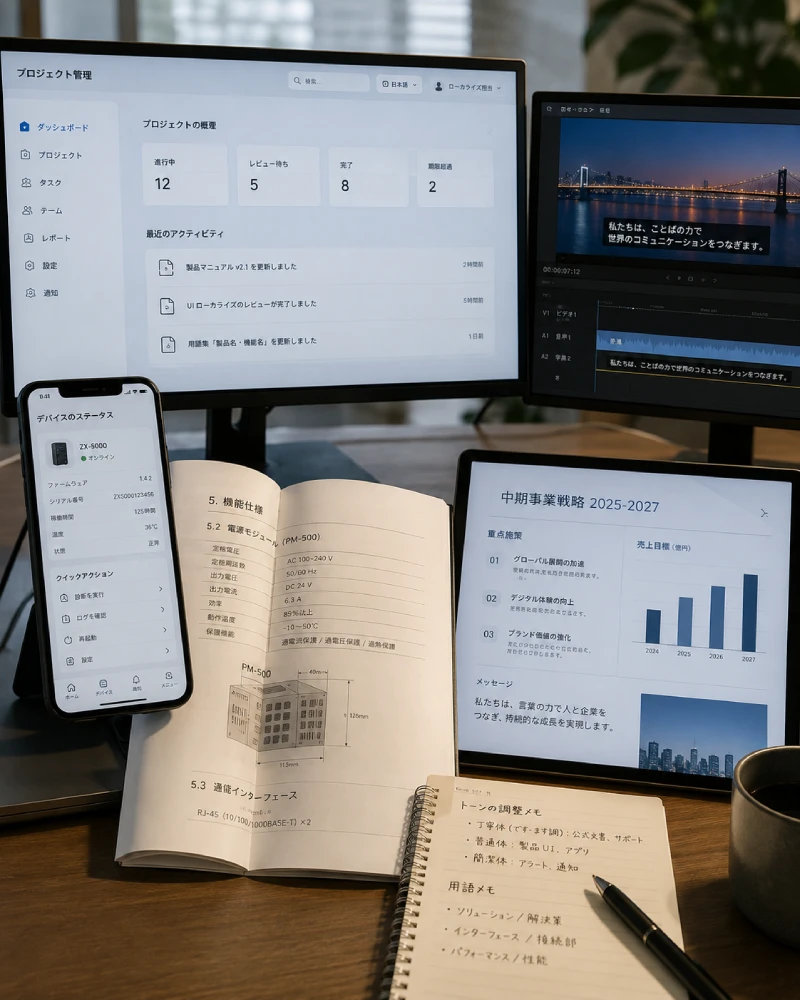
An English product name or technical term may be kept in its original form, represented in Katakana or adapted into established Japanese terminology. The right choice depends on audience familiarity, context and approved usage.
Some names and standardized terms are best retained in Latin characters, particularly when recognition and consistency are more important than localization.
Foreign-origin terms are often represented phonetically in Katakana, but phonetic conversion alone does not guarantee that the term is familiar or appropriate for the target audience.
Functional descriptions, category names and specialized concepts may be clearer when established Japanese terminology already exists and is familiar to the intended audience.
Once the appropriate form is selected, it should be used consistently across content so customers, employees and professional users encounter the same terminology wherever the term appears.
Long-term Japanese content needs more than one-off terminology decisions. Preferred forms should be documented so future content follows the same conventions.
Japanese content often connects businesses in Japan with international customers, partners and teams. English ↔ Japanese is the primary language pair, supported by additional combinations for multilingual communication.
Supporting international business, technical, digital and professional communication between English- and Japanese-speaking audiences.
Supporting cross-border business, product, technical and corporate communication between Chinese- and Japanese-speaking audiences.
Discuss This Pair→Supporting regional communication for digital products, business content and professional materials across Japan and Korea.
Discuss This Pair→Suitable for technical, industrial and business communication where terminology accuracy and professional clarity are especially important.
Discuss This Pair→Supporting multilingual corporate, consumer and professional content between Japanese- and French-speaking markets.
Discuss This Pair→Supporting Japanese content for Spanish-speaking customers, business partners and international organizations across multiple markets.
Japanese choices depend on more than the source text. Audience, relationships, content format and approved terminology all influence how the final language should work.
Tell us who will read, hear or interact with the content—customers, business partners, employees, technical professionals or another audience.
We need to understand who is speaking, who is receiving the message and how formal or relationship-sensitive the communication should be.
A website, software interface, technical document, presentation, package or video may require different Japanese conventions and wording.
Share approved terminology, Japanese product names, preferred Katakana forms, abbreviations and brand naming conventions where available.
Previous translations, Japanese website content, glossaries and approved reference materials help maintain continuity across projects.
Let us know whether the content needs to inform, instruct, persuade, support, explain or build a professional relationship with the audience.
The source text tells us what to communicate. Project context helps determine how it should sound in Japanese.
Kanji carries much of the lexical meaning in Japanese, while Hiragana is widely used for grammatical elements and inflections. Katakana is commonly used for foreign loanwords, names, product terminology and certain technical expressions.
Yes. Natural Japanese routinely combines Kanji, Hiragana and Katakana within the same sentence. Latin letters, numbers, abbreviations and product codes may also appear alongside them, especially in business, technical and digital content.
Japanese language choices can reflect hierarchy, professional distance and the relationship between the speaker and audience. A sentence may be grammatically correct yet still feel inappropriate if the level of politeness does not fit the situation.
Keigo is a system of polite and honorific Japanese used when relationships and social context require additional respect or formality. Its use depends on who is speaking, who is receiving the message and the relationship between them.
Not always. Consumer content may prioritize accessibility, familiarity and brand personality, while business communication often requires greater professional restraint, relationship awareness and an appropriate level of politeness.
Depending on established market usage and brand requirements, a name may remain in its original Latin-character form, appear in Katakana or use an approved Japanese representation. Consistency is particularly important across long-term content.
It depends on the term and the audience. Some foreign-origin technical vocabulary is commonly expressed in Katakana, while other concepts have established Japanese equivalents. Product, industry and client terminology should guide the final choice.
English and Japanese organize information differently. Japanese may omit subjects that are clear from context, restructure sentence information and adjust tone or formality. Natural translation therefore often requires more than replacing English words with Japanese equivalents.