
In-Game Text & UI
Menus, settings, tutorials, notifications, prompts, variables and other interface text.
Localize game scripts, dialogue, UI, subtitles, audio, store content and other player-facing content for international releases. Textsprime supports more than 230 languages across PC, console, mobile, browser and VR/AR platforms, with game-experienced linguists and in-context localization QA.
We will reply within 15 minutes.
Game localization connects player-facing content, technical assets and release requirements so the game works naturally across languages, platforms and target markets.
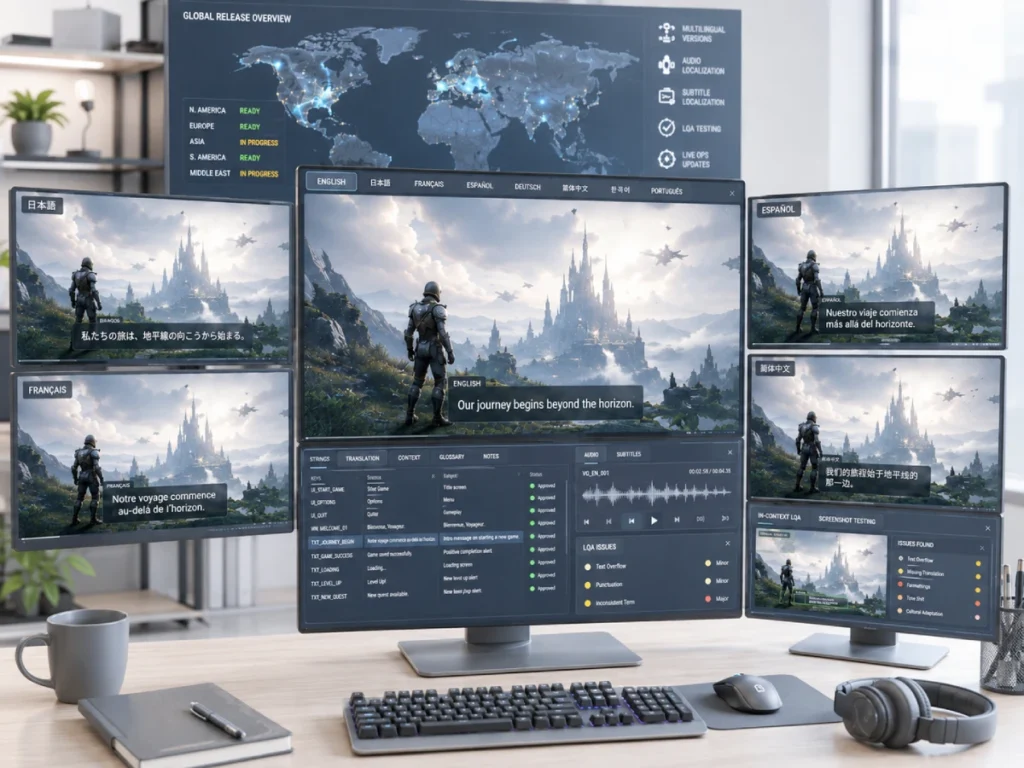
Prepare player-facing content for regional platforms, storefronts and market requirements.
Natural dialogue, clear UI and consistent terminology help players understand the game without breaking immersion.
Maintain approved terminology and language assets across launch content, DLC, patches and live operations.
Game localization goes beyond translation by adapting language, cultural references, interface constraints and player-facing content for each target market.
Menus, settings, tutorials, notifications, prompts, variables and other interface text.
Dialogue, quests, lore, character names, item descriptions and character voice.
Store descriptions, screenshots, promotional copy and other player-facing launch content.
Help content, release notes, events, seasons, DLC, patches and recurring live-service updates.
Localization QA reviews translated content inside the game environment, where context, UI behavior, audio and platform-specific issues can be checked together.
Confirm target languages, platforms, test scope, devices and build access.
Review accuracy, terminology, tone, narrative consistency and cultural context.
Test localized text, UI, subtitles and audio inside the game build.
Document reproducible issues, share evidence and verify fixes in subsequent builds.
QA Areas:
Mistranslation, ambiguity, tone, character consistency and missing context.
Text overflow, unsupported glyphs, variables, line breaks and other in-game display issues.
Pronunciation, synchronization, subtitle timing, reading speed and on-screen display.
Textsprime supports game localization across major platforms while maintaining shared terminology, language assets and release requirements across updates.
Localization for PC builds and distribution platforms.
Localization support for console interfaces, terminology and release requirements.
UI, store content and player-facing text for iOS and Android games.
Localization for browser-based games and web-delivered player content.
Localization for spatial UI, subtitles, audio cues and immersive interfaces.
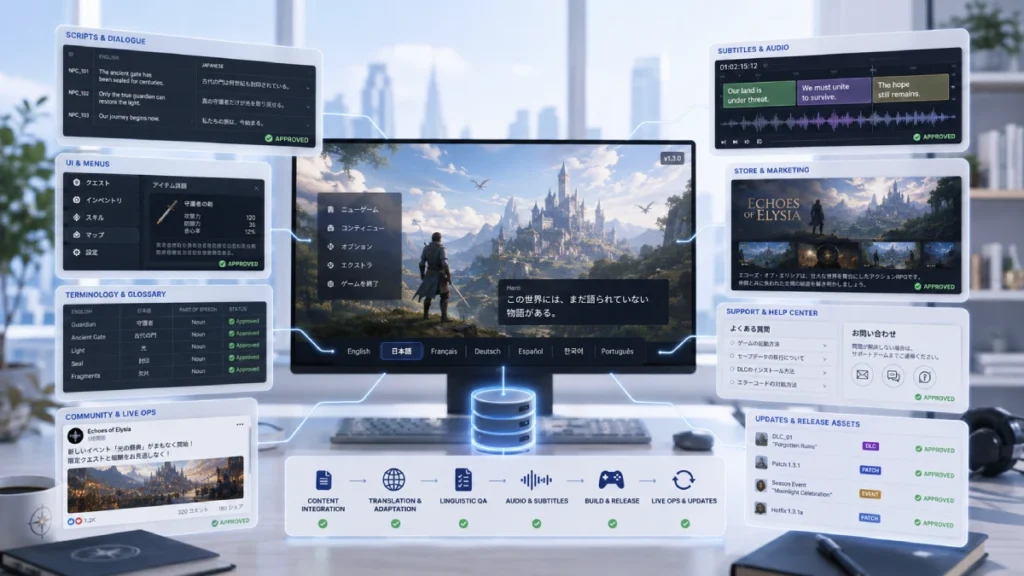
Shared terminology, translation memory and versioned files help teams keep multilingual releases consistent as the game changes.
Track source changes, build versions and approved localization updates across releases.
Glossaries, translation memory and style guidance help keep terminology and narrative consistent across languages.
Reuse approved language assets for patches, downloadable content, seasonal events and ongoing releases.
Different game genres place different demands on dialogue, terminology, UI, narrative continuity and update cycles.
Branching dialogue, quests, lore, character voice and long-term terminology require strong context and consistency across large content volumes.
Fast prompts, objectives, cinematic dialogue and contextual tutorials.
Dense systems, data labels, technical terminology and repeatable UI patterns.
Commentary, statistics, licensing terminology, platform conventions and live rosters.
Short strings, onboarding, events, monetization content and frequent updates.
Seasons, events, player support, community content, DLC and continuous delivery.
Localize dialogue, voiceover and subtitles while preserving character, timing and the creative direction of the game. Projects can include script adaptation, recording, post-production and in-game audio QA.
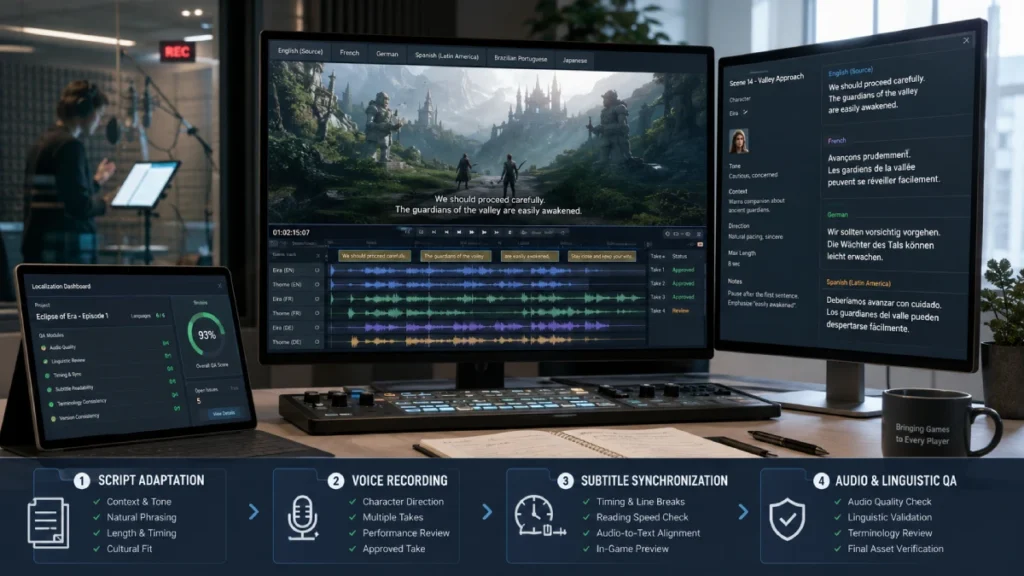
Casting, pronunciation preparation, recording and performance direction for localized character dialogue.
Subtitle timing, reading speed, line length, speaker treatment and on-screen display are reviewed for the target language.
Editing, file naming, processing and delivery according to the agreed technical specifications.
Review localized voice and subtitles inside the build for pronunciation, timing, synchronization, playback and context.
Game localization often involves limited context, variables, UI constraints, language-specific formatting and frequent content updates. These issues need to be considered during translation and tested in the game build.
Screenshots, character information, reference notes and linguistic queries help resolve ambiguous strings before they create in-game issues.
Variables, placeholders, character limits, plurals and text expansion need to remain functional across languages.
Terminology, versions and approved translations need to stay consistent across patches, DLC and live-service releases.
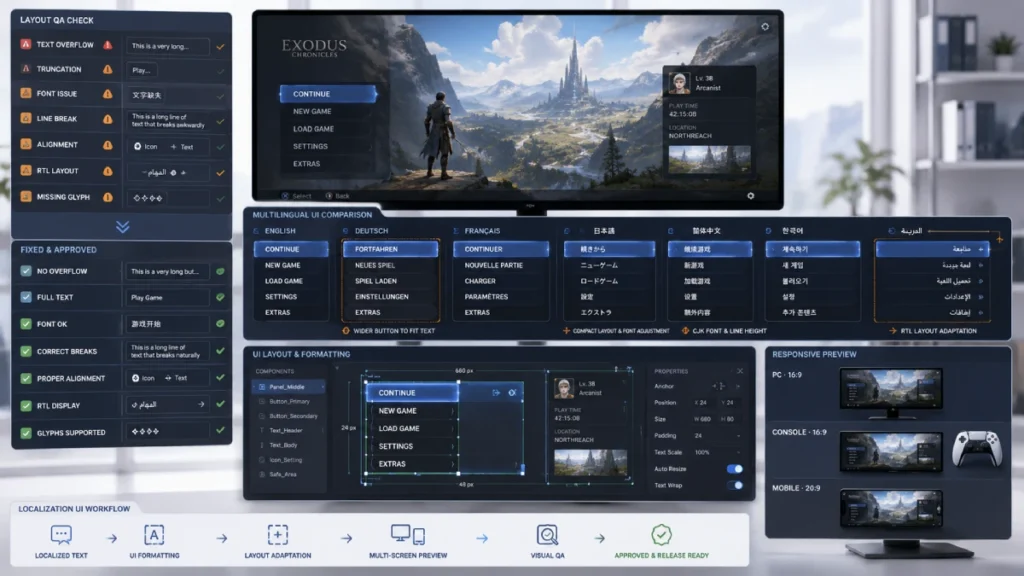
Chinese, Japanese and Korean require appropriate font support, spacing, terminology and interface handling.
Text expansion, grammar, regional variants and terminology can affect UI and player-facing content.
Arabic and other RTL languages may require mirrored layouts, bidirectional text handling and additional UI review.
Localized UI needs to remain readable and functional across languages. Review can cover text expansion, fonts, line breaks, right-to-left layouts, graphics and screenshots.
Game localization requires language expertise, technical file handling, in-context testing and reliable support across releases. Textsprime brings these capabilities together for both new launches and ongoing game content.
Linguists are selected for language ability, gaming knowledge and familiarity with the genre and target audience.
Localization files, variables, build versions and structured content can be managed without losing the technical information developers need.
Localized builds can be reviewed for language, context, UI display, audio, variables and other issues that only appear during gameplay.
Controlled file access and reusable language resources support multilingual launches, DLC, patches and recurring updates.
Pricing and delivery time depend on the content volume, target languages, platforms, localization services, LQA requirements, audio scope and release schedule. We confirm the project scope after reviewing the files and requirements.
Content volume, file types, repetition, preparation requirements and required output formats.
Target languages, specialist availability, parallel production and review requirements.
Review stages, LQA coverage, audio requirements, milestones and the planned launch date.
A quote can cover translation, terminology work, UI localization, subtitles, voiceover, LQA and other agreed production services. The final scope depends on the game content, target languages, platforms and release requirements.
Turnaround depends on the amount of content, number of languages, platforms, LQA scope, audio requirements and release schedule. We confirm the delivery plan after reviewing the files, build access and project requirements.
Yes. We can support recurring localization for DLC, patches, seasonal content and live-service updates. Translation memory, terminology and approved language assets can be maintained across releases to help keep new content consistent with the existing game.
Yes, where it is appropriate for the content and agreed as part of the project. Creative dialogue, narrative content and other context-sensitive text often require greater human involvement, while suitable repetitive or structured content may use machine translation with professional review.
The translation approach is confirmed before production begins.
Confidential builds, scripts and game assets can be handled through controlled access, secure file transfer and project-specific confidentiality requirements. Access permissions and security requirements are confirmed before production begins.