

Chinese localization is often framed as a binary question: Simplified or Traditional? The script matters, but it is only the first layer. Two versions can use the same character system and still differ in terminology, tone, search queries, formatting, legal references, and interface conventions.
A sound decision starts with the audience: define the market and content type first, then select the locale, script, terminology, and technical implementation.
Quick Answer
Simplified and Traditional Chinese are two writing systems that use different character forms. Simplified Chinese is commonly used in Mainland China and Singapore, while Traditional Chinese is commonly used in Taiwan, Hong Kong, and Macau. However, script choice is not the same as locale choice: terminology, tone, formatting, and search behavior also vary by market.
What Is Simplified Chinese?
Simplified Chinese uses standardized simplified forms for part of the Chinese character inventory. For example, 國 becomes 国 and 書 becomes 书, while many characters remain identical in both systems.
It is the normal starting point for broad commercial communication in Mainland China and Singapore. It is also widely used in Malaysian Chinese education and contemporary communication, although usage varies by audience and channel.
Mainland China’s language framework distinguishes its standard spoken form, Putonghua, from standardized written characters—an important reminder that speech and script are separate concepts.
“Simplified Chinese” therefore describes writing. It does not mean Mandarin, nor does it specify Mainland, Singaporean, or Malaysian terminology.
What Is Traditional Chinese?
Traditional Chinese uses forms such as 國 and 書. It is the normal written choice for Taiwan, Hong Kong, and Macau, as well as some overseas, cultural, and publishing contexts.
Traditional Chinese is also a script—not one universal locale. Taiwan and Hong Kong may use the same character forms while preferring different words, product labels, and search phrases.
It is not synonymous with Cantonese. Mandarin-oriented content can be written in Traditional characters, while Cantonese speech is a separate project requirement.
Simplified vs Traditional Chinese at a Glance
| Factor | Simplified Chinese | Traditional Chinese |
|---|---|---|
| Character system | Standardized simplified forms | Traditional forms |
| Common markets | Mainland China, Singapore; often Malaysia depending on audience | Taiwan, Hong Kong, Macau |
| Script tag | zh-Hans | zh-Hant |
| Common regional tags | zh-CN, zh-SG | zh-TW, zh-HK, zh-MO |
| Terminology | Differs among Mainland China, Singapore, and Malaysia | Differs among Taiwan, Hong Kong, and Macau |
| Typography | Requires locale-appropriate fonts and punctuation | Same requirement; Hong Kong may need additional character support |
| Search behavior | Keywords vary by market and search platform | Taiwan and Hong Kong queries are not interchangeable |
| Business use | Market-specific websites, software, marketing, and support | Market-specific websites, software, marketing, and support |
Hans and Hant are script subtags for Simplified and Traditional Han characters. By contrast, CN, SG, TW, HK, and MO identify regions.
The practical difference is therefore larger than character shape. A script label cannot determine vocabulary, spoken language, SEO strategy, or regulatory wording.
Simplified and Traditional Character Examples
A few basic examples show the visible difference between the two writing systems:
| English | Simplified | Traditional |
|---|---|---|
| country | 国 | 國 |
| door | 门 | 門 |
| book | 书 | 書 |
| love | 爱 | 愛 |
Conversion is not always one to one. The Simplified character 发 may become 發 in words related to sending or development, but 髮 in words related to hair. Context determines the correct form.
Character conversion also cannot resolve market vocabulary. “Software,” for example, is commonly written as 软件 in Mainland China, 軟體 in Taiwan, and 軟件 in Hong Kong.
Script and Spoken Language Are Different Decisions
Mandarin and Cantonese are spoken languages or language varieties. Simplified and Traditional Chinese are writing systems. Standard Written Chinese is a broadly shared written register.
Mandarin can be written in either script. Traditional characters in Hong Kong do not mean that every text is written Cantonese. Websites may require only a written locale, but audio, video, voice interfaces, and customer-support operations must also define:
- Spoken language or variety
- Target-market accent
- Subtitle script
- Subtitle register
- Voice-search requirements
- Customer-service language
The distinction also affects language tags. zh-HK means Chinese as used in Hong Kong; it does not specifically mean Cantonese. A system that needs to identify Cantonese separately may support a tag based on yue, such as yue-HK.
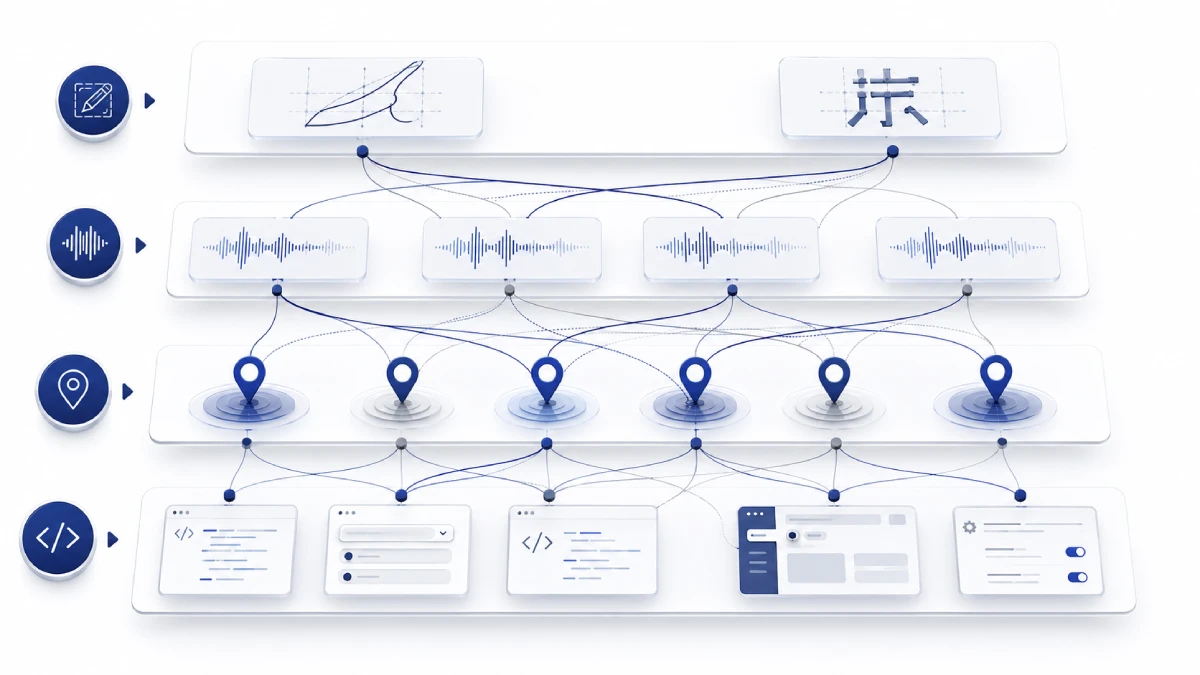
Which Markets Use Simplified Chinese?
Mainland China
Simplified Chinese is the standard choice for broad public and commercial communication in Mainland China. A Mainland version should also use local product terminology, search phrases, platform references, forms, and regulatory language—not merely the correct character shapes.
A version prepared for Singapore or Malaysia should not automatically be reused for Mainland China. Even where the script is the same, references to government bodies, payments, ecommerce, legal requirements, customer support, and digital platforms may need to change.
Singapore
Simplified characters are the usual starting point for mainstream Chinese education and public communication in Singapore. However, Singapore has its own institutional and everyday vocabulary, shaped partly by its multilingual environment.
A Mainland Chinese version may therefore be useful as source material, but it should not automatically become the final Singapore version.
Malaysia
Simplified Chinese is often the practical starting point in Malaysia, particularly for audiences shaped by Chinese-language education. Traditional characters also remain visible in some publications, signs, brands, imported media, and cultural settings.
Malaysia is a multilingual market, so the best commercial choice cannot be determined by national language policy alone. Audience age, industry, channel, location, existing brand language, and the role of English or Malay should all be considered.
Which Markets Use Traditional Chinese?
Taiwan
Traditional Chinese is the normal written choice for Taiwan. A Taiwan version should use Taiwan terminology, editorial conventions, technology vocabulary, tone, and local keyword data rather than a mechanically converted Mainland or Hong Kong version.
The target spoken language should still be specified separately when a project includes audio. Mandarin is widely used, but written Traditional Chinese does not by itself define every audience’s spoken-language requirements.
Hong Kong
Traditional Chinese is also the broad-market written choice in Hong Kong, but local terminology differs from Taiwan usage.
Content may use Standard Written Chinese, Cantonese-influenced wording, or explicitly written Cantonese, depending on the channel and audience. A corporate website and a conversational social campaign, for example, may require different registers even when both use Traditional characters.
Digital products may also need support for the Hong Kong Supplementary Character Set, particularly for locally used names, places, and specialized characters.
Macau
Traditional Chinese is generally the starting point for Chinese-language content in Macau. Cantonese is widely spoken, while Chinese and Portuguese are both relevant in official and institutional contexts.
Macau should not simply inherit a Hong Kong version. Government, tourism, gaming, finance, legal, hospitality, and cross-border content can require Macau-specific institutional terminology and sector review.
Chinese Locale Codes Explained
Common Chinese locale and script identifiers include:
zh-CN: Chinese as used in Mainland Chinazh-SG: Chinese as used in Singaporezh-TW: Chinese as used in Taiwanzh-HK: Chinese as used in Hong Kongzh-Hans: Chinese written in Simplified Han characterszh-Hant: Chinese written in Traditional Han characters
In a BCP 47 tag such as zh-Hant-HK:
zhidentifies ChineseHantidentifies the Traditional Han scriptHKidentifies the Hong Kong region
Region tags and script tags are therefore not interchangeable. More explicit combinations such as zh-Hans-SG, zh-Hant-TW, and zh-Hant-HK can be used when both the writing system and market need to be represented and the target platform supports them.
Unicode CLDR uses likely-subtag and locale data to help software infer locale behavior. These are technical defaults, not proof that one market version is suitable for every audience using the same script.
Implementation also varies. A translation platform may shorten a tag, a framework may fall back to a parent resource, and a folder called zh-TW may contain text that was never adapted for Taiwan. Inspect the content and test the system; do not infer linguistic quality from a file name.
Traditional Chinese for Taiwan vs Hong Kong
The following are common terminology contrasts. Product teams should still confirm each term against their industry, brand glossary, and target audience.
| English | Mainland China | Taiwan | Hong Kong |
|---|---|---|---|
| software | 软件 | 軟體 | 軟件 |
| network | 网络 | 網路 | 網絡 |
| 电子邮件 / 邮件 | 電子郵件 | 電郵 | |
| printer | 打印机 | 印表機 | 打印機 |
The differences extend beyond individual words. Product messaging, customer-service language, English-Chinese searches, punctuation, glyph preferences, and query intent can all vary.
A Taiwan keyword converted into Hong Kong character forms is not automatically the phrase Hong Kong users search. The visible script may be correct while the terminology and search intent remain wrong.
Simplified Chinese for Mainland China vs Singapore
Mainland China and Singapore share widespread use of Simplified character forms, but they do not form one interchangeable locale.
Differences can appear in:
- Institutional and government terms
- Transport and housing vocabulary
- Education and financial terminology
- Product naming
- Business expressions
- Use of English
- Legal and regulatory references
- Search behavior
A Mainland version may serve as source material for Singapore when the content is factual and low risk. It should still be adapted, checked against local terminology, and reviewed by a Singapore-aware linguist. The same principle applies in reverse.
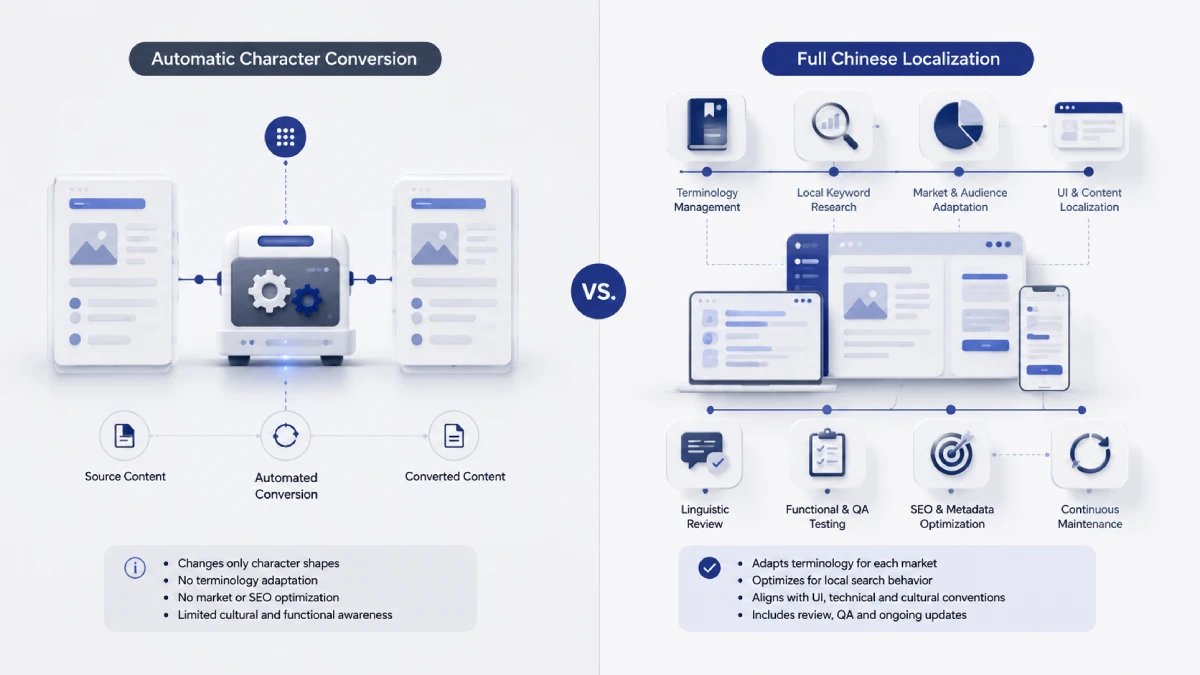
Why Automatic Character Conversion Is Not Full Localization
Modern converters can handle character variants, phrase-level rules, and some Mainland, Taiwan, or Hong Kong vocabulary. They are useful for creating a first-pass derivative version and reducing repetitive production work.
They cannot independently decide whether:
- A headline sounds natural
- A keyword reflects local search intent
- A product name is established in the market
- A call to action fits the local tone
- A legal reference applies
- A technical term matches the client’s industry
- A proper noun requires a market-specific form
Even advanced conversion engines distinguish between character variants, one-to-many mappings, and regional phrase dictionaries. That capability makes conversion more accurate, but it does not replace market research or linguistic review.
A safer production model is:
Conversion or content reuse → terminology adaptation → local linguistic review → in-context QA
Character encoding, Unicode normalization, script conversion, translation, and localization are different operations.
Website and SEO Considerations
Research Keywords by Market
Do not translate one English keyword list and reuse it across every Chinese market.
Research product terms, customer problems, modifiers, competitor wording, and English-Chinese combinations for each priority locale. A term that has the right dictionary meaning may have low search demand or a different commercial intent in another market.
Search ecosystems also differ by market and device. Mainland China requires a different search strategy from Taiwan, Hong Kong, or Singapore, and search-engine share should always be rechecked before making market-level investment decisions.
Use Crawlable Locale URLs
A multi-market website might use:
/zh-cn//zh-tw//zh-hk//zh-sg/
Use hreflang values that match the actual audience. Search engines can support Chinese script tags such as zh-Hans and zh-Hant, as well as optional regional targeting. Alternate pages should reference one another, and each genuinely localized page should normally remain self-canonical. x-default can identify a neutral language selector or fallback page.
Do not rely only on IP redirects, cookies, or browser-language detection. Separate URLs are easier to crawl, share, test, analyze, and maintain.
Localize the Whole Experience
Localization should include:
- Page titles and meta descriptions
- Headings and navigation
- Internal links
- Structured content
- Image alt text
- Filters and on-site search
- Error messages
- Consent and privacy text
- Customer-support content
Test fonts, line wrapping, names, addresses, telephone fields, dates, numbers, currencies, shipping information, payment flows, and checkout behavior.
For a broader implementation framework, see website localization.
Software and App Localization Considerations
Applications require more than translated strings. Product and engineering teams should define:
- Resource bundles and fallback rules
- UTF-8 and Unicode handling
- Region-appropriate fonts
- Input-method compatibility
- Sorting and collation
- Internal search behavior
- Date, time, number, and currency formats
- Names and address fields
- UI wrapping and truncation
- Notifications and error messages
Internal search should account for users who paste text in another Chinese script or use a local synonym. App-store metadata, screenshots, release notes, help centers, chatbots, and customer-support scripts should follow the same locale strategy.
Fallback behavior deserves explicit testing. A framework may use a more general resource when a specific locale bundle is missing. That can keep an interface operational without guaranteeing that the fallback terminology is commercially appropriate for the requested market.
See app and software localization for the wider product-localization context.
Which Chinese Version Does Your Business Need?
| Target market | Written version | Recommended locale | Reuse approach | Review model |
|---|---|---|---|---|
| Mainland China | Simplified | zh-CN or zh-Hans-CN | Other Chinese copy as source only | Mainland linguistic, SEO, and in-context review |
| Singapore | Simplified | zh-SG or zh-Hans-SG | Adapt a Mainland base where suitable | Singapore terminology and linguistic review |
| Malaysia | Audience-dependent; often Simplified | zh-MY or a supported explicit form | Reuse only after audience research | Malaysian Chinese review |
| Taiwan | Traditional | zh-TW or zh-Hant-TW | Adapt a Hong Kong base where suitable | Taiwan linguistic, SEO, and in-context review |
| Hong Kong | Traditional | zh-HK or zh-Hant-HK | Adapt a Taiwan base where suitable | Hong Kong review; Cantonese-aware review where needed |
| Macau | Usually Traditional | zh-MO or zh-Hant-MO | Hong Kong copy may be a starting point | Macau and sector-aware review |
| Global script-defined audience | Simplified or Traditional | zh-Hans or zh-Hant | Neutral copy only for low-risk use | Review against the principal audience |
Reuse translation memories, glossaries, and modular source content, but do not make one generic Chinese translation the final version everywhere.
After defining the target locales, the Chinese translation page provides the related service context.
When One Chinese Version May Be Enough
One Chinese version can be reasonable when:
- The audience is narrow and clearly defined
- The content is internal or mainly factual
- The project is a temporary market test
- Organic search is not central
- The launch is intentionally staged
- The content has limited commercial or regulatory risk
Document which audience the version serves, avoid unreviewed regulatory claims, arrange local review, collect user data, and define when a separate locale will be created.
This is a controlled compromise, not proof that all Chinese-speaking audiences are interchangeable.
When Separate Chinese Versions Are Recommended
Separate versions are usually justified for:
- Customer-facing corporate websites
- Ecommerce
- Paid campaigns
- Search-led content
- Software and mobile applications
- Customer-support systems
- Regulatory or policy-sensitive material
- Products with established local terminology
- Long-term market operations
They do not need to be translated from zero. A reviewed primary version can provide shared meaning, structure, and reusable assets, followed by controlled market adaptation.
A Practical Chinese Localization Workflow
- Define markets and locales: Identify the audience, script, region, channel, and spoken-language requirements.
- Audit the source: Separate market-neutral, market-sensitive, regulatory, visual, and frequently updated content.
- Research local keywords: Build a separate query map for every priority search market.
- Create terminology resources: Approve product, UI, brand, and regulatory language in a terminology and style guide.
- Translate the primary locale: Establish a complete and reviewed base version.
- Adapt additional locales: Change script, terminology, examples, metadata, formats, and market references.
- Review locally: Check naturalness, tone, terminology, and factual suitability.
- Run in-context QA: Test glyphs, layout, links, forms, search, fallback, and complete user journeys.
- Maintain the content: Update terminology, products, keyword data, and regulatory references over time.
A documented quality management process should assign reviewers, acceptance criteria, issue owners, and revalidation rules.
Common Mistakes
| Mistake | Why It Fails |
|---|---|
| Requesting only “Chinese” | Market, script, locale, and spoken-language requirements remain undefined |
| Choosing the script before the market | Terminology may target the wrong audience |
| Equating Simplified Chinese with Mandarin | It confuses writing with speech |
| Equating Traditional Chinese with Cantonese | It makes the same error in reverse |
| Combining Taiwan and Hong Kong | Vocabulary, search behavior, and conventions differ |
| Reusing Mainland keywords elsewhere | Converted words may not match local queries |
| Publishing raw character conversion | Tone, terminology, and context remain unresolved |
| Ignoring locale fallback | Users may receive an inappropriate default version |
| Using incomplete fonts | Characters or regional glyphs may fail to render |
| Reusing legal or policy content | Institutions and requirements are market-specific |
| Skipping local review | Many linguistic and interface defects appear only in context |
Project Brief Checklist
Before production begins, confirm:
- Target country, region, or market
- Intended audience
- Written script
- Required locale tag
- Spoken language if audio is involved
- Content type
- Publishing platform
- Website or application framework
- SEO requirements
- Priority search engines
- Approved terminology
- Regulatory context
- Existing Chinese content
- Available glossaries or translation memories
- Local reviewers
- Locale fallback behavior
- Delivery format
- QA scope
- Update frequency
That is far more actionable than a brief requesting only “Chinese translation.”
FAQ
Should I use Simplified or Traditional Chinese?
Choose according to the target market. Mainland China and Singapore normally call for Simplified Chinese, while Taiwan, Hong Kong, and Macau normally call for Traditional Chinese. Then adapt terminology, tone, formats, keywords, and market references for the specific locale.
Is Simplified Chinese the same as Mandarin?
No. Simplified Chinese is a writing system; Mandarin is spoken. Mandarin-oriented content can be written in either Simplified or Traditional characters.
Is Traditional Chinese the same as Cantonese?
No. Traditional Chinese is a script; Cantonese is spoken. Hong Kong written content may use Standard Written Chinese, Cantonese-influenced language, or explicitly written Cantonese, depending on its purpose and audience.
Do Taiwan and Hong Kong use the same Traditional Chinese?
They share many Traditional character forms, but their terminology, tone, technology vocabulary, search phrases, typography, and customer expectations can differ. Important public-facing content should be adapted and reviewed separately.
Can Simplified Chinese be converted automatically into Traditional Chinese?
A converter can create a useful first pass, particularly when it supports phrase-level and regional rules. Ambiguous characters, market terminology, search keywords, tone, product names, and local references still require professional review.
What is the difference between zh-CN, zh-TW, zh-Hans, and zh-Hant?
u003ccodeu003ezh-CNu003c/codeu003e and u003ccodeu003ezh-TWu003c/codeu003e identify Chinese associated with particular regions. u003ccodeu003ezh-Hansu003c/codeu003e and u003ccodeu003ezh-Hantu003c/codeu003e identify Chinese written in Simplified and Traditional scripts. Use the tag that represents the distinction your audience and technical system actually need.
Can one Simplified Chinese version cover Mainland China, Singapore, and Malaysia?
Possibly for limited, factual, low-risk content after local review. It is rarely sufficient for SEO, campaigns, ecommerce, regulated information, or long-term market operations because terminology and audience expectations vary.
Does a global website need more than one Chinese version?
Not always. Separate versions become advisable when several Chinese-language markets have meaningful revenue, traffic, search demand, local teams, regulatory differences, or distinct customer-experience requirements.
Choose the Audience Before the Script
The best question is not simply “Simplified or Traditional?” It is: who will read the content, in which market and channel, and what must the experience help them do?
Once that is clear, the script, locale tag, terminology, keyword strategy, review model, and maintenance plan become much easier to define.