

AI is changing localization, but the most important enterprise decision is not whether AI should replace human translators. The real question is how to divide work among automation, machine translation, generative AI, professional linguists, subject-matter experts and business approvers according to what the content is for and what happens if it is wrong.
That distinction matters as organizations move from isolated AI experiments into repeatable production. A model may generate fluent multilingual text, yet production readiness depends on much more: source meaning, terminology, market suitability, privacy, quality evidence, escalation rules and clear accountability. The strongest AI localization strategy is therefore a workflow strategy rather than a model-selection exercise.
Executive Answer
AI and human expertise are not competing localization strategies. The better approach is to break localization into individual tasks, classify content according to its purpose and risk, and then decide which activities can be automated, which require professional review, and who has authority to approve the final output.
AI can create value far beyond generating a first translation. It can support content classification, terminology extraction, translation-memory retrieval, quality estimation, automated QA, routing and continuous localization. Human judgment remains critical when meaning is ambiguous, market suitability matters, specialist knowledge affects interpretation, or errors could have serious consequences.
A mature AI localization strategy is designed around workflow, controls, language assets, evidence and accountability—not around choosing AI or humans as a universal solution.
Why “AI vs Human” Is the Wrong Decision Frame
Questions such as “Can AI replace translators?” or “Is AI translation better than human translation?” sound important, but they are usually too broad to support an enterprise decision.
Localization is not a single activity.
Consider a product page for an industrial device. One page might contain descriptive marketing copy, technical specifications, interface labels, warranty conditions and safety instructions. All of that content may need to reach the same market in the same language, but the consequences of mistranslating each section are very different.
A slightly awkward product description may reduce conversion. An incorrect voltage specification could lead to a product-selection error. A mistranslated safety warning could have far more serious consequences.
Treating the entire page as either “AI translation” or “human translation” ignores those differences.
The more useful questions are:
- Which task is being performed?
- Which content is being processed?
- Who will use it?
- What happens if it is wrong?
- What quality threshold is required?
- What data environment is permitted?
- Who remains accountable for the result?
This reframes AI localization from a technology-selection problem into an operating-model problem. The correct unit of decision is often not the document. It is the task and the risk attached to that task.
Break Localization Into Tasks Before Choosing Technology
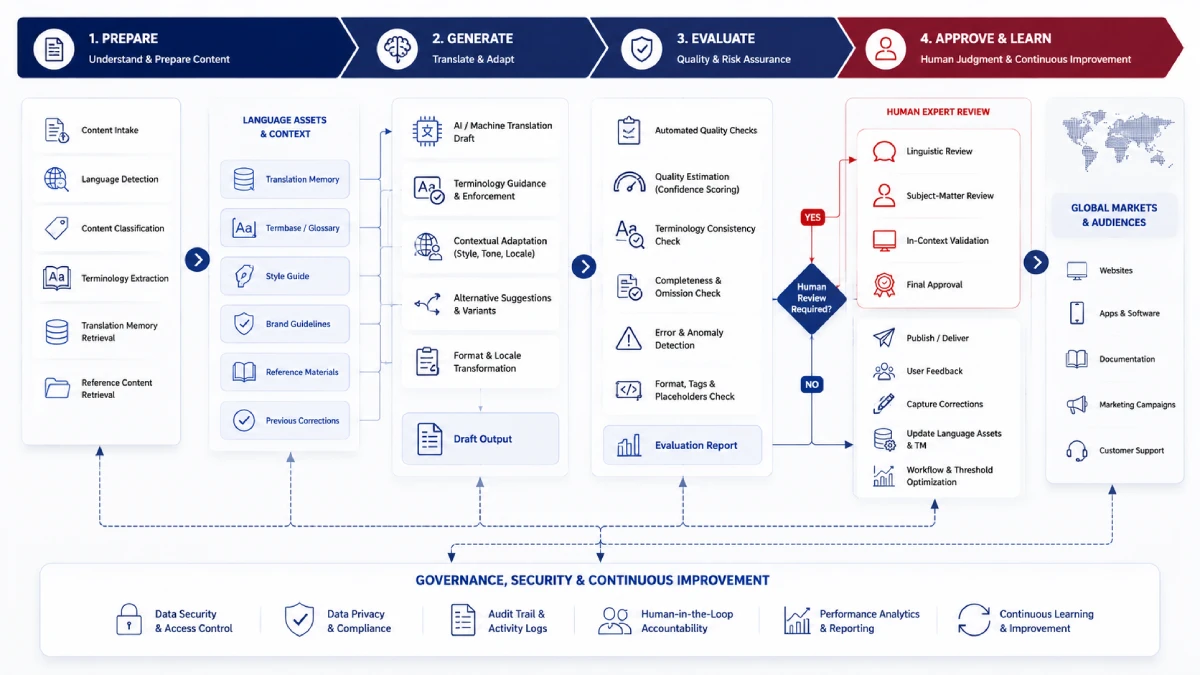
Organizations often evaluate AI by asking whether it can translate a document. That is only one part of the localization workflow.
Before translation begins, systems may need to identify languages, extract content from files, classify content, detect repetition, retrieve translation-memory matches, identify terminology, locate reference material or assign the content to an appropriate workflow.
During production, AI or machine translation may generate target text, suggest alternatives, apply terminology, use style instructions or assist with adaptation.
After generation, other systems may check completeness, numbers, tags, formatting, terminology or suspicious additions. Quality-estimation models may identify segments that appear more likely to require review. Linguists, subject-matter experts or local-market teams may then validate particular parts of the output before approval.
The process continues after publication. Corrections can be captured, terminology updated, reviewer decisions analyzed and routing thresholds adjusted.
This matters because an organization may use significant amounts of AI without allowing AI to make the final publishing decision.
In some environments, classification, retrieval, QA and routing may create as much operational value as translation generation itself.
That is a more useful way to think about localization automation: not “How much can AI translate?” but “Which parts of the process can technology perform reliably enough to improve the whole system?”
Where AI Adds the Most Value
AI tends to be most useful where the work is high-volume, repeatable, context can be supplied systematically and the consequences of occasional errors are understood.
High-Volume and Repetitive Content
Product catalogs, knowledge bases, recurring documentation updates and large volumes of structured content can create a strong case for automation.
AI or machine translation can generate drafts quickly, while terminology databases, approved previous translations and automated checks can help improve consistency.
However, volume does not automatically mean low risk. A catalog containing thousands of routine descriptions may also include technical specifications or regulated claims. Those elements may need different controls even if they pass through the same content system.
Translation Drafting and Alternative Generation
AI can be highly useful as a drafting layer.
Instead of beginning every segment from a blank target field, linguists can evaluate an existing translation, compare alternatives or focus attention on difficult passages.
The important distinction is that a drafting mechanism is not an approval mechanism.
Highly fluent target-language output can still contain omissions, altered relationships, unsupported additions or incorrect interpretations. Peer-reviewed research on multilingual machine translation has documented hallucinated translations in both NMT and LLM-based systems, with particular difficulties appearing in some lower-resource translation directions. See, for example, the research paper Hallucinations in Large Multilingual Translation Models.
Fluency is therefore useful evidence about fluency. It is not, by itself, evidence that the translation is faithful or safe to publish.
Terminology Extraction and Language-Asset Support
AI can help identify candidate terminology, inconsistent product names, newly introduced concepts and recurring expressions across large document collections.
That can reduce the manual effort required to maintain enterprise language assets.
But there is a governance boundary: AI may propose terminology, while the organization still needs an authoritative process for deciding which term is approved, deprecated, prohibited or market-specific.
Terminology management is ultimately about organizational decisions, not only linguistic probability.
Content Classification and Routing
One of the most valuable applications of AI may be deciding what should happen to content next.
Content can potentially be classified according to business function, audience, sensitivity, regulatory relevance, publication channel, language, content type or other risk indicators.
That classification can then determine whether the content goes through an automated workflow, selective human review, full post-editing, specialist review or a human-led process.
In this sense, AI may deliver more strategic value by answering:
“Which workflow should this content enter?”
than by answering:
“What is the translation of this sentence?”
Quality Estimation and Automated QA
Automation is also well suited to deterministic or semi-deterministic checks.
Numbers can be compared. Placeholders can be validated. Missing segments can be detected. Terminology can be checked. Formatting and tags can be inspected. Language mismatches and suspicious output patterns can be flagged.
Quality estimation can add another layer by helping prioritize material for review.
But automated evaluation should normally be treated as a decision signal, not unquestionable proof of publication readiness.
The same caution applies when LLMs are used as translation evaluators. Automated scores may support routing and monitoring, but business acceptance still depends on the content’s purpose and the consequences of an escaped error.
Rapid Triage and Continuous Localization
Frequently updated software, support libraries, internal knowledge systems and long-tail content may benefit from workflows that reduce manual handling at every update.
The argument is not that AI translates such content perfectly. It is that automation can make previously impractical multilingual coverage operationally feasible when the required quality level matches the content’s purpose and the workflow still contains appropriate controls.
Where Human Judgment Still Matters
The value of human expertise in localization is sometimes reduced to “humans are more creative.” That description is too narrow.
Human value is often most important where the workflow requires interpretation, challenge, contextual judgment or responsibility.
When the Source Itself Is Ambiguous
Not every source sentence has one clearly recoverable meaning.
The source may contain an ambiguous reference, incorrect terminology, missing information or contradictory instructions.
An automated system may still produce a confident translation.
A skilled professional can make a different decision: stop and ask for clarification.
That ability to recognize that no safe answer should yet be produced is an important form of judgment.
When Language Changes Business Intent
Marketing copy is not difficult merely because it is creative. It is difficult because wording affects positioning.
A slogan may need to preserve confidence without sounding arrogant. A benefit statement may be persuasive in one market and legally sensitive in another. Humor may depend on cultural knowledge that cannot be separated from audience expectations.
The decision is therefore not simply whether the target text sounds natural.
The question is whether it achieves the intended commercial effect without introducing an unintended meaning, claim or cultural signal.
When Specialist Knowledge Changes Interpretation
Legal language, financial communication, medical information, technical documentation and safety instructions may contain wording whose significance depends on domain knowledge.
A linguistically plausible translation can still be technically wrong.
In such cases, the necessary human involvement may extend beyond a translator. The workflow may require a subject-matter expert, regulatory reviewer, legal stakeholder, engineer or local-market owner.
The relevant question is not “Does this need a human?”
It is:
Which human competence is required to make this decision?
When Language Resources Are Weak
Enterprises should resist the assumption that AI capability is uniform across languages.
Multilingual models cover an increasingly broad range of languages, but peer-reviewed research continues to show meaningful differences across language directions, resource levels and scripts. Hallucination detection itself can also be more difficult in lower-resource settings.
A workflow validated for English-to-Spanish content should therefore not automatically be approved for every language the business supports.
When Someone Must Accept Responsibility
Human review and human accountability are not identical.
A reviewer may identify linguistic problems. A product manager may decide whether a UI string works in context. A compliance team may determine whether regulated wording is acceptable. A regional marketing lead may approve a campaign.
High-impact workflows should identify both who checks the content and who has authority to release it.
That distinction becomes increasingly important as localization becomes more automated.
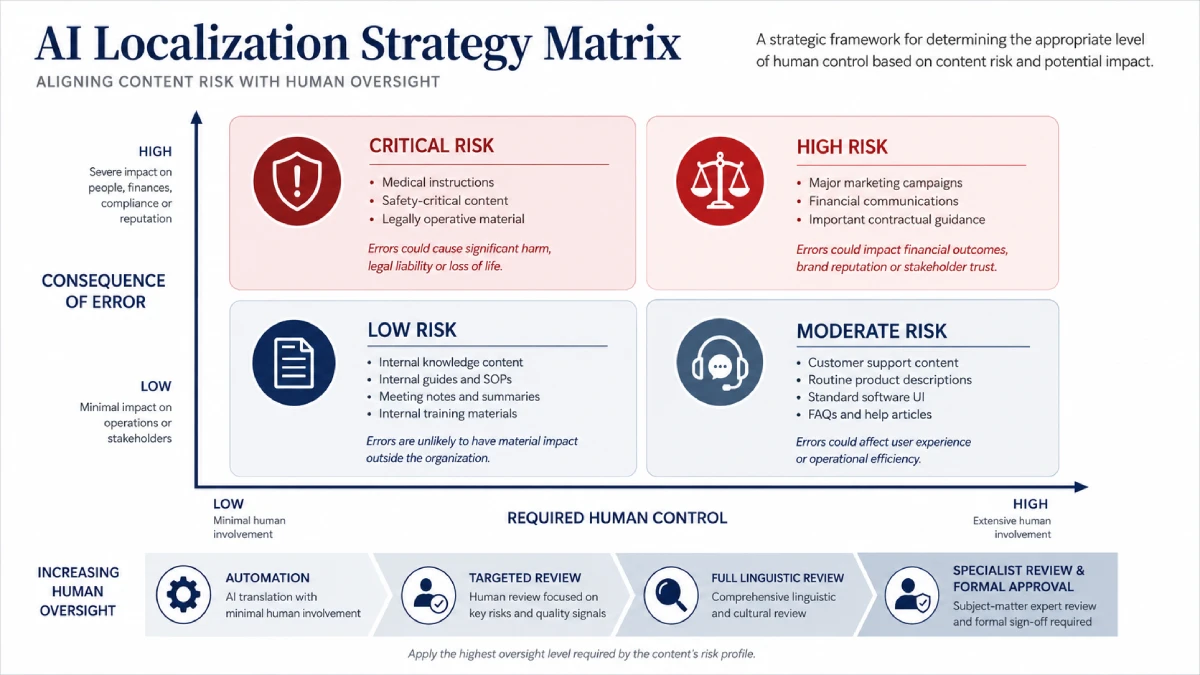
Match the Workflow to Content Risk
The amount of automation should not be determined solely by word count, translation cost or model confidence.
A more useful starting point is the consequence of an escaped error.
| Risk Level | Typical Content | Consequence of Error | Recommended AI Role | Human Review | Final Control |
|---|---|---|---|---|---|
| Low Risk | Internal knowledge discovery, non-critical internal summaries, low-impact long-tail content | Reversible misunderstanding with limited external impact | High automation, including translation, classification and QA | Sampling or exception-based review where appropriate | Content or process owner |
| Moderate Risk | Support content, routine product descriptions, standard software UI, general documentation | Customer confusion, support cost or moderate brand impact | AI/MT drafting with automated QA and routing | Targeted linguistic or in-context review | Product, content or localization owner |
| High Risk | Major campaigns, financial communication, important contractual guidance, high-value commercial claims | Material financial, legal, compliance or brand consequences | AI-assisted drafting, retrieval and QA | Full linguistic review plus market or specialist review where required | Named business, legal or market owner |
| Critical Risk | Medical or safety instructions, legally operative content, regulated product information, high-consequence technical instructions | Injury, regulatory action, significant liability or severe operational harm | Constrained assistive use where permitted | Qualified specialist translation/revision and appropriate SME validation | Formal accountable authority |
This framework is not a substitute for sector-specific regulatory or legal requirements. It is a way to prevent enterprises from applying the same localization workflow to fundamentally different levels of risk.
Five Workflow Models—Not One “Hybrid” Workflow
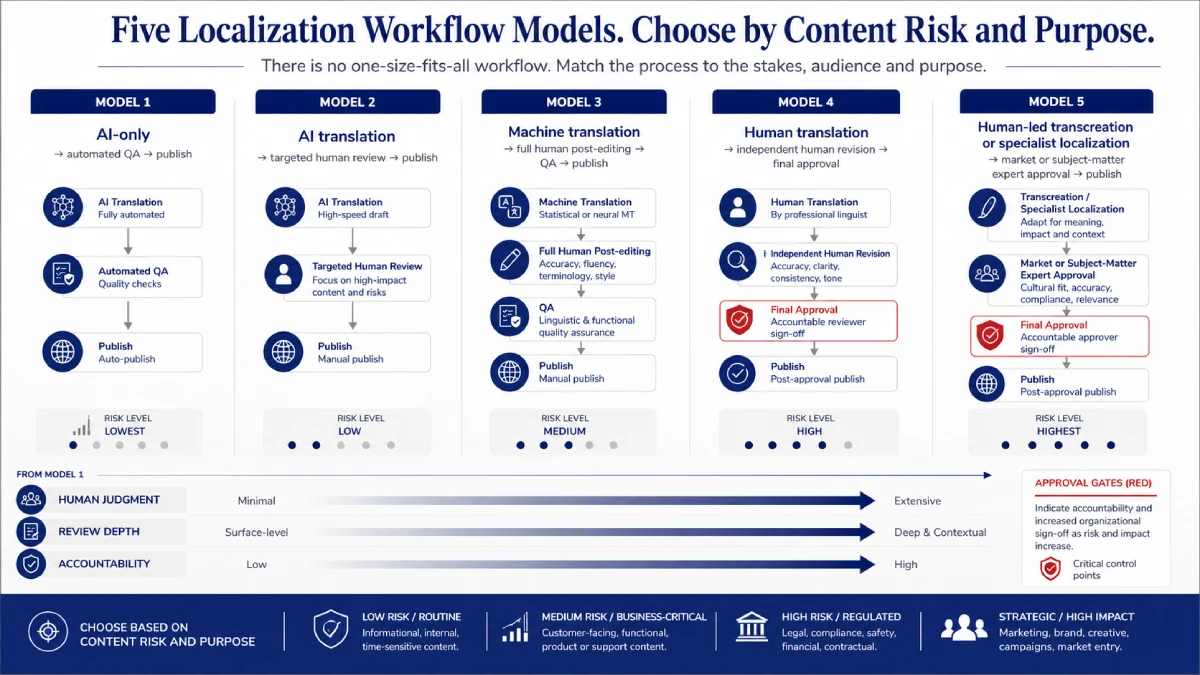
“Human-in-the-loop” and “hybrid localization” are useful terms, but they can hide substantial differences in workflow design.
| Workflow Model | Appropriate Use | Human Role | Main Control |
|---|---|---|---|
| AI-only with automated checks | Low-risk, reversible, high-volume content | Sampling, monitoring or exception handling | Automated QA and performance monitoring |
| AI plus light human review | Moderate-risk support, product or content updates | Review selected, sampled or flagged output | Automated checks plus targeted linguistic/in-context review |
| Machine translation plus full post-editing | Repetitive content requiring controlled publication quality | Post-editor reviews and corrects the full output | Full post-editing, terminology and QA |
| Human translation plus independent revision | Higher-risk content or workflows requiring formal professional controls | Translator and separate reviser | Independent revision and defined specifications |
| Human-led transcreation or specialist localization | Campaigns, sensitive messaging and specialist high-impact content | Human owns interpretation and adaptation | Market, brand, SME or regulatory approval |
None of these models is inherently the “best” workflow.
They represent different combinations of cost, speed, evidence and residual risk.
This distinction is also reflected in current translation standards. ISO 18587:2017 remains the published standard covering full human post-editing of machine translation output. As of August 2026, a second edition is at Draft International Standard stage and broadens the terminology to post-editing of non-human translation output, reflecting the changing technology environment. ISO 17100:2015 remains the published translation-services standard while its second edition is also under development.
Why Language Assets Often Matter More Than the Model Choice
Organizations searching for an AI localization solution naturally compare models and platforms.
But model selection is only one variable.
Translation memory, approved terminology, style guidance, brand instructions, previous approved content, market-specific language rules and reviewer corrections all provide context that influences both automated output and human productivity.
An organization with well-maintained language assets can tell a system how it has previously translated a product feature, which term must be used in regulated documentation and whether different markets use different approved terminology.
An organization without those assets asks the model to infer more of those decisions.
Poor assets create a different problem.
A translation memory may contain obsolete terminology. Multiple glossaries may disagree. Previous translations may include historical errors. Brand guidance may no longer reflect the current product.
Connecting those resources to AI does not automatically improve quality.
It can allow outdated decisions to spread more efficiently.
This is why language-asset governance should be part of an AI localization program rather than treated as a legacy CAT-tool function.
The more automation an enterprise introduces, the more important it becomes to know which linguistic instructions are authoritative.
Data Security and Governance Must Be Designed Into the Workflow
Translation content frequently contains information that organizations would not intentionally publish.
It may include unreleased products, employee communications, contracts, technical documentation, customer information, financial content or confidential strategy.
The security question is therefore not simply:
“Is this AI model secure?”
Enterprises need to understand the actual processing chain.
Where is the content processed? Is it retained? For how long? Can it be used for model training or service improvement? Which subprocessors receive it? Who can access the system? Where are logs stored? What happens when a user uploads content to an unapproved tool? Can the organization reconstruct which system processed a particular document?
The word enterprise does not answer those questions.
Retention, training policies, data residency, access controls and subprocessors vary by service and contractual arrangement and should be verified against current provider terms.
Governance should also define decision rights. Organizations need policies covering approved systems, prohibited data classes, workflow ownership, human escalation, audit records, incident response and model or configuration changes.
The NIST AI Risk Management Framework provides a useful cross-sector approach to AI risk management, while the Generative AI Profile adds guidance specific to generative systems. AI RMF 1.0 is voluntary and, as of August 2026, NIST states that it is being revised.
Regulation also requires careful interpretation rather than broad statements. In the European Union, Article 50 AI Act transparency obligations began applying on 2 August 2026. The rules address specific providers, deployers, AI interactions and forms of AI-generated or manipulated content; they do not create a simple rule that every AI-assisted translation must carry an AI label. The European Commission guidance on AI transparency obligations should be consulted when determining how a specific use case is affected.
Localization teams should involve appropriate legal, privacy and security stakeholders when their use case requires it rather than treating an article about localization strategy as legal advice.
How to Evaluate AI-Assisted Localization
A localization program cannot be governed by the question:
“Does the translation sound good?”
Evaluation needs several dimensions.
Accuracy asks whether the target reflects the source correctly. Completeness asks whether anything has been omitted or added. Terminology measures compliance with approved domain language. Style considers the required voice and conventions. Locale suitability looks at whether the content works for the target market. Functional integrity checks whether tags, numbers, variables, links and interface constraints remain intact.
The evaluation should also look specifically for unsupported additions or hallucinations.
ISO 5060:2024 is relevant here because it provides general guidance for evaluating human translation, post-edited machine translation and unedited machine translation output. Its approach focuses on analytic evaluation using error types and penalty points, while also addressing evaluator competence and sampling.
MQM provides another established framework for organizing translation errors into dimensions and severity levels, including areas such as accuracy, terminology and style.
But linguistic error counts are only one side of enterprise performance.
Organizations should also measure reviewer effort, rework, escalation frequency, time to approved content and—most importantly—the severity of errors that escape the process.
A workflow that produces an excellent average score but occasionally releases a critical safety error may be unacceptable.
Conversely, a low-risk internal workflow may not need the same level of linguistic refinement as a customer-facing campaign.
This is why BLEU, COMET, quality-estimation scores or LLM-based evaluation should be treated as inputs into a decision system rather than substitutes for the business decision itself.
The useful question is not:
“What is the translation score?”
It is:
“Do we have enough evidence to release this content for this purpose?”
From Pilot to Production
An AI localization pilot should test a workflow, not merely demonstrate that a model can generate multilingual text.
| Stage | Enterprise Decision |
|---|---|
| 1. Select a contained use case | Choose a specific content type with a clear audience and business purpose. |
| 2. Classify risk | Define what could happen if the translated content is wrong. |
| 3. Establish a baseline | Measure the current workflow’s quality, approval time, reviewer effort and rework. |
| 4. Prepare language assets | Clean terminology, translation memories, style guidance and reference material. |
| 5. Define evaluation criteria | Decide which errors matter and what constitutes acceptable output. |
| 6. Run controlled comparisons | Compare AI-only, AI plus review, MTPE or existing human workflows where appropriate. |
| 7. Define escalation | Document which signals require linguistic, SME, security or business review. |
| 8. Review data handling | Confirm systems, retention, training policies, access controls and subprocessors. |
| 9. Approve limited production | Move beyond pilot only when evidence supports the workflow. |
| 10. Monitor and expand selectively | Add new languages or content types independently rather than assuming previous results transfer automatically. |
One important discipline is to include difficult examples in the pilot.
A test composed only of clean, repetitive source content may demonstrate ideal conditions rather than operational reliability.
Edge cases, terminology conflicts, ambiguous passages and realistic formatting problems reveal where human escalation rules actually need to exist.
Questions to Ask an AI Localization Provider
Enterprise buyers should ask providers to explain their controls, not simply demonstrate fluent multilingual output.
| Area | Questions Worth Asking |
|---|---|
| Workflow | How is content classified? Can different content types use different workflows? What triggers human review? |
| Models | Which engines or models may process our data? Can they vary by language or domain? How are model and configuration changes managed? |
| Language Assets | How are translation memory, terminology and approved references used? Can mandatory terminology be enforced? Who owns corrections? |
| Quality | How are accuracy, omissions, additions and terminology evaluated? What triggers escalation? Can quality decisions be audited? |
| Human Expertise | Who reviews the output? When are subject-matter experts or local-market reviewers involved? |
| Security | Where is data processed? Is it retained? Is customer content used for training? Which subprocessors are involved? |
| Accountability | Who approves high-risk content? Can the organization reconstruct the workflow used for a particular output? |
| Change Management | What happens when models, prompts, thresholds or workflows change over time? |
A mature provider should be able to discuss these questions without reducing the answer to the name of a model.
Final Strategic Takeaway
The most mature localization program is not necessarily the one with the highest automation rate.
Nor is it the one that retains the greatest amount of manual work.
A mature AI localization strategy knows which decisions can be automated, which require professional judgment, what evidence is sufficient for release and who remains accountable when the content reaches its audience.
That is a more durable framework than any claim about the capability of a particular model.
Models will improve. Platforms will change. Evaluation methods will evolve.
The strategic requirement remains the same:
Assign automation and human judgment according to content purpose, risk and evidence—not according to a universal promise about AI capability.
FAQ
Where should AI be used in localization?
AI can support content classification, terminology extraction, translation drafting, translation-memory assistance, quality estimation, automated QA and workflow routing. The right level of automation depends on content purpose, available language assets and the consequence of error.
Does AI translation still need human review?
Not every AI-generated translation requires the same level of review. Low-risk internal content may use automated processing with monitoring, while public, high-impact or regulated content may require full linguistic or specialist review.
What is human-in-the-loop translation?
Human-in-the-loop translation places human expertise at defined decision points within an automated or AI-assisted workflow. Humans may validate terminology, resolve ambiguity, review selected output, approve market adaptation or sign off high-risk content.
Which content should not rely on AI-only translation?
Content with serious consequences if mistranslated generally requires stronger controls. This can include medical or safety instructions, legally operative content, regulated communication and other high-consequence material where specialist validation or formal approval is appropriate.
How can companies evaluate AI translation quality?
Evaluate accuracy, completeness, terminology, style, locale suitability, unsupported additions and functional integrity, then add workflow measures such as reviewer effort, rework, approval time and severity of escaped errors.
Is enterprise AI translation safe for confidential content?
It can be appropriate only when the specific deployment and contractual controls satisfy the organization’s requirements. Companies should verify processing location, retention, training policies, subprocessors, access controls, data residency and auditability rather than relying on the word “enterprise.”