A multilingual content operating model defines how an organization assigns people, processes, governance, technology, and measurement to manage content across languages and markets. It establishes who owns source content, approves local changes, funds localization, controls quality, and resolves conflicts.
Unlike a global content strategy, which determines priorities, or a multilingual workflow, which defines execution steps, an operating model establishes the responsibilities and decision rights that make continuous multilingual content delivery possible.
This distinction becomes important as organizations expand. A global marketing team may control brand messaging, product teams manage technical information, regional teams request adaptations, and external language providers handle translation. Without agreed decision rights, even well-designed workflows can become fragmented.
The objective is not to centralize every activity. It is to create an accountable system in which global standards, local expertise, and business priorities work together.
What Does a Multilingual Content Operating Model Actually Control?
An operating model connects strategic intentions to organizational accountability.
It determines who makes recurring decisions, which standards apply across markets, what local teams can change independently, and how disagreements are resolved.
Three related concepts need to remain distinct:
| Concept | Core Question | Primary Output |
|---|---|---|
| Global content strategy | What should we prioritize internationally, and why? | Markets, audiences, content priorities, and investment direction |
| Multilingual content operating model | Who owns, funds, approves, and governs ongoing content delivery? | Organizational structure, decision rights, policies, and accountability |
| Multilingual workflow | How does a content request move from creation to publication? | Execution steps, handoffs, reviews, and delivery rules |
For example, a B2B software company might decide to localize its product documentation and marketing website into several languages.
That is a strategic decision.
Its operating model then determines whether the product team or localization team controls terminology, who approves regional messaging changes, and which department funds ongoing updates.
The workflow specifies how each approved request moves through translation, review, testing, and publication.
These layers should reinforce one another without becoming interchangeable. For more detail on strategic planning, see What Is a Global Content Strategy?.
The Five Components of a Sustainable Operating Model
An effective global content operating model combines five interdependent components.
1. People — Who performs and owns the work?
Define responsibilities across global content, localization, marketing, product, regional teams, IT, procurement, and external partners. Every critical responsibility needs an identifiable owner, even when one person fills several roles.
2. Process — How is work authorized and coordinated?
Establish rules for submitting requests, assessing priorities, allocating resources, managing changes, and escalating exceptions. Different content categories can follow different execution workflows while sharing common governance principles.
3. Governance — Who has decision authority?
Document who approves budgets, global standards, market-specific adaptations, terminology changes, quality exceptions, and publication.
4. Technology — Which systems support those decisions?
Define authoritative systems, integration ownership, access permissions, version control, and automation boundaries.
5. Measurement — How is effectiveness evaluated?
Assign responsibility for tracking operational performance, quality incidents, content freshness, market feedback, and relevant business outcomes.
These components should operate as one management system.
A translation management system cannot compensate for missing approval authority. Similarly, assigning a localization manager does not solve fragmented content ownership if product and marketing teams maintain conflicting source information.
Centralized, Decentralized or Federated: Which Model Fits?
Organizations generally distribute multilingual content responsibilities through centralized, decentralized, or federated arrangements.
The appropriate choice depends on business complexity, market expertise, content risk, and the organization’s ability to maintain shared standards.
| Dimension | Centralized | Decentralized | Federated / Hybrid |
|---|---|---|---|
| Decision authority | Primarily global | Primarily regional | Distributed through agreed policies |
| Content standards | Centrally controlled | Potentially market-specific | Shared standards with approved exceptions |
| Local autonomy | Limited or delegated | High | Defined by responsibility and risk |
| Budget ownership | Usually central | Usually regional | Central, regional, or shared |
| Main advantage | Consistency and oversight | Local responsiveness | Balanced control and flexibility |
| Main risk | Approval bottlenecks | Fragmentation and duplication | Coordination complexity |
| Suitable conditions | Strong consistency requirements | Capable independent market teams | Established cross-market collaboration |
Centralized: One Team Controls Most Decisions
In a centralized model, a global content or localization function manages standards, major approvals, language resources, and often supplier relationships.
This structure can suit organizations with limited local resources, relatively uniform content, or high requirements for global consistency.
However, central decision-making may become a bottleneck when regional teams need frequent adaptations or specialized market knowledge.
A centralized model works best when responsibilities and response expectations are clear rather than when every change requires informal headquarters approval.
Decentralized: Markets Manage Their Own Content
Decentralized organizations give regional teams substantial authority over content planning, translation resources, spending, and publication.
This structure can support market responsiveness where regional teams possess strong expertise and own local business outcomes.
The trade-off is potential inconsistency. Different markets may purchase overlapping services, maintain separate terminology, or publish conflicting product information.
Decentralization therefore still requires explicit enterprise boundaries for shared brand assets, product facts, security, and other controlled content.
Federated or Hybrid: Shared Standards, Distributed Accountability
A federated localization operating model combines shared governance with delegated execution and decision-making.
For example, a global team may own terminology policy and core product messaging, while regional marketing teams approve market-specific campaigns within those standards.
A hybrid arrangement may also centralize certain content categories while decentralizing others.
Federation is not automatically the most mature option. It requires sufficiently capable local teams, enforceable shared policies, and clear escalation routes.
Selection principle: Centralize decisions where consistency or risk demands common authority. Delegate decisions where local knowledge creates value and accountability can be maintained.

Map Global, Localization and Local-Market Responsibilities
Before drawing an organizational chart, identify the capabilities the company needs and the decisions each function must support.
Global Content, Localization and Market Teams
The global content team typically maintains shared editorial standards, coordinates enterprise priorities, and owns the governance framework.
The localization team manages language-specific requirements, linguistic assets, translation coordination, supplier performance, and localization quality policies.
The market team validates local relevance, identifies audience needs, reports regional issues, and approves adaptations within delegated authority.
These functions should collaborate without assuming that participation gives everyone the same approval rights.
Product, Marketing, IT, Procurement and External Partners
Other functions contribute specialized authority:
- Product: Owns authoritative product facts, technical meaning, and product-release requirements.
- Marketing: Owns brand messaging, campaign objectives, and marketing-content requirements.
- IT and Engineering: Own system integrations, access controls, technical validation, and infrastructure decisions.
- Procurement and Finance: Control commercial purchasing processes, supplier contracts, and authorized spending.
- External language partners: Perform contracted delivery activities and provide linguistic or specialist expertise.
Microsoft’s globalization roles and responsibilities guidance also distinguishes source-content responsibilities from localization activities.
Smaller organizations may combine several roles. The critical requirement is not creating a large team, but ensuring that no essential decision remains unassigned.
For additional discussion of localization delivery responsibilities, see What Is Localization Management?.
Define Decision Rights with a Multilingual Content RACI Matrix
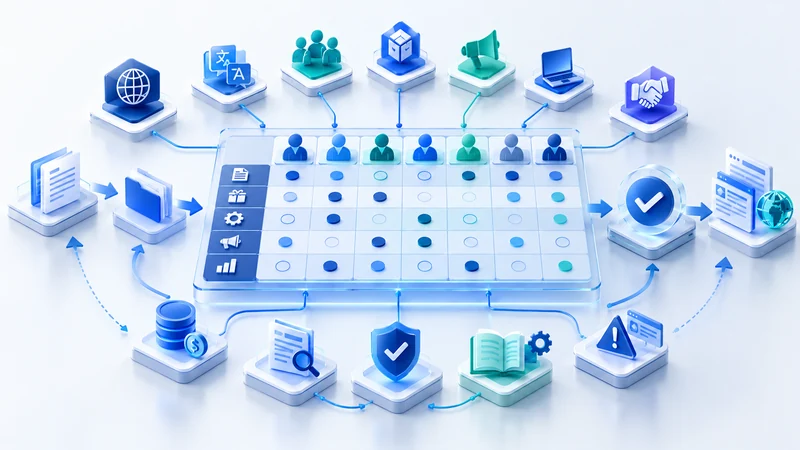
A RACI matrix clarifies which participants perform, approve, contribute to, and receive information about recurring decisions.
The four designations are:
- Responsible (R): Performs or coordinates the activity.
- Accountable (A): Has final ownership of the decision or outcome.
- Consulted (C): Provides required expertise before the decision.
- Informed (I): Receives the decision or resulting information.
Identify the Decisions That Require Named Owners
Start with decisions that regularly create delays or disagreements.
These often concern terminology, market adaptations, budgets, source-content changes, vendor selection, technology modifications, and release readiness.
For example, a German marketing team may request different product terminology from the globally approved glossary.
The operating model must clarify whether the regional team can approve that change, which product specialists must be consulted, and who records the final decision.
Assign Responsibility, Accountability and Consultation
The following matrix illustrates a possible arrangement for a hypothetical multinational B2B software company.
| Decision | Accountable (A) | Responsible (R) | Consulted (C) |
|---|---|---|---|
| Approve global terminology policy | Global Content Owner | Localization Lead | Product and Market Teams |
| Approve local marketing campaigns | Market Content Lead | Marketing Team | Localization and Brand Teams |
| Validate product specifications | Product Owner | Product Specialists | Localization and Technical Reviewers |
| Prioritize cross-market requests | Global Content Owner | Localization Lead | Product, Marketing, and Markets |
| Approve shared program budget | Authorized Finance Owner | Global Program Lead | Localization and Regional Stakeholders |
| Select language vendors | Authorized Procurement Owner | Localization Lead | Legal, Security, and Relevant Business Teams |
| Approve localization integrations | IT / Engineering Owner | Technical Implementation Team | Localization and Content Teams |
| Authorize localized product releases | Product Release Owner | Engineering and Localization Teams | Market and Quality Specialists |
Informed stakeholders should be recorded in the organization’s complete RACI register, even though they are omitted from this condensed table.
Every decision should have one clearly accountable role. Multiple people may execute work, but final accountability should not become ambiguous.
RACI also does not override legal, regulatory, contractual, or security approval requirements. High-risk decisions may need additional mandatory specialist authorization.
The distinction between strategic process ownership and day-to-day stewardship is consistent with APQC’s process-governance guidance.
Establish Rules for Intake, Prioritization and Budget Ownership
Multilingual content programs need an agreed mechanism for deciding what work enters the system and how resources are allocated.
One Intake Policy, Different Approval Paths
Every request should identify its business owner, source content, target languages or locales, intended audience, content category, requested deadline, business justification, and budget owner.
The intake policy should also establish whether the request concerns new content, an update, a correction, or a market-specific exception.
Prioritization should consider:
- Business importance and committed launch dates.
- Potential consequences of incorrect or outdated content.
- Source readiness and required approvals.
- Available resources and funding.
- Dependencies involving product releases or regional campaigns.
An urgent request should not automatically override higher-risk or business-critical work.
The operating model must identify who can change priorities and how affected teams are informed.
Detailed execution routing belongs in the Localization Workflow by Content Type guide.
Decide Who Funds, Approves and Tracks Spending
Three common funding approaches are centrally managed budgets, market-owned budgets, and shared funding.
Central funding supports coordinated investment and visibility. Regional funding connects spending to local business ownership. Shared funding can distribute costs between enterprise infrastructure and market-specific demand.
Whichever approach is selected, document who approves ordinary spending, who authorizes exceptions, and who covers additional costs caused by late source changes.
Finance or procurement approval limits should remain explicit.
A governance committee may prioritize an initiative without possessing authority to authorize spending beyond its delegated budget.
Assign Content, Quality and Terminology Ownership
Multilingual content governance must cover the full content lifecycle, including source creation, updates, local adaptation, publication, and retirement.
Each source asset should have an authoritative owner. Local versions should remain traceable to an approved source or documented market-originated content.
For example, product specifications should normally remain under product ownership even when marketing teams adapt their presentation.
A local content owner may control wording and examples without independently changing technical facts.
Separate Linguistic Review from Final Release Authority
Quality accountability has several layers.
Quality policy ownership establishes required standards and acceptance conditions.
Linguistic evaluation checks translation accuracy, terminology, completeness, and language suitability.
Subject-matter validation confirms specialized facts, product behavior, regulatory requirements, or technical meaning.
Release authority determines whether the content can be published or deployed.
These responsibilities may belong to different teams.
ISO 5060:2024 provides guidance for evaluating translation output, including human translation and machine translation. It does not assign an enterprise’s internal publishing authority.
A translation passing linguistic review should not automatically be considered ready for release if its product instructions are incorrect or its interface fails functional testing.
Govern Source Content, Approved Terms and Local Exceptions
Terminology governance should identify who proposes terms, validates definitions, authorizes translations, and approves local variations.
ISO 704:2022 provides principles and methods for terminology work.
For enterprise governance, an approved terminology record should connect a concept to its definition, applicable products, languages, authorized terms, and relevant restrictions.
A market-specific exception should include a justification, accountable approver, effective scope, and change history.
When source terminology changes, the organization must also determine which translations, documentation, software resources, and other published assets need review.
Quality metrics and evaluation methods can be explored further in Localization Quality Metrics: Beyond Error Counts.
Connect the CMS, TMS, DAM, PIM and Content Repositories
Technology should reinforce the operating model’s ownership rules rather than independently determine them.
Enterprise multilingual content management often involves several connected platforms, each responsible for different information.
| System | Primary Role | Governance Owner |
|---|---|---|
| CMS / CCMS | Manage web or structured content and publishing | Content or Publishing Owner |
| TMS | Coordinate localization and language assets | Localization Owner |
| DAM | Manage media, versions, and usage rights | Brand or Asset Owner |
| PIM | Maintain authoritative product information | Product Data Owner |
| Source Repository | Control software resources and release versions | Engineering Owner |
| Reporting Systems | Collect operational and business signals | Assigned Data and Business Owners |
Define the System of Record for Each Content Asset
Every significant content type needs an authoritative source.
A TMS may store approved translations but should not independently become the source of truth for product specifications.
Likewise, changing a translated website page should not silently overwrite approved product data.
Systems should exchange consistent identifiers, locale metadata, version information, content status, and approval evidence.
Language identifiers should follow appropriate standards and platform requirements. RFC 5646 defines language-tag conventions, while Google’s localized page guidance explains supported hreflang implementations for multilingual websites.
Automate Handoffs Without Automating Unapproved Decisions
Automation can identify source changes, initiate localization requests, reuse approved translations, route reviews, and flag outdated content.
However, automation should operate within approved authority boundaries.
For AI-assisted processing, the organization should define eligible content, required review, data-handling permissions, and incident responsibilities.
A system may flag an inconsistent product term or suggest a correction. That does not give it authority to approve a safety-sensitive change or bypass mandatory specialist review.
Design Vendor Governance and Escalation Paths
External language providers should be integrated into governance without replacing internal business accountability.
Define What Internal Teams Own and Vendors Deliver
An enterprise may work with one strategic language partner, several specialist suppliers, or a combination.
Supplier selection should consider language requirements, domain expertise, service coverage, quality controls, technical compatibility, and commercial arrangements.
Contracts should address ownership and portability of translation memories, terminology assets, approved translations, relevant data, and project records.
Internal teams should retain clear authority over business priorities, source facts, acceptance requirements, and publication decisions.
When internal language capacity is insufficient, organizations may use professional language translation solutions for defined delivery and specialist-review responsibilities.
Resolve Conflicts, Quality Incidents and Exceptions
An escalation path should answer three questions:
- Who investigates and documents the issue?
- Who can approve a correction or exception?
- Who has authority to delay or block publication?
Routine linguistic questions may be resolved by the localization lead. A disputed product specification should reach the product owner. A material security or regulatory concern requires the relevant authorized specialists.
Each significant escalation should produce a documented decision, affected-content assessment, and corrective action.
Response expectations should reflect business risk rather than one universal deadline.
Build a Governance Cadence Around KPIs and Market Feedback
An operating model needs management routines that turn performance evidence into decisions.
Measure Decisions, Quality and Operational Health
A useful localization governance scorecard includes measures linked to specific management responsibilities.
| KPI | What It Reveals | Management Use |
|---|---|---|
| Intake completeness | Whether requests arrive with necessary information | Improve request policies |
| Approval cycle time | Where decisions become delayed | Reassign authority or resolve bottlenecks |
| Rework caused by ownership conflicts | Whether responsibilities are clear | Improve RACI and source control |
| Critical quality incidents | Whether high-risk controls are effective | Correct assurance and release policies |
| Localized content freshness | Whether target versions remain aligned with approved information | Improve update accountability |
| Market feedback resolution | Whether local issues lead to decisions | Strengthen global–local collaboration |
Business indicators such as qualified leads, product adoption, and support outcomes may provide further context.
However, their movement should not automatically be attributed to localization without supporting evidence.
Turn Market Feedback into Governance Changes
Establish a repeatable feedback loop: identify an issue, assign its owner, assess its relevance, approve the appropriate change, and communicate the outcome.
Illustrative governance rhythms include weekly reviews of urgent issues, monthly reviews of performance and supplier concerns, and quarterly reviews of funding, standards, and operating-model effectiveness.
These are suggested cadences, not mandatory industry schedules.
The most important requirement is that meetings produce decisions with named owners and follow-up dates.
Assess Your Multilingual Content Operating Model Maturity
Before introducing additional technology or restructuring teams, assess whether the current organization can reliably make and implement decisions.
The following four-stage model is an illustrative diagnostic framework, not a certified industry maturity standard.
| Stage | Organizational Characteristics | Next Priority |
|---|---|---|
| 1. Reactive | Informal requests, unclear ownership, fragmented decisions | Establish accountable owners and intake rules |
| 2. Defined | Documented roles, basic standards, repeatable approvals | Improve cross-functional coordination |
| 3. Integrated | Shared systems, language assets, governance reviews | Resolve bottlenecks and strengthen measurement |
| 4. Adaptive | Evidence-based governance, controlled automation, active feedback | Refine delegation and continuous improvement |
Maturity may vary across departments.
An organization could have advanced translation automation while still relying on informal budget approvals or inconsistent terminology ownership.
The assessment should therefore identify the weakest management controls that materially affect delivery, risk, or accountability.
Complete a Multilingual Content Operating Model Canvas
An Operating Model Canvas converts organizational discussions into explicit decisions.
The following 12-block template can be used during a cross-functional planning workshop.
| Canvas Block | Decision to Document |
|---|---|
| 1. Program Scope | Which markets, content types, channels, and business units are included? |
| 2. Organizational Model | Which decisions are centralized, decentralized, or federated? |
| 3. Sponsorship | Who sponsors and owns the program? |
| 4. Roles and Decision Rights | Who is responsible, accountable, consulted, and informed? |
| 5. Intake | Who submits requests, and what information is required? |
| 6. Priorities and Funding | Who prioritizes work, owns budgets, and approves exceptions? |
| 7. Content Ownership | Who controls authoritative source and localized content? |
| 8. Terminology | Who manages approved terms and market-specific exceptions? |
| 9. Quality | Who defines standards, evaluates output, and authorizes releases? |
| 10. Technology | Which systems are authoritative, integrated, and controlled? |
| 11. Vendors and Escalation | What do partners deliver, and how are conflicts resolved? |
| 12. Measurement | Which KPIs are monitored, by whom, and how often? |
Every block should identify an accountable role, applicable policy, and documented output where appropriate.
A missing answer represents a governance gap requiring resolution, not permission to assign responsibility arbitrarily.
The completed Canvas should produce four practical artifacts: an operating-model charter, a RACI register, a governance policy register, and a prioritized implementation backlog.
The goal is not to create extensive documentation. It is to establish decisions that employees and partners can consistently apply.
Implement the Operating Model in 90 Days
A 90-day roadmap provides a practical starting structure for organizations improving multilingual governance.
It is an illustrative implementation plan, not a guaranteed transformation timeline.
Days 1–30: Map Ownership and Decision Bottlenecks
Identify the executive sponsor and interview global content, localization, product, marketing, IT, finance, and representative market stakeholders.
Document existing responsibilities, systems, approval conflicts, and recurring exceptions.
Select a small number of content categories for initial governance testing.
Deliverables: Current-state assessment, stakeholder map, initial charter, and decision-gap register.
Days 31–60: Establish Rules and Test a Pilot
Design the target organizational model, complete the RACI, and establish rules for intake, prioritization, budgets, terminology, and quality ownership.
Test the decisions through a limited pilot involving real content requests.
For example, a hypothetical software company might pilot one product-release content stream and one regional marketing campaign.
The purpose is to expose unclear authority and integration gaps before broader adoption.
Deliverables: Draft governance policies, pilot decision records, escalation rules, and revised responsibilities.
Days 61–90: Validate, Adjust and Expand
Review the pilot with accountable stakeholders.
Identify unresolved approval delays, inconsistent ownership, terminology exceptions, and technology limitations.
Finalize operating-model documentation, establish a governance cadence, and select measurable improvement priorities.
Expand only after responsible teams agree that the required controls are usable.
Deliverables: Approved operating-model version, KPI ownership, governance calendar, and expansion backlog.
A successful initial rollout is demonstrated by clearer decisions and functioning controls—not by the number of workflows documented or tools purchased.
FAQ
What is a multilingual content operating model?
A multilingual content operating model is the organizational framework defining how people, processes, governance, technology, and measurement work together to manage content across languages and markets. It establishes responsibility for funding, approvals, quality, source content, local adaptations, and ongoing improvement.
How is an operating model different from a localization workflow?
An operating model defines who owns decisions, resources, policies, and accountability across the organization. A localization workflow defines how an individual content request moves through execution. One operating model may govern several workflows.
Should localization be centralized or decentralized?
The appropriate structure depends on organizational maturity, local expertise, content risk, shared technology, and budget ownership. Centralization supports consistency, decentralization supports local autonomy, and federated models distribute decision authority under shared rules. Different content types may require different arrangements.
Who should own multilingual content quality?
Quality ownership should be divided by responsibility. Localization leadership may establish linguistic quality policy, qualified reviewers evaluate translations, subject-matter experts validate specialized meaning, and authorized content or product owners approve release. The RACI should clearly identify final accountability.
Build an Operating Model That Can Evolve
A sustainable multilingual content operating model does not require every market to operate identically.
It requires consistent rules for assigning authority, maintaining reliable information, handling exceptions, and improving decisions over time.
Organizations should begin by identifying their most consequential ownership gaps, documenting the decisions that matter, and testing the model against real business situations.
When responsibilities are clear, global teams can maintain essential standards while regional teams contribute the knowledge necessary for relevant local experiences.
That is the foundation of multilingual content operations that can continue as the organization, its markets, and its content requirements evolve.