
You have received three translation quotes for the same project. One agency offers a noticeably lower price, another includes several quality assurance steps, and the third proposes a different pricing structure with translation memory discounts.
Which quotation represents the best value?
The answer is not necessarily the cheapest—or the most expensive.
To compare translation quotes fairly, first confirm that every supplier has priced the same source files, language pairs, review requirements, deadline, and deliverables. Then examine the translation workflow, linguistic expertise, technology assumptions, security measures, and additional charges. Calculate a comparable total project cost and evaluate each supplier against your actual requirements.
For business buyers, the objective is to select a provider that can deliver the required quality and service at an appropriate total cost, with manageable risks.
This guide provides a practical comparison framework, a three-vendor quotation table, and a weighted evaluation scorecard.
1. How to Compare Translation Quotes in Five Steps
A reliable translation quote comparison follows five steps:
- Normalize the scope. Confirm that vendors are quoting for identical source content, languages, review requirements, deadlines, and deliverables.
- Compare included services. Identify whether translation, independent revision, proofreading, linguistic QA, formatting, and project management are included.
- Evaluate supplier suitability. Verify language expertise, industry experience, technology, confidentiality, and delivery capabilities.
- Calculate comparable total costs. Add required services and confirmed additional charges rather than comparing headline rates alone.
- Select using documented criteria. Check mandatory requirements first, then apply a consistent vendor scorecard.
The sequence matters. Evaluating price before establishing scope equivalence can make a less comprehensive service appear more competitive than it actually is.
2. Why Do Translation Quotes Differ Between Agencies?
Translation companies may quote different prices because they are proposing different levels of work, using different resources, or making different assumptions about the project.
Eight factors commonly explain the variation.
| Factor | How it affects a quotation |
|---|---|
| Service scope | Translation alone and a fully reviewed, formatted deliverable require different amounts of work. |
| Language pair | Translator availability, language direction, and regional requirements affect resource selection. |
| Subject matter | Specialized technical, legal, medical, or financial content may require domain expertise. |
| Quality level | Independent revision, specialist review, and additional QA increase the work involved. |
| Technology | CAT tools, translation memories, and approved MTPE workflows influence production effort. |
| Timeline | Urgent work may require priority scheduling or additional coordination. |
| File format | Scanned PDFs, design files, and structured software files may require preparation or engineering. |
| Project complexity | Multiple languages, stakeholders, content versions, and delivery stages increase coordination needs. |
A lower quotation may reflect efficient technology use, reusable content, or a leaner operating model. A higher quotation may cover additional review or production responsibilities.
Neither difference establishes quality on its own.
The buyer must determine what each supplier is actually offering.
3. Normalize the Project Scope Before Comparing Prices
The most important step in comparing translation services is ensuring that all quotations refer to the same work.
Establish a Common Project Baseline
Start with the approved source package and establish these requirements:
- Source files: The same documents, content versions, and included text.
- Language pairs: The same source language, target languages, and regional variants.
- Volume: A consistent source-word count or another clearly defined billing basis.
- Review requirements: The same translation, revision, and QA expectations.
- Deadline: The same delivery date, time zone, and milestones.
- Deliverables: The same file formats, formatting requirements, and final production responsibilities.
Locale differences are particularly important.
For example, French for France and French for Canada may require different terminology, spelling conventions, or market-specific review. A quotation that specifies only “French” may need clarification.
Similarly, one vendor may count text embedded in diagrams while another excludes it. Their reported word counts may therefore differ even when they receive identical files.
Identify Scope Gaps Before Evaluating Price
Use a simple classification for every important service:
| Status | Meaning |
|---|---|
| Included | Explicitly covered by the quoted price |
| Additional | Available at an extra charge |
| Excluded | Not provided under the proposed scope |
| Unconfirmed | Insufficient information to determine coverage |
Ask vendors to clarify unconfirmed items and reprice missing mandatory services.
Do not assign a zero cost to something merely because the quotation does not mention it.
The project-specification principles described in ISO 11669:2024 provide a useful reference for defining translation requirements and communication responsibilities.
If your initial request did not define the work clearly, Textsprime’s translation quote requirements checklist explains what information suppliers need.

4. Understand Pricing Models and Translation Memory Discounts
Before comparing rates, determine how each agency calculates its price.
Compare the Pricing Basis
Professional translation quotations may use several billing models:
| Pricing model | What to verify |
|---|---|
| Per word | Source or target words, counting method, and included services |
| Per page | Definition of a billable page and treatment of dense content |
| Per hour | Hourly rate, estimated hours, and approval limits |
| Per project | Included scope, exclusions, and change-order conditions |
| Minimum charge | Whether a minimum fee overrides the calculated rate |
| Subscription or volume agreement | Usage limits, commitments, overages, and included review |
A source-word rate cannot be compared directly with a target-word rate without accounting for differences in word-count conventions.
Likewise, a fixed project price may include activities that another supplier bills separately.
For a broader explanation of these structures, see Translation Services Cost: How Professional Pricing Works.
Compare Translation Memory and Repetition Discounts
Translation memory ™ stores previously translated source and target segments for potential reuse.
A CAT-tool analysis may distinguish:
- Context matches: Previously translated segments matching the source and relevant context.
- 100% matches: Segments identical to entries stored in the translation memory.
- Fuzzy matches: Segments partially matching existing translations.
- Repetitions: Content repeated within or across the source files.
- New content: Text without a qualifying reusable match.
Agencies may apply different billing percentages to these categories.
Importantly, a 90% fuzzy match does not automatically mean a 90% price discount. The match percentage describes textual similarity, while the billable percentage depends on the supplier’s agreed rate scheme.
Phrase’s net-rate documentation illustrates how match categories can be assigned different billing treatments.
When comparing agency quotes, ask for the TM analysis and applicable net-rate schedule.
Also confirm whether matched content receives linguistic review. Previously approved translations can become unsuitable when terminology, product specifications, or context changes.
Verify Translation Memory Ownership
For recurring projects, establish who owns the newly created translation assets, whether your organization can reuse them, and whether they can be exported in a usable format.
Access to a vendor’s translation platform does not automatically establish ownership or portability of its underlying language resources.
5. Compare What Is Included in the Translation Quote
Two translation service quotations can use similar terminology while covering different workflows.
For that reason, buyers should examine each production stage separately.
Translation, Revision, Proofreading, and Linguistic QA
| Service | Primary responsibility |
|---|---|
| Translation | Produce target-language content from the source |
| Independent revision | Compare source and target text for accuracy, completeness, and appropriateness |
| Proofreading | Check target-language presentation, linguistic details, or final publication materials as defined in scope |
| Linguistic QA | Evaluate translation against agreed linguistic and quality criteria |
| Terminology management | Develop, apply, and maintain approved terminology |
| Project management | Coordinate resources, schedules, queries, files, and delivery |
| Formatting and DTP | Prepare the translated layout for its intended use |
| Localization engineering | Prepare and validate structured files, tags, variables, or integrations |
Independent bilingual revision is not the same as proofreading.
Automated QA tools can identify missing numbers, inconsistent terminology, or formatting issues, but these checks do not replace human judgment about meaning and context.
ISO 17100:2015 establishes requirements for professional translation-service processes and resources. ISO 5060:2024 provides guidance on evaluating translation output.
Compare the Proposed Quality Level
Not every project requires an identical review process.
Translation with translator self-check may be sufficient for certain low-risk materials, depending on the intended use.
Translation plus independent revision adds a separate bilingual review stage and is often appropriate when accuracy and completeness require stronger verification.
Subject-matter review may be valuable for specialized terminology or technical interpretation.
In-country review can help assess regional language preferences, cultural suitability, and market expectations.
In-context QA evaluates translated content within its final document, website, software interface, or other delivery environment.
For high-risk material, additional checks may be warranted.
The appropriate workflow should reflect the consequences of errors, not simply the buyer’s preference for the maximum number of review stages.
Before choosing, ask each supplier to define the quality controls included and explain how translation errors will be corrected.
Textsprime’s Quality Management page provides additional information about linguistic review, terminology control, and quality validation.
6. Evaluate Language Expertise, Technology, and Security
A quotation should demonstrate that the proposed supplier can deliver the required work—not merely that it offers the requested language pair.
Check Language and Industry Expertise
Confirm the exact language direction and target locale.
Then review the qualifications and relevant experience of the translators and reviewers assigned to the project.
For specialized content, ask whether they have experience with the specific subject matter, terminology, document type, and intended audience.
A general business translator may not have the expertise required for a complex medical-device manual or specialized engineering specification.
Relevant references, anonymized work samples, or a representative pilot can help assess suitability.
Compare Translation Technology and Language Assets
Ask which computer-assisted translation (CAT) tools and translation management systems (TMS) will be used.
Check whether the workflow supports your existing translation memories, glossaries, style guides, and file formats.
If a supplier proposes machine translation post-editing (MTPE), clarify the intended output quality, human editing responsibilities, and final QA.
ISO 18587:2017 addresses full human post-editing of machine translation output and post-editor competence.
Different workflows can be appropriate for different content types. The important question is whether the proposed approach is permitted and capable of meeting the project’s requirements.
Verify Security and Confidentiality
For confidential business materials, review:
- NDA and confidentiality obligations.
- Access restrictions and subcontractor permissions.
- Storage, transmission, retention, and deletion arrangements.
- AI or machine translation tool usage.
- Whether client content can be used for model training.
- Applicable information-security and privacy requirements.
Supplier security certifications may provide useful evidence, but buyers should also confirm which systems, personnel, and third-party services will actually handle their files.
7. Compare Project Management and Delivery Responsibilities
The quotation should explain what happens between project approval and final delivery.
A capable project manager can coordinate linguistic queries, terminology decisions, source-file changes, reviewer feedback, and delivery schedules.
Check whether each proposal identifies:
- A responsible project owner and escalation contact.
- The procedure for resolving translator questions.
- Delivery milestones and time-zone commitments.
- File version control and change management.
- Included review and correction rounds.
- Final file formats and production responsibilities.
For multilingual projects, clarify whether all languages will be delivered together or in stages.
Also determine who is responsible for incorporating approved client feedback and delivering the corrected final files.
A low initial price can lose its appeal if important coordination or handover responsibilities remain unresolved.
8. Calculate Total Translation Project Cost
The headline quote is only one part of the commercial comparison.
A more useful measure is the complete cost of obtaining the required deliverables.
Calculate Comparable Total Cost
Use the following framework:
Comparable Total Project Cost = Linguistic Services + Required Review and QA + Production and Engineering + Confirmed Additional Charges + Applicable Taxes
Where relevant, verify the following cost components:
- Minimum project charges
- Independent revision and specialist review
- Terminology preparation
- Translation memory setup or alignment
- OCR and source-file preparation
- Desktop publishing and formatting
- Localization engineering
- Rush or priority delivery
- Additional feedback and revision rounds
- Source-content changes
- Certification or special delivery requirements
- Language asset export and handover
Separately record uncertain charges, contractual contingencies, and potential rework.
Potential rework is a project risk, not a confirmed supplier fee. It should not be inserted into the cost comparison as an invented amount.
How to Evaluate a Suspiciously Low Translation Quote
An unusually low quotation deserves clarification, not automatic rejection.
It may reflect a narrower service scope, substantial TM reuse, efficient operations, a different translation workflow, or a commercial discount.
Ask the supplier:
What assumptions allow this price, and which activities are excluded?
If the lower-cost proposal satisfies the same mandatory requirements, provides sufficient quality controls, and carries acceptable delivery risks, it may genuinely offer the best value.
The goal is to understand the price difference rather than assume its cause.
9. Translation Quote Comparison Table: Three Vendors Side by Side
Use the following template to compare three translation agencies against the same approved project requirements.
Replace each dash with written supplier-confirmed information.
| Comparison criterion | Vendor A | Vendor B | Vendor C |
|---|---|---|---|
| Project scope | — | — | — |
| Language pairs and locales | — | — | — |
| Billing basis and volume | — | — | — |
| Unit rate or project price | — | — | — |
| Translation workflow | — | — | — |
| Independent revision | — | — | — |
| Proofreading and QA | — | — | — |
| Industry expertise | — | — | — |
| Terminology management | — | — | — |
| Translation memory discounts | — | — | — |
| Project management | — | — | — |
| Formatting, DTP, and engineering | — | — | — |
| Delivery deadline | — | — | — |
| Technology and asset rights | — | — | — |
| Security and AI policies | — | — | — |
| Revision and correction policy | — | — | — |
| Initial quoted amount | — | — | — |
| Confirmed additional charges | — | — | — |
| Normalized total cost | — | — | — |
| Main risks and open questions | — | — | — |
For included services, use consistent labels such as Included, Additional, Excluded, or Unconfirmed.
For prices, use the same currency, tax treatment, volume basis, and required deliverables.
If material differences remain, request revised quotations before making the final translation pricing comparison.
The completed table should reveal which proposal is commercially lowest and whether that proposal is equivalent to its competitors.
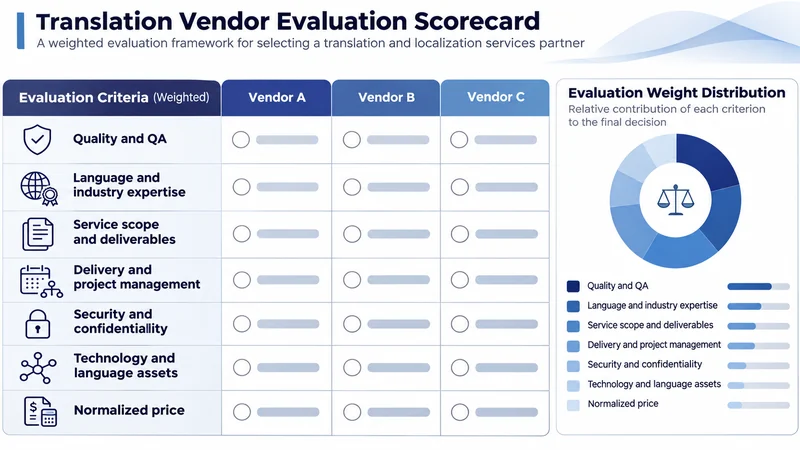
10. Use a Weighted Translation Vendor Scorecard
A comparison table identifies differences. A weighted scorecard helps determine which differences matter most.
However, scoring should begin only after confirming that each supplier meets mandatory project requirements.
A vendor unable to satisfy an essential confidentiality or language requirement should not be selected simply because it offers a low price.
Illustrative Vendor Evaluation Criteria
The following weights are illustrative, not mandatory industry standards.
| Evaluation criterion | Weight | Vendor A | Vendor B | Vendor C |
|---|---|---|---|---|
| Quality and QA | 25% | — | — | — |
| Language and industry expertise | 20% | — | — | — |
| Service scope and deliverables | 15% | — | — | — |
| Delivery and project management | 10% | — | — | — |
| Security and confidentiality | 10% | — | — | — |
| Technology and language assets | 10% | — | — | — |
| Normalized price | 10% | — | — | — |
| Total | 100% | — | — | — |
Rate each eligible vendor from 1 to 5 against predefined criteria:
- 1: Does not adequately meet the criterion.
- 2: Partially meets the criterion, with substantial gaps.
- 3: Meets the stated requirements.
- 4: Exceeds requirements with supporting evidence.
- 5: Strongly exceeds requirements with clear, relevant evidence.
Calculate each criterion using:
Weighted Score = (Vendor Rating ÷ 5) × Criterion Weight
Add the weighted scores to obtain a total out of 100.
For price, establish a consistent scoring rule based on normalized project costs before reviewing the results.
The weighting should also reflect project risk. Technical expertise may deserve greater emphasis for specialized instructions, while market-specific language quality may matter more for advertising content.
The scorecard supports the decision; it does not replace judgment about unresolved risks or contract conditions.
For more extensive supplier-selection processes, see Textsprime’s Translation Services RFP guide.
11. Questions to Ask Before Accepting a Translation Quote
Before approving a supplier, obtain written answers to the questions that materially affect your comparison.
Scope and Pricing
- Does your quotation cover every approved source file and target locale?
- How was the billable volume calculated?
- Which services are included, excluded, or separately charged?
- What conditions could change the final invoiced amount?
Translation Quality
- Is independent bilingual revision included?
- What relevant subject-matter experience do the assigned linguists have?
- Which linguistic QA checks and acceptance criteria apply?
- What corrections and feedback rounds are included?
Technology and Language Assets
- Can you provide the TM match analysis and discount schedule?
- Will AI or machine translation be used, and what human review is included?
- Who owns the approved translations and language assets, and can we export them?
Delivery and Security
- Who is responsible for project coordination and escalation?
- Does the deadline include all agreed reviews and production checks?
- How will confidential files and third-party processing be controlled?
Commercial Responsibilities
- Which minimum fees, rush charges, or change-order conditions apply?
- How will completion, acceptance, and correction of nonconforming work be handled?
Ask the same material questions of every shortlisted supplier. Written clarification is especially valuable when comparing quotations with different service descriptions.
12. Common Translation Quote Comparison Mistakes
Even experienced buyers can make avoidable mistakes when comparing translation agency quotes.
Comparing different scopes. One supplier may include full formatting while another provides translated text only. Normalize the deliverables first.
Focusing only on the per-word rate. A competitive unit rate does not necessarily produce the lowest total project cost.
Ignoring linguistic review. Translation, independent revision, proofreading, and automated QA perform different functions.
Overlooking additional charges. Confirm minimum fees, rush work, DTP, engineering, and change-order terms.
Ignoring regional language requirements. A general language designation may not adequately describe the intended market.
Failing to clarify asset ownership. Translation memories and glossaries can become valuable resources for future projects.
Accepting an unclear revision policy. Establish which corrections are included and which client-requested changes may incur charges.
Correcting these mistakes before project approval is generally easier than resolving commercial disagreements after delivery.
13. Final Translation Quote Decision Checklist
Before accepting a translation service quotation, confirm:
- All vendors were evaluated against equivalent project requirements.
- Mandatory language, quality, and security requirements are satisfied.
- Included services and exclusions are documented.
- TM discounts and billing assumptions are understood.
- The complete project cost is commercially comparable.
- Delivery responsibilities and milestones are confirmed.
- Revision, correction, and change-order terms are clear.
- Translation memory and terminology rights are addressed.
- The selected vendor’s evaluation is supported by evidence.
The best translation quote is the one that meets your project requirements at an acceptable total cost and risk—not necessarily the one with the lowest initial price.
FAQ
Why do translation companies charge different rates?
Translation companies may use different pricing models, linguistic resources, review processes, technologies, and project-management arrangements. Language pairs, subject complexity, translation-memory reuse, formatting requirements, and deadlines also affect quotations. Compare the included scope and total project responsibilities before evaluating the rates.
Is the cheapest translation quote always worse?
No. A lower price may reflect efficient workflows, translation-memory reuse, volume arrangements, or a competitive commercial model. The important question is whether the quotation meets your requirements for quality, expertise, confidentiality, deliverables, and delivery reliability.
What should be included in a translation quote?
A useful translation quotation should identify the source materials, language pairs and locales, volume, billing basis, proposed translation workflow, review requirements, delivery formats, deadline, total price, additional charges, exclusions, and relevant commercial conditions.
How do I compare translation quality between vendors?
Compare the proposed linguistic qualifications, subject-matter expertise, revision responsibilities, terminology controls, and QA procedures. For significant projects, a representative pilot evaluated against the same criteria can provide more meaningful evidence than general quality claims.
What are fuzzy match discounts in translation?
Fuzzy match discounts are pricing adjustments applied to source segments that partially match content stored in a translation memory. The discount depends on the agreed rate scheme and the work needed to adapt or verify the previous translation. Match percentages are not equivalent to discount percentages.
What hidden costs should I check in a translation quote?
Check for independent revision, specialist review, terminology preparation, OCR, file conversion, desktop publishing, localization engineering, minimum fees, rush charges, additional revisions, source-file changes, and language-asset handover. Ask suppliers to identify which activities are included and which require separate approval.
Final Thoughts: Compare Value, Not Just Translation Rates
Choosing translation services becomes easier when every quotation is assessed against the same project requirements.
A strong comparison establishes what each vendor will deliver, how the work will be reviewed, which resources and technologies will be used, what the complete project will cost, and who is responsible if problems arise.
Price remains an important factor. A business should not pay more for services it does not need. Equally, a lower initial quote may provide poor value when essential review, production, or delivery responsibilities are excluded.
The most defensible purchasing decision is based on equivalent scope, demonstrated capability, transparent pricing, and acceptable project risk.
Whether you are evaluating a single document translation or a multilingual localization project, a consistent comparison table and evidence-based scorecard can help turn competing quotations into a clear, justified supplier decision.