Requesting a translation quote may seem straightforward: upload a document, specify the languages, and ask for a price.
But for business translation projects, those details rarely tell the whole story.
A 30-page technical manual might require translation only, or it might also need independent revision, terminology checks, diagram updates, desktop publishing, and a final PDF ready for distribution. The source document may be identical, but the work required is not.
This is why a request such as “Please quote this file” often leads to additional questions before a supplier can provide a reliable quotation.
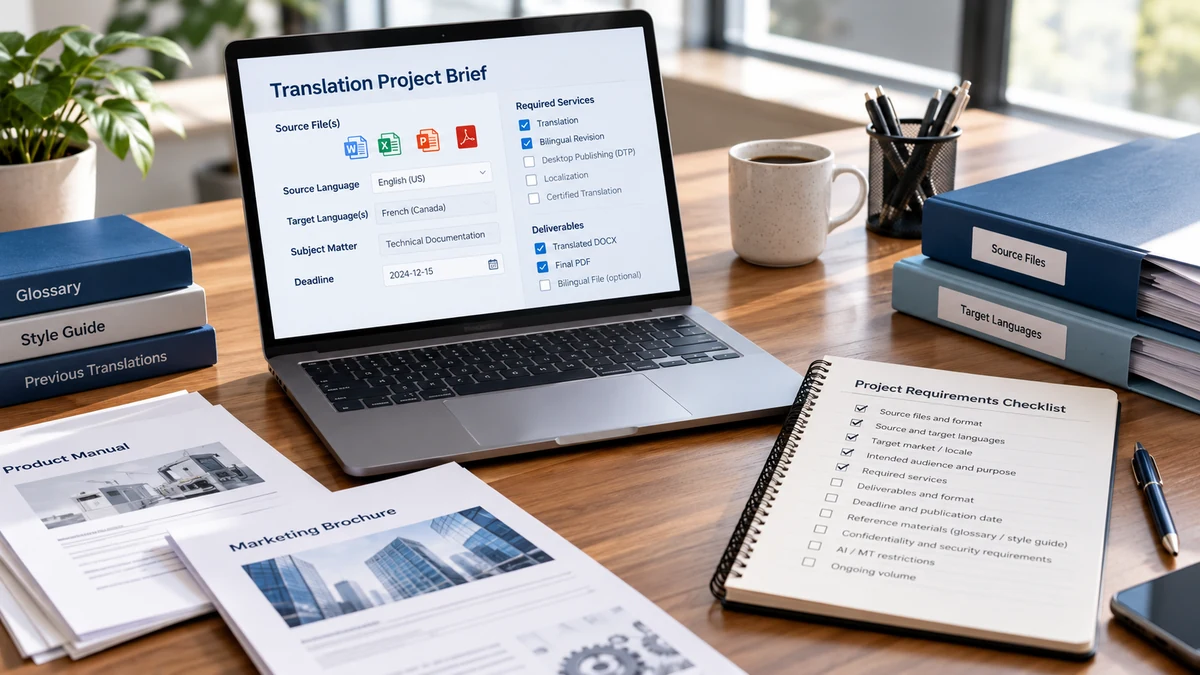
A clear translation project brief helps the supplier understand what needs to be translated, how the content will be used, which services are required, and what the finished work should look like.
This guide explains the essential translation quote requirements, provides a practical project brief checklist, and includes a translation RFQ template you can adapt for your next project.
What Information Do You Need for an Accurate Translation Quote?
To request an accurate translation quote, provide your source files, source and target languages, target locales, approximate word count, subject matter, intended audience, required services, deliverables, and deadline.
Where relevant, also include terminology resources, previous translations, review responsibilities, formatting instructions, confidentiality requirements, and AI or machine translation restrictions.
You do not need every detail finalized before contacting a supplier. Representative files and estimated volumes can support an initial assessment. However, the more clearly the project is defined, the easier it becomes to establish a quotation that reflects the actual work.
1. Why ‘Please Quote This File’ Is Not Enough
A source file shows a translation supplier what content exists. It does not necessarily explain what your organization expects from the finished project.
For example, a product brochure could be intended for internal distributor training, a public website, or a printed marketing campaign. Each application may involve different terminology, localization, review, and formatting requirements.
An incomplete request can leave important questions unanswered:
- Is the content final or still being edited?
- Which regional language variants are required?
- Does the project include independent revision?
- Must the original document layout be preserved?
- Who will review the translation?
- Are AI or machine translation tools permitted?
These questions affect the proposed workflow, deliverables, and project schedule.
ISO 11669:2024, which provides guidance on translation projects, emphasizes the importance of defining project specifications and maintaining communication between the requester and the translation service provider.
For practical purchasing purposes, consider three levels of quote readiness:
| Readiness level | Available information | Expected outcome |
|---|---|---|
| Initial inquiry | Content type, languages, approximate volume, intended use, tentative deadline | Preliminary assessment or indicative estimate |
| Scope-ready RFQ | Reviewable files, service requirements, deliverables, timeline, project constraints | Detailed quotation with stated assumptions |
| Confirmed project scope | Approved files, agreed requirements, resolved questions, confirmed responsibilities | Agreed commercial and delivery terms |
The goal is not to prepare an unnecessarily complicated document. It is to remove the uncertainties that matter.

2. Start With a Complete, Reviewable Source Package
Identify the Source Files and Content Included
Begin by identifying exactly what the supplier needs to translate.
For a single document, this may be simple. For a multilingual website, product catalog, or software release, the source package may contain several files, supporting assets, and content versions.
Provide the following information:
- Source files and their formats.
- The approved version or current revision status.
- Approximate source word count.
- Content that should be excluded from translation.
- Text embedded in diagrams, images, tables, or screenshots.
- Any additional files expected later.
If the source content is still being edited, explain that before requesting a firm quotation. Changes after the quotation may affect the scope and delivery schedule.
Word count is useful, but it should not be treated as a complete description of the project. A supplier may need to inspect the files to identify text that cannot be extracted automatically or requires additional preparation.
Provide Editable Files Whenever Available
File format can affect how a translation project is prepared and delivered.
| Source format | What to provide or clarify |
|---|---|
| Word, Excel, PowerPoint | Original editable files, including embedded objects and relevant notes |
| InDesign and other design files | Editable project files, linked assets, fonts or approved substitutes, and reference PDFs |
| Original editable source if available; indicate whether the PDF is scanned or contains selectable text | |
| HTML, XML, JSON, XLIFF | Structured source files, technical instructions, and any content that must remain unchanged |
| Images or scanned documents | High-quality originals and instructions for text extraction or layout recreation |
For example, translating a PDF and delivering a Word document is different from producing a translated PDF that closely matches the original design.
If the document must remain visually consistent, identify that requirement explicitly.
For projects with substantial layout work, review the scope of multilingual desktop publishing services before finalizing the RFQ.
3. Specify the Languages, Markets, and Intended Readers
Define the Source Language and Target Locale
“Translate into Portuguese” may not provide enough information for a market-specific project.
Portuguese for Brazil and Portuguese for Portugal can differ in terminology, spelling, and usage. Similar distinctions may matter for French, Spanish, Chinese, English, and other languages.
A clearer request identifies both the language and the intended market.
Examples include:
- English (United States) to Portuguese (Brazil):
en-US → pt-BR - English (United States) to French (Canada):
en-US → fr-CA - English (United States) to Spanish (Mexico):
en-US → es-MX
Where technical language tags are required, they should follow the relevant conventions, such as those described in the W3C guidance on choosing language tags.
For Chinese or other languages with significant script distinctions, confirm the script as well as the market when relevant.
Explain the Audience, Purpose, and Subject Matter
The supplier also needs to understand who will read the translation and what the content is intended to achieve.
Consider three examples:
Technical documentation: Maintenance engineers need accurate equipment terminology and unambiguous operating instructions.
Marketing content: Prospective customers need clear product benefits, natural language, and messaging appropriate to their market.
Internal business communication: Employees need understandable instructions consistent with company terminology and procedures.
In your translation project brief, identify the industry, document purpose, reader profile, intended publication channel, and any particularly sensitive terminology.
These details help the supplier assess the appropriate linguistic expertise and review requirements.
4. Define the Required Services and Final Deliverables
One of the most important translation quote requirements is specifying exactly what services should be included.
Different suppliers may propose different workflows unless the buyer defines the expected scope.
Specify the Translation Workflow
| Service | When to include it in your request |
|---|---|
| Translation | When source-language content must be produced in the target language |
| Independent bilingual revision | When a separate linguist should compare the translation against the source |
| Localization | When content requires adaptation for a particular market, audience, or product environment |
| Desktop publishing (DTP) | When translated documents need layout adjustment, typesetting, or design restoration |
| Certified translation | When the receiving institution requires a specified certification or formal translation procedure |
Translation, revision, proofreading, and automated quality checks are not interchangeable activities.
ISO 17100:2015 provides requirements for professional translation-service processes. It should not be assumed that every supplier quotation automatically includes the same review workflow.
If machine translation post-editing is being considered, identify it separately and agree on the permitted technology and human-review requirements.
Define Exactly What the Supplier Must Deliver
A project is not fully defined until the expected output is clear.
For example, a translation request might require:
- An editable Word document.
- A final PDF with preserved formatting.
- A bilingual source-and-target file.
- Translated text within the original presentation.
- Localized software resource files with protected variables.
- Reviewed diagrams and tables.
- A final document that has undergone layout inspection.
Also specify whether the supplier or your internal team will perform final layout checks, technical implementation, or publication.
A useful RFQ defines both the work to be performed and the files that constitute successful delivery.
5. Share Reference Materials That Define the Expected Result
Translation quality and consistency depend partly on the context available to the linguists.
If your organization already has approved terminology or multilingual materials, identify them in the request.
Provide Terminology, Style, and Content References
Useful reference materials include:
- Approved product and technical terminology.
- Brand and writing style guides.
- Product specifications and supporting documentation.
- Terms that must remain in the source language.
- Previously approved marketing or technical content.
- Examples of the expected tone and writing style.
A glossary is particularly useful when the same technical term appears across manuals, product descriptions, and support content.
A style guide can clarify whether the translation should use a formal or conversational tone, how product names should appear, and which conventions matter to the organization.
Identify Translation Memories and Previous Translations
If you have an existing translation memory (TM), tell the supplier.
A translation memory stores previously translated source and target segments for potential reuse. It can support consistency across recurring projects when the stored content is relevant and approved.
Also clarify whether existing translations are approved, whether the supplier may reuse them, and what access or ownership arrangements apply.
You do not need to create a translation memory before requesting a quote. Simply identify any resources already available.
The American Translators Association’s buyer guidance also recommends providing reference documents, glossaries, style guides, and previous translations.
6. Clarify Deadlines, Publication Dates, and Review Responsibilities
Distinguish the Delivery Deadline From the Publication Date
A translation deadline and a business launch date are not necessarily the same.
A translated website may need several days of internal review, implementation, and testing before publication. A printed catalog may require design approval and printing arrangements after translation delivery.
When requesting a quote, specify:
- When the final source materials will be available.
- When the first translated version is needed, if applicable.
- The required final delivery date and time zone.
- The planned publication, launch, or submission date.
- Any internal approval milestones.
This allows the supplier to evaluate the requested schedule and identify dependencies.
For a more detailed discussion, see Translation Turnaround Time: How Long Does It Take?.
Name the Internal Reviewer and Explain Future Volume
Identify who will answer terminology questions, review the translated content, and approve the final deliverables.
If an internal product manager or subject-matter expert must review the translation, specify the expected feedback window.
Also mention whether the assignment is a one-time project or part of an ongoing content program.
Recurring product updates, monthly content releases, and regular documentation changes may require different arrangements from a standalone translation.
7. State Confidentiality, Security, and AI/MT Restrictions
Some translation projects involve confidential commercial information, personal data, intellectual property, or unpublished product documentation.
These requirements should be communicated before sensitive content is transferred or processed.
Specify Confidentiality and Processing Requirements
Depending on the project, buyers may need to address:
- Nondisclosure agreements (NDAs).
- Approved file-transfer and storage methods.
- Authorized personnel and subcontractor access.
- Data retention and deletion requirements.
- Restrictions on processing locations.
- Applicable contractual or regulatory obligations.
If an NDA is required before source files can be shared, state this in the initial inquiry. A supplier may still be able to discuss the project using a non-confidential summary or representative material.
Explain Whether AI or Machine Translation Is Permitted
Do not assume that all translation providers use the same tools or data-processing arrangements.
If your organization has an AI policy, communicate it explicitly.
For example:
- Human translation is required; machine translation and generative AI are not authorized.
- Machine translation may be considered only with prior written approval.
- AI-assisted workflows are permitted subject to specified confidentiality and human-review conditions.
- Certain third-party platforms or processing environments are prohibited.
Ask the supplier to confirm how the agreed restrictions apply to the proposed workflow, including any external tools and subcontractors.
For additional context, see Generative AI Translation: Benefits, Risks & Best Uses.
The objective is not to require one technology approach for every project. It is to ensure that the quotation reflects your organization’s approved working conditions.
8. Translation Quote Example: A Weak Brief vs. a Strong Brief
Consider a hypothetical manufacturer preparing an equipment operating manual for a Canadian distributor.
The company could send a supplier the following request:
Please translate the attached manual into French. We need it urgently. Please send your best quote.
This provides very little information about the expected result.
A stronger request would specify the relevant project requirements.
| Requirement | Weak brief | Strong brief |
|---|---|---|
| Content | Manual | Approved equipment operating manual |
| Language | French | English (US) to French (Canada) |
| Source files | PDF attached | Editable Word source, reference PDF, and diagrams available |
| Volume | Not specified | Source word count to be verified from supplied files |
| Purpose | Not specified | Distributor training and equipment operation |
| Services | Translation | Translation, independent bilingual revision, and final-format inspection |
| Deliverables | Translated file | Editable French document and reviewed PDF |
| Deadline | Urgent | Requested delivery date, time zone, and review milestones specified |
| Reference materials | None mentioned | Product glossary and previous manual available |
| Internal review | Not specified | Product specialist responsible for terminology approval |
| AI policy | Not specified | No machine translation or generative AI processing without written approval |
The stronger brief does not guarantee that every question has been resolved.
However, it gives the supplier a much clearer basis for assessing language requirements, production activities, scheduling, and final deliverables.
It also makes it easier for the buyer to identify differences when comparing quotations from multiple providers.

9. Translation Quote Request Template: Copy and Customize
You can use the following translation RFQ template in an email, procurement document, or supplier inquiry form.
Complete the fields relevant to your project. If something is unknown, mark it for supplier assessment rather than providing an unsupported estimate.
Translation RFQ Email Template
Subject: Translation Quote Request — [Project Name] — [Source Language to Target Language(s)]
Hello,
We would like to request a quotation for the following translation project.
1. Project Overview
- Project name: [Name]
- Content type: [Manual, brochure, website, software, etc.]
- Subject matter: [Industry or technical field]
- Intended purpose: [How the translated content will be used]
- Target audience: [Readers and markets]
2. Languages and Source Materials
- Source language: [Language and variant]
- Target language(s) and locale(s): [List]
- Source files: [Formats and availability]
- Approximate source word count: [Count or to be assessed]
- Source content status: [Final / Draft / Updates expected]
3. Required Services and Deliverables
- Requested services: [Translation, revision, localization, DTP, certification, etc.]
- Required deliverable formats: [DOCX, PDF, XLIFF, etc.]
- Formatting requirements: [Layout, images, tables, special instructions]
- Quality or acceptance requirements: [If applicable]
4. Schedule and Review
- Source files available from: [Date]
- Requested delivery deadline: [Date, time, time zone]
- Publication or launch date: [Date, if applicable]
- Internal reviewer: [Role or contact]
- Review and approval requirements: [Details]
5. Reference Materials
- Glossary or terminology list: [Available / Not available]
- Style guide: [Available / Not available]
- Translation memory: [Available / Not available]
- Previous translations: [Available / Not available]
6. Security and Technology Requirements
- Confidentiality requirements: [Details]
- AI/MT restrictions: [Permitted, prohibited, or approval required]
- File-transfer or data-handling requirements: [Details]
7. Additional Information
- Expected future translation volume: [If known]
- Special requirements: [Details]
- Items requiring supplier assessment: [List]
Please review the project details and confirm the proposed services, deliverables, delivery schedule, commercial terms, exclusions, and any assumptions requiring clarification.
Thank you.
[Name]
[Company]
[Contact Information]
Additional Requirements for Complex Projects
Enterprise or technically complex projects may also require a separate specification covering file structure, localization environments, terminology ownership, review cycles, regulatory requirements, and final acceptance criteria.
For an initial quotation, however, a concise project brief with representative files is often a practical starting point.
10. Translation Project Brief Checklist: What to Verify Before Sending
Use this checklist before submitting your translation RFQ.
Essential Information
- Source files or representative content are identified.
- Source and target languages are specified.
- Target markets or locales are identified where relevant.
- Approximate word count or volume is provided.
- Content subject, audience, and intended use are explained.
- Required services and deliverables are described.
- Requested delivery date and time zone are included.
- A project contact is identified.
Conditional Project Requirements
- Editable originals or design assets are available.
- Formatting, DTP, or certification requirements are defined.
- Glossaries and style guides are provided where available.
- Previous translations and translation memories are identified.
- Internal review and approval responsibilities are assigned.
- Confidentiality and security requirements are communicated.
- AI and machine translation permissions are stated.
- Expected recurring volume or future updates are described.
Final Consistency Checks
Before sending, confirm that the file versions match the project description, the deadline allows for necessary internal review, and any unknown requirements are clearly identified.
A useful project brief does not hide uncertainty. It makes uncertainty visible so the supplier can assess it.
11. How to Check Whether the Supplier’s Quote Matches Your Scope
Receiving a quotation is not the end of the scoping process.
Before approving the project, confirm that the supplier has understood the requirements and that the proposed work matches your expectations.
Ask five questions:
1. Does the quote cover the correct content and languages?
Check the source files, word-count basis, language combinations, target locales, and any excluded material.
2. Are the required services included?
Confirm translation, independent revision, specialized review, DTP, certification, or other activities as applicable.
3. Are the deliverables clearly defined?
Check final file formats, formatting obligations, technical requirements, and any agreed acceptance conditions.
4. Are the timeline and responsibilities realistic?
Verify delivery milestones, internal review windows, dependencies, and the person responsible for each approval.
5. What assumptions or changes could affect the quotation?
Identify provisional file counts, unfinished source content, additional review rounds, and other potential changes.
Two quotations should be compared against the same requested scope. A lower price is not necessarily a better purchasing outcome when key services or deliverables are excluded.
For a deeper explanation of commercial pricing considerations, see Translation Services Cost: How Professional Pricing Works.
12. When a Professional Language Services Team Should Help Define the Scope
Not every buyer will have a finalized project specification when they first contact a translation provider.
Professional scoping assistance can be particularly valuable when a project involves multiple target markets, complex technical files, safety-related content, strict security conditions, specialized terminology, or several internal stakeholders.
In these situations, discussing the source materials, intended use, and deliverables before finalizing the quotation can help both parties establish a realistic workflow.
Final Takeaway
An accurate translation quote begins with a clear understanding of the work—not simply the number of words in a document.
By preparing reviewable source files, defining the target audience and locale, specifying the required workflow and deliverables, and communicating deadlines and project restrictions, buyers give suppliers a stronger basis for assessing the assignment.
You do not need a perfect translation project brief before making an inquiry. Start with the information you have, identify what remains uncertain, and confirm the scope before production begins.
The result is a more transparent quotation process, fewer avoidable misunderstandings, and a clearer foundation for successful multilingual content delivery.
FAQ
Can I Request a Translation Quote Without Final Source Files?
Yes. An initial estimate may be possible using representative files, draft content, or approximate volume. The supplier may need the approved source materials before confirming the final scope and quotation.
What If I Do Not Know the Exact Word Count?
Provide the available files and ask the supplier to assess the volume. Indicate whether text inside diagrams, images, tables, or other supporting assets is included.
Do I Need to Specify a Target Country or Locale?
Specify the target market whenever regional vocabulary, spelling, cultural conventions, or compliance requirements may affect the translation. This helps avoid ambiguity between language variants.
Should I Provide a Glossary or Translation Memory?
Provide approved glossaries, translation memories, and previous translations when available. These materials can support terminology consistency and content reuse, but they are not prerequisites for an initial quote.
Can I Request Human Translation Without AI or Machine Translation?
Yes. State your technology restrictions clearly and ask the supplier to confirm its proposed workflow in writing. Include requirements concerning third-party tools and confidential content where relevant.
What Happens If the Project Scope Changes After I Receive a Quote?
Changes to source files, languages, services, deliverables, or deadlines may require an updated quotation or delivery schedule. Communicate material changes before approving additional work.