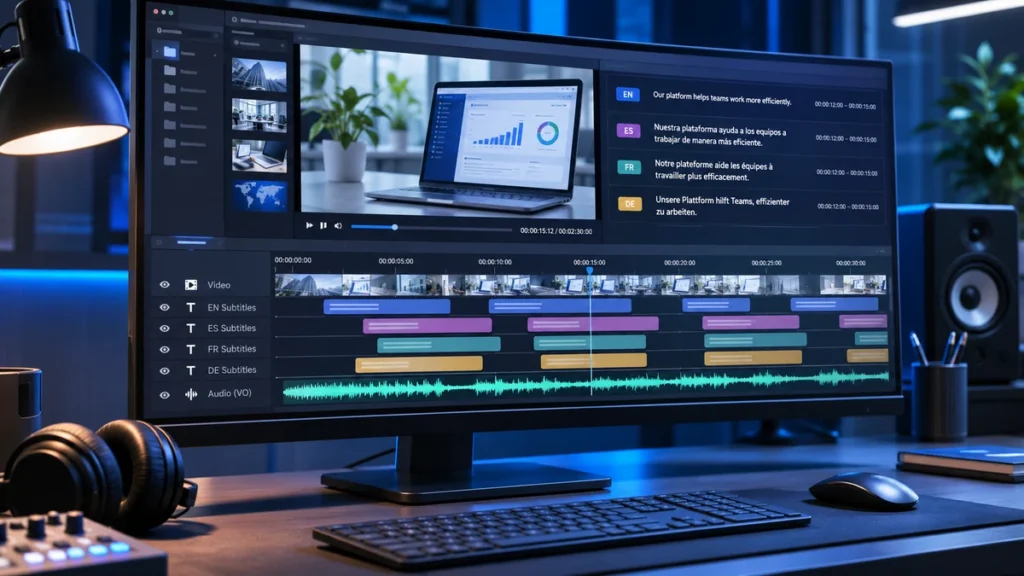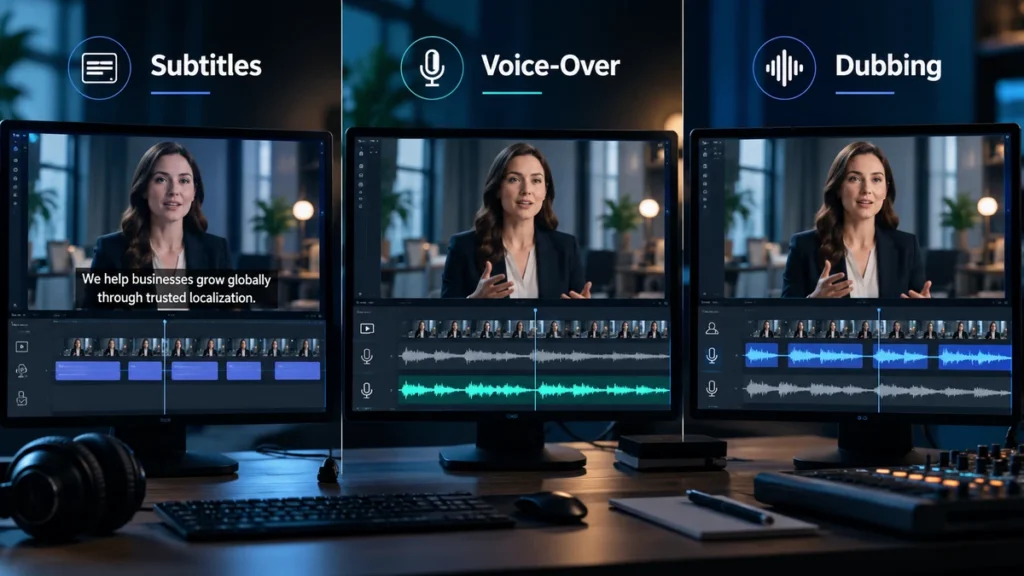
Video translation cost can vary significantly, even when two projects have the same runtime. A five-minute product demonstration requiring Spanish subtitles is a very different investment from a five-minute promotional video requiring multilingual dubbing, professional voice actors, localized motion graphics, and final video production.
For marketing teams, localization managers, and procurement professionals, the challenge is not simply finding a price per minute. It is understanding which production activities are included, which costs repeat across languages, and which requirements could increase the final invoice.
This guide explains the main factors behind video translation pricing, compares different production methods, examines published supplier rates, and provides practical examples to help businesses develop accurate budgets.
Video Translation Cost: Quick Answer
Video translation cost depends on video length, spoken word volume, target languages, and whether the project requires subtitles, captions, voice-over, dubbing, or full localization. Transcription, voice talent, lip synchronization, graphics, audio engineering, quality assurance, and final delivery can add costs. An accurate estimate requires a clearly defined production scope.
The delivery method is often one of the most important budget decisions.
| Localization Method | What the Price Typically Covers | Main Cost Drivers |
|---|---|---|
| Translated subtitles | Translation, subtitle segmentation, timing, and review | Languages, dialogue volume, synchronization |
| Captions and SDH | Transcription, speaker identification, sound cues, and timing | Accessibility requirements, audio complexity |
| Voice-over | Script adaptation, narration, recording, and audio editing | Voice talent, language, usage rights |
| Dubbing | Dialogue adaptation, casting, recording, and synchronization | Speakers, performances, studio requirements |
| Lip-sync dubbing | Dubbing with closer synchronization requirements | Script adaptation, recording, visual matching |
| Full video localization | Selected language services plus visual and technical adaptation | Graphics, audio engineering, QA, delivery formats |
Subtitles generally require fewer production components than professional dubbing because they retain the original soundtrack. However, even a subtitle-only project can become more complex when transcription, specialist terminology, accessibility requirements, or multiple delivery formats are involved.
The most reliable way to compare video translation prices is to evaluate the complete deliverable—not just the advertised rate.
Why Video Runtime Alone Cannot Predict the Final Cost
Runtime is a useful measurement, but it does not describe the amount of linguistic or production work involved.
Consider two ten-minute videos.
The first is a product demonstration featuring one narrator, clear audio, an approved script, and minimal on-screen text.
The second is a technical interview featuring four speakers, overlapping dialogue, background noise, industry terminology, and animated graphics.
Both videos have identical runtimes, yet the second may require more transcription effort, speaker identification, terminology research, editing, and quality assurance.
Speech Density and Source Complexity
A video containing continuous dialogue typically generates more translation work than one containing long demonstrations, music, or visual sequences.
Other factors include:
- Speech speed, overlapping dialogue, and audio clarity.
- Technical terminology and pronunciation requirements.
- The number of speakers and changes between them.
- Cultural references, humor, and expressions requiring adaptation.
- Existing scripts that may not match the final recording.
For buyers, the important distinction is between video duration and billable production effort.
A supplier may use runtime to calculate an initial rate while adding separate charges for complex audio, language adaptation, or specialist production.
For a broader explanation of the production stages, see how video translation works.
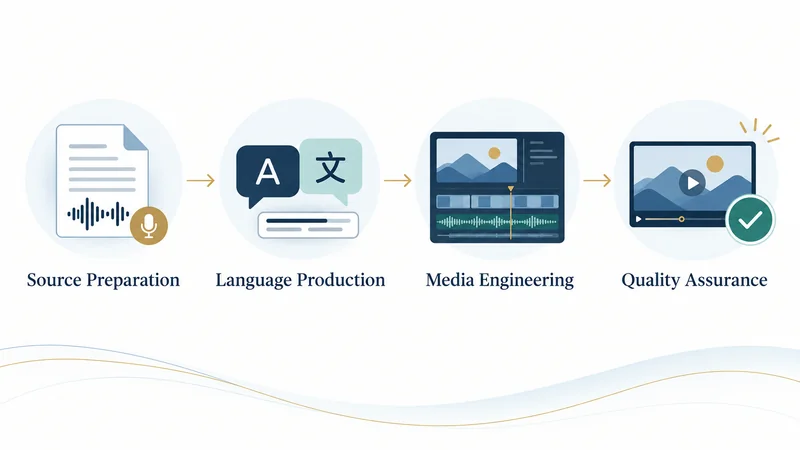
Source Preparation and Language Count: Costs Before Production
Several important cost decisions occur before translated subtitles or recorded voices are produced.
Transcription and Source Script Availability
If a video does not have an accurate written script, transcription may be necessary.
Professional transcription can include identifying speakers, resolving unclear words, confirming technical terminology, and aligning dialogue with the recording.
Automatic speech recognition may reduce initial preparation effort, but machine-generated transcripts can still require human verification.
Providing an existing script can help, provided it matches the final recording. Outdated scripts may require reconciliation before translation begins.
An approved transcript or subtitle template can also create reusable source material for multiple target languages.
When comparing proposals, confirm whether video transcription is included, charged separately, or unnecessary because suitable source assets already exist.
Number of Target Languages and Regional Variants
Adding languages increases the amount of language-specific work.
Each target language may require translation, terminology verification, subtitle adaptation, voice production, and final linguistic QA.
However, not every activity needs to be repeated.
Source transcription, initial video analysis, and certain technical preparations can potentially be shared across language versions.
Regional variations may introduce additional requirements. Spanish intended for Spain and Spanish intended for Latin American audiences, for example, may need different language choices or voice performances.
Budget implication: Ask suppliers to separate one-time source preparation costs from costs repeated for each language or locale.
Subtitle Translation vs Captions: What Are You Paying For?
Subtitle translation cost is influenced by more than the number of minutes displayed on screen.
Professional subtitle production combines linguistic work with technical timing and readability requirements.
Translated Subtitles and Synchronization
A translated subtitle project may include script translation, adaptation to reading constraints, subtitle segmentation, timecoding, synchronization, and final review.
Languages differ in sentence structure and text length. A translation that is accurate in a document may need careful editing to remain readable within the available screen time.
Existing timecoded subtitles can reduce preparation requirements, but translated text may still need timing or segmentation adjustments.
Some suppliers quote translation separately from spotting and synchronization. Others provide a bundled subtitle rate.
Buyers should establish whether the quoted deliverable is a translated document, a synchronized subtitle file, or a finished video with subtitles.
Captions, SDH, and Accessibility Requirements
Captions are not necessarily the same product as translated subtitles.
Same-language captions may include dialogue, speaker identification, and relevant non-speech audio information. Subtitles for deaf and hard-of-hearing audiences, commonly called SDH, can require additional accessibility-related conventions.
The W3C guidance for WCAG 2.2 Success Criterion 1.2.2 explains that captions should convey meaningful audio information, including relevant sound effects and speaker identification.
The cost therefore depends on what the viewer must receive, not simply whether text appears on screen.
Delivery also matters. Separate SRT or VTT files differ from subtitles permanently rendered into a video.
A buyer requesting selectable multilingual subtitles may need a different delivery package from one requiring individual burned-in video versions.
Voice-Over, Dubbing, and Lip-Sync: What Changes the Budget?
Replacing or supplementing spoken audio introduces production components that subtitle-only projects do not require.
Voice-Over Translation Cost
Voice-over commonly involves translating and adapting the source script, selecting an appropriate voice, recording or generating narration, editing the audio, and preparing the final mix.
The price can change according to the target language, narrator requirements, recording arrangement, pronunciation complexity, and intended distribution.
For example, a straightforward internal training narration may have different production and licensing requirements from a customer-facing advertising campaign.
Suppliers may charge separately for voice talent, studio time, direction, editing, and usage rights.
Dubbing and Lip-Sync Dubbing Cost
Dubbing requires additional attention to the relationship between translated dialogue, speaker performance, and the original visual content.
A project with several characters may require multiple voice actors, casting approvals, dialogue adaptation, recording sessions, and more extensive synchronization.
Lip-sync dubbing introduces closer constraints around speech timing and visible mouth movements.
Not every dubbing project requires the same synchronization standard. Buyers should specify whether approximate dialogue timing, closer performance synchronization, or specialized lip-sync work is required.
The stricter the requirements, the more adaptation, recording, and review may be necessary.
Voice Casting, Speakers, and Studio Requirements
A single-narrator video can be easier to coordinate than a dialogue-driven production involving several distinct voices.
Budget variables may include:
- Number of speakers and required voice characteristics.
- Regional accents, performance styles, and casting samples.
- Studio bookings, recording direction, and audio engineering.
- Voice talent minimum fees and additional recording sessions.
- Commercial usage permissions, licensing periods, and distribution channels.
One important purchasing question is whether the quotation covers recorded dialogue only or fully edited, mixed, and approved audio.
AI and Synthetic Voice Considerations
AI-generated speech can change production economics by reducing certain recording requirements.
However, the cost of generating an audio track is not necessarily the cost of delivering a usable localized video.
Pronunciation corrections, speech timing, emotional consistency, speaker differentiation, and linguistic review may still be required.
Voice cloning also introduces consent and usage-rights questions.
For example, Microsoft’s Custom Voice documentation describes eligibility restrictions and voice talent consent requirements for its custom voice technology.
When evaluating AI dubbing, buyers should also examine contractual data processing, media retention, commercial-use permissions, and human review.
Compare AI and human production against the same acceptance criteria. A lower generation fee provides limited purchasing insight if essential editing, QA, or final delivery is excluded.

On-Screen Text, Motion Graphics, and Audio Engineering Costs
Video localization can extend beyond dialogue and subtitles.
Product demonstrations, software tutorials, advertisements, and corporate presentations frequently contain visible text that must be adapted.
On-Screen Text and Motion Graphics
Titles, lower thirds, charts, interface labels, screenshots, animated callouts, and closing messages may all require localization.
The cost depends partly on whether editable design files are available.
Replacing text inside an editable graphics project may require less reconstruction than recreating text embedded in a flattened video.
Translated text may also require layout changes, font adjustments, animation retiming, or revised screen positioning.
Some languages introduce additional script or layout considerations, particularly when right-to-left presentation is required.
Audio Mixing and File Engineering
Voice localization may require separating original dialogue from music and effects, cleaning recorded audio, balancing levels, and mastering the final soundtrack.
Having original audio stems can make this work more manageable.
File engineering can also affect pricing. Delivering an SRT file is different from exporting separate localized video masters for several languages and platforms.
Adobe’s caption export documentation distinguishes burned-in, sidecar, and embedded caption workflows.
Budget implication: Specify whether the supplier is responsible for language files, finished audio, integrated video, or complete platform-ready media.
QA, Revision Rounds, and Delivery Requirements
Quality assurance is another important component of video localization cost.
Linguistic QA may check accuracy, terminology, tone, and cultural appropriateness. Subtitle QA may examine segmentation, readability, missing text, and timing.
Voice projects can require pronunciation checks, synchronization review, audio inspection, and full playback testing.
The ISO 5060:2024 standard provides guidance on evaluating translation output. It does not establish audiovisual production prices or replace technical media QA.
Revision Policies and Final Delivery
A quotation should specify how many review rounds are included.
Correcting supplier errors is different from implementing client-requested changes after an approved script or recording.
Late changes to the source video can trigger additional subtitle timing, rerecording, mixing, or rendering work.
Delivery requirements should also be confirmed in advance, including subtitle formats, audio files, final video masters, and any editable project assets.
A less expensive proposal may become less competitive if essential reviews or deliverables require separate approval and payment.
How Is Video Translation Priced: Per Minute, Word, Recording Hour, or Project?
Video translation rates are commonly expressed using several different pricing units.
Understanding these units helps procurement teams avoid comparing fundamentally different services.
| Pricing Model | Typical Application | What Buyers Should Verify |
|---|---|---|
| Per video minute | Subtitling, captioning, some dubbing services | Per language, minimum duration, included stages |
| Per word | Script translation, dialogue adaptation | Source or target words, review requirements |
| Per recording hour | Source transcription or recording-related services | Source audio duration versus booked studio or talent time |
| Per project | Complete multimedia localization packages | Deliverables, revisions, licensing, QA, and exclusions |
A recording hour should not automatically be interpreted as one finished hour of dubbed video. Production sessions and completed output are different measurements.
Examples of Published Video Translation Prices
Published supplier pricing illustrates the differences between services.
As checked in October 2026:
| Supplier | Published Starting Price | Advertised Service |
|---|---|---|
| Amara On Demand | From $2.00 per video minute | Professional captions |
| Amara On Demand | From $9.00 per video minute | Professional translated subtitles |
| GoLocalise | Approximately £15 per video minute | Translated subtitles |
| GoLocalise | From £400 per studio hour, plus a usage licence | Voice-over studio pricing |
Sources: Amara On Demand and GoLocalise.
These are individual suppliers’ publicly advertised starting prices, not industry averages or Textsprime rates. They use different currencies and service definitions and should not be treated as directly equivalent quotations.
Actual pricing may vary according to language pair, source condition, specialist requirements, production scope, minimum charges, rights, and turnaround.
For broader information about word-based pricing and language-service quotations, see how professional translation pricing works.
A Practical Video Translation Budget Formula
A useful conceptual model is:
Total Project Cost = Shared Source Preparation + Language-Specific Work + Media Production + QA and Delivery + Applicable Additional Charges
This is a budgeting framework, not a requirement that suppliers bill every component separately.
If a bundled rate already includes translation, synchronization, and review, those activities should not be counted again.
Three Illustrative Video Translation Project Scopes
The following examples demonstrate how production requirements shape costs. They are fictional project scenarios, not actual Textsprime quotations or customer projects.
| Project | Runtime | Languages | Main Deliverables | Primary Cost Drivers |
|---|---|---|---|---|
| A: Product demonstration | 5 minutes | 1 target language | Translated SRT file | Translation, subtitle timing, QA |
| B: Enterprise training | 12 minutes | 3 target languages | Voice-over, captions, localized media | Multiple language scripts, narration, terminology, QA |
| C: Brand campaign | 2 minutes | 2 target locales | Professional dubbing, localized graphics, video masters | Casting, synchronization, studio, graphics, mixing |
Scenario A: Short Product Demonstration
A business has an approved English script and needs Spanish subtitles for a five-minute product video.
No recorded narration, graphics replacement, or additional video editing is required.
The main costs involve verifying the script against the video, translating the dialogue, preparing synchronized subtitles, and conducting linguistic and timing checks.
Because the source materials are well prepared and the deliverable is limited, the production scope is relatively straightforward.
Scenario B: Multilingual Enterprise Training
A company needs a twelve-minute training video localized into three languages with narration and captions.
The project includes technical terminology, on-screen instructional text, and one original narrator.
Costs now arise from multiple translated scripts, target-language narration, caption production, graphics adaptation, audio mixing, and language-specific QA.
Source preparation may be reusable, but much of the language production must be completed separately.
Scenario C: Short Brand Campaign with Dubbing
A marketing team needs a two-minute promotional video dubbed into two target locales.
The video contains several speakers, performance-sensitive dialogue, animated text, and branded closing graphics.
Despite the shorter runtime, casting, dialogue adaptation, synchronization, recording, visual localization, and final mastering create a more demanding production scope.
The lesson is straightforward: a shorter video is not necessarily a less expensive localization project.
Hidden Video Translation Costs: A Buyer’s Checklist
Before approving a video translation quote, check whether the following items are included, excluded, or charged conditionally.
- Source transcription and transcript verification.
- Translation, adaptation, and terminology review.
- Subtitle spotting, synchronization, and readability checks.
- Voice casting, recording minimums, and studio engineering.
- Voice talent licensing and distribution rights.
- On-screen text replacement and motion graphics editing.
- Audio stem preparation, mixing, and mastering.
- Independent linguistic or specialist review where required.
- Final video playback and technical QA.
- Additional subtitle, audio, or rendered-video formats.
- Included revision rounds and change-order terms.
- Rush charges, project minimums, and applicable taxes.
Not every project needs every item.
The objective is to identify which requirements apply and prevent essential deliverables from appearing as unexpected additions later.
For enterprise procurement, the quotation should also identify ownership and permitted reuse of final assets, including translated scripts, subtitle files, recordings, and editable project materials where applicable.
How to Prepare Your Video and Avoid Unnecessary Costs
Reducing video localization costs does not have to mean reducing quality.
The most effective approach is to eliminate avoidable preparation, duplicated production, and late-stage corrections.
Finalize the source video first. Changes after translation, timecoding, or recording can create unnecessary rework.
Provide accurate source assets. Approved scripts, existing subtitle files, editable graphics, and original audio stems can reduce preparation uncertainty.
Define target markets precisely. Identify languages, regional variants, and audience requirements before assigning translation or voice production.
Separate required deliverables from optional enhancements. A project needing subtitles should not automatically be scoped for dubbing or complete video reconstruction.
Consolidate stakeholder feedback. Agree on terminology, pronunciation, voice choices, and approval responsibilities before final production.
For recurring video programs, approved terminology, source templates, and reusable language assets can also support more consistent budgeting across releases.
When projects involve multiple languages, professional voice casting, technical graphics, and coordinated media delivery, an experienced localization team can help define the appropriate production scope.
Textsprime’s subtitling and voice-over services and multimedia localization solutions provide relevant options for businesses planning these requirements.
FAQ
Is video translation charged per minute or per language?
Both may apply. Suppliers can charge per video minute for each target language, while source preparation, voice production, engineering, and other services may have separate pricing structures.
Can an existing transcript or SRT file reduce video translation costs?
Yes. Accurate scripts and timecoded subtitles may reduce source preparation. However, translated content can still require linguistic verification, timing adjustments, and final QA.
Does professional dubbing pricing include voice actors and studio recording?
Not necessarily. Some suppliers bundle casting, recording, and engineering, while others quote them separately. Always request an itemized scope.
Are voice usage rights included in video translation prices?
They may be included or separately licensed. Confirm permitted media channels, territories, duration, and usage before approving the recording budget.
Does AI dubbing eliminate the need for human review?
No. Depending on the content and acceptance criteria, pronunciation, language accuracy, timing, audio quality, and usage permissions may still require professional review.
What information is needed for an accurate video translation quote?
Provide the source video, available scripts, target languages, required outputs, speaker details, publishing platforms, delivery formats, review expectations, and project deadline.
Final Takeaway: Compare Production Scope, Not Just Price per Minute
Understanding video translation cost requires looking beyond runtime and advertised rates.
Transcription, language selection, subtitles, captions, voice talent, dubbing, graphics, engineering, QA, licensing, and revisions can all influence the final budget.
For business buyers, the most useful quotation is not necessarily the one with the lowest initial rate. It is the one that clearly defines the deliverables, required quality, included services, and potential additional charges.
A well-prepared project brief and comparable supplier scopes provide a stronger foundation for controlling video localization costs while protecting the quality of the final content.