

AI translation can produce multilingual content in seconds, but speed is only one part of the decision. Fluent output may still omit a condition, change a product term, alter a number, or use wording that does not suit the target market. Businesses therefore need to evaluate the content, language direction, data environment, quality controls, and people responsible for approval.
AI translation is also broader than a single model or tool. It may involve neural machine translation, a large language model, terminology resources, translation memory, automated quality checks, quality estimation, and professional human review within the same workflow.
Quick Answer: What Is AI Translation?
AI translation uses artificial intelligence—most commonly neural machine translation or large language models—to convert content from one language into another. It may also apply terminology, estimate quality, and route text for review. Its suitability depends on the language pair, content risk, quality requirements, data sensitivity, and human oversight.
What Is AI Translation?
AI translation is a broad term for using artificial intelligence in translation production or management. In its narrowest sense, a system automatically generates target-language text from source-language text. Within broader language translation solutions, AI may also select an engine, apply terminology, identify likely errors, estimate quality, or route content to a reviewer.
The term does not identify one technology. An AI translator may use neural machine translation, a general-purpose large language model, a translation-tuned model, or several systems together.
Several related technologies and resources should remain distinct:
- Translation memory reuses previously approved source-and-target segments.
- A terminology database records preferred, prohibited, or market-specific terms.
- A CAT tool supports linguists as they translate, revise, and manage language resources.
- A translation management system, or TMS, coordinates content, automation, suppliers, and approvals.
- Machine translation post-editing is the human correction of automatically generated translation.
- AI-assisted human translation keeps a qualified person responsible while technology supports part of the work.
- Fully automated translation moves content from input to output without human approval before delivery.
Translation memory, terminology, CAT tools, and a TMS can all support AI translation, but they are not themselves generative translation models.
A Brief Evolution of Machine Translation
Early rule-based machine translation systems relied on dictionaries and manually written linguistic rules. They could produce predictable results in tightly controlled situations, but creating and maintaining the required resources demanded considerable specialist work.
Statistical machine translation later learned probable word and phrase correspondences from bilingual corpora. Instead of depending entirely on manually written rules, it selected translations according to statistical patterns found in previously translated material.
Neural machine translation, or NMT, then used end-to-end neural networks to predict target-language sequences. This approach improved fluency and overall quality for many supported language pairs. The Transformer architecture introduced in 2017 subsequently became foundational to both modern NMT systems and large language models.
Generative AI expanded the range of possible workflows. A large language model can be prompted to translate, rewrite, explain, summarize, or adapt text. Some LLMs are also tuned specifically for translation, so the boundary between NMT and LLM translation is becoming less rigid.
The model label alone does not establish which technology is more accurate, secure, or appropriate for a particular business use.
How AI Translation Works
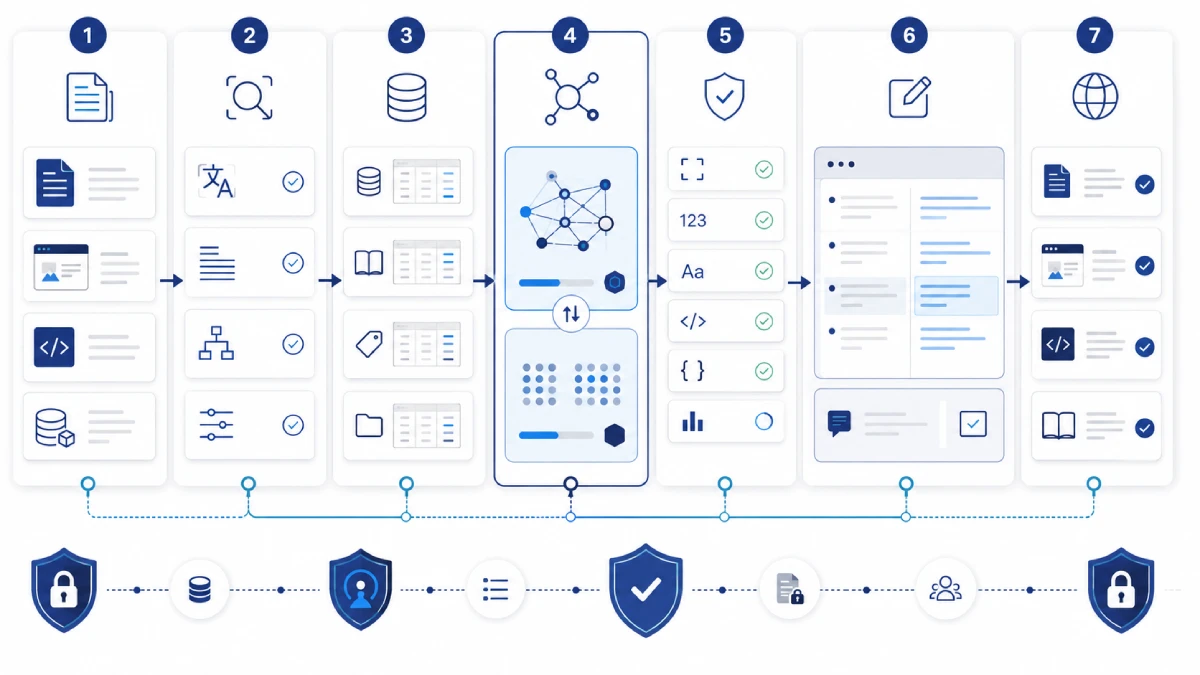
A consumer translation tool may hide the process behind a single text box. An enterprise AI translation workflow usually includes several stages.
1. Input Processing
Text is extracted from a document, website, application, content management system, or repository. The system may detect the source language and identify tags, variables, tables, metadata, or elements that should not be translated.
For AI document translation, the quality of text extraction matters. Scanned files may require OCR, while complex tables, text boxes, headers, and footnotes may need additional validation.
2. Segmentation and Context Preparation
Content may be processed by sentence, paragraph, conversation, or complete document. The workflow can provide information about the target locale, intended audience, document purpose, product, or surrounding content.
Segmentation remains important because a sentence translated in isolation may be ambiguous even when the full paragraph makes the intended meaning clear.
A large context window can allow a model to receive more source material, but it does not guarantee that every relevant detail will be used consistently. Long-document translation still needs evaluation for terminology, references, omissions, and coherence.
3. Language-Resource Application
Where supported, the system may receive:
- Translation-memory matches.
- Approved terminology.
- Do-not-translate lists.
- Style and tone instructions.
- Locale rules.
- Previously approved examples.
These resources can guide the output, but their existence does not guarantee perfect compliance.
4. Model Selection and Inference
The content is routed to an NMT engine, an LLM, or a human-led workflow. The selected model predicts a likely target-language sequence based on the source and any available instructions or context.
It is not retrieving an inherently authoritative answer. Different model versions, prompts, settings, and context can produce different translations.
5. Output Generation
The system generates the translation and may reconstruct the original document or structured content. For websites and software, this may include returning strings to a CMS, repository, or localization platform.
6. Automated Validation
Rules can check for:
- Missing content.
- Changed numbers or units.
- Broken tags and placeholders.
- Terminology deviations.
- Untranslated segments.
- Formatting inconsistencies.
Automated QA is valuable, but it normally detects predefined issues rather than determining whether the translation communicates the correct meaning.
7. Quality Estimation and Human Review
A quality-estimation system may predict which segments are likely to contain errors and prioritize them for review. Depending on the content, human involvement may range from representative sampling to full post-editing, independent revision, or subject-matter approval.
Quality estimation can support routing and triage. It should not be treated as proof that a translation is ready to publish.
8. Final QA and Approval
Linguistic, functional, and in-context checks are completed before release. The approving person or team should be clear, especially for customer-facing or high-consequence content.
NMT vs Generative AI Translation
Neural machine translation systems are generally optimized for translation. Large language models are broader language-generation systems that can also translate and follow instructions.
The following comparison describes common tendencies rather than universal rules. Individual models, language pairs, and enterprise integrations can behave differently.
| Dimension | Neural Machine Translation | Generative AI or LLM Translation |
|---|---|---|
| Primary design | Source-to-target translation | General or translation-tuned language generation |
| Context | Often segment-based, although context-aware NMT exists | Can accept wider instructions and longer passages |
| Terminology | Mature glossary and custom-model options are common | Can use prompts, retrieval, or external tools, but adherence may vary |
| Predictability | Usually stable under a fixed engine and configuration | More sensitive to prompts, settings, and model updates |
| Output style | Often direct and consistent | More flexible tone, with greater risk of drifting from the source |
| Speed and scale | Often efficient for high-volume routine content | May require more computation and larger context inputs |
| Typical role | Structured, repetitive translation | Context-rich translation and supporting language tasks |
| Human review | Based on content risk and tested performance | Based on content risk and tested performance |
Correct terminology can improve both overall quality and term accuracy, but terminology control is not automatic. Long-form and document-level content also needs testing because short sentence-level performance does not necessarily predict document consistency.
An enterprise may therefore use both technologies:
- NMT for stable, repetitive, high-volume content.
- An LLM for context-sensitive drafting, alternatives, or review assistance.
- Professional linguists where interpretation, cultural judgment, or accountability is central.
The decision should be based on representative testing rather than on the assumption that the newest model is always the best model.
AI Translation vs Machine Translation
Machine translation means that a system automatically generates a translation. Modern NMT and LLM translation can both fall within this category.
AI translation is less standardized. Depending on the provider or publication, it may refer to:
- Modern neural machine translation.
- Generative AI or LLM translation specifically.
- A wider workflow that includes model routing, terminology, quality estimation, automation, and human review.
For clarity, this article uses AI translation as the umbrella term and names NMT or LLM translation when the distinction matters.
AI Translation vs Human Translation
The useful comparison is not “machine intelligence versus human intelligence.” It is how different production models perform under a defined translation specification.
| Factor | AI-Led Workflow | Human-Led Workflow | Hybrid Workflow |
|---|---|---|---|
| Speed | Rapid initial output | Limited by professional capacity | Rapid draft with planned review |
| Scale | High raw-output volume | Scales through staffing | Automation plus selective expertise |
| Context and intent | Depends on supplied context and model behavior | Supports interpretation and informed judgment | Model context plus human decisions |
| Creativity | Generates alternatives but may alter meaning | Supports deliberate adaptation and transcreation | AI ideation with human selection |
| Consistency | May vary by context, configuration, or version | Depends on resources and coordination | TM, terminology, automation, and revision |
| Accountability | Must be assigned by the deploying organization | Can be assigned through professional roles | Requires ownership at every stage |
| Cost structure | Generation, integration, QA, and rework | Professional labor and project management | Technology, orchestration, and review |
AI-only output may be suitable for low-risk understanding. Human-led translation is often preferable where wording carries legal, medical, financial, safety, reputational, or persuasive consequences.
Hybrid workflows can combine scale with controlled review. Human work is not error-free either; clear instructions, qualified revision, and final QA still matter.
What AI Translation Does Well
AI translation is strongest when:
- The source content is clear.
- The content is repetitive.
- The language direction has been tested.
- Approved terminology is available.
- The consequences of an error are limited.
- The output can be sampled or reviewed.
- The data is processed in an approved environment.
Potential applications include:
- Internal content discovery and gisting.
- First-draft translation.
- Repetitive product-catalog fields.
- Routine knowledge-base updates.
- Customer-support suggestions under agent control.
- High-volume operational content supported by terminology.
- Low-risk website or software updates with automated and in-context checks.
AI can also support document translation services by accelerating the first stage of suitable projects. However, file format, layout, context, confidentiality, and review requirements still need to be considered.
Content type alone does not determine suitability. A product catalog may appear routine but become high risk if a translation changes voltage, dimensions, materials, operating limits, or safety restrictions.
Where AI Translation Struggles
AI systems may struggle with:
- Ambiguity and implied meaning.
- Pronouns and references across sentences.
- Humor, wordplay, and cultural references.
- Persuasive intent and brand voice.
- Specialized terminology.
- Names, numbers, dates, and units.
- Tables and cross-references.
- OCR errors.
- Software variables and placeholders.
- Long-document consistency.
Longer input does not automatically preserve terminology, resolve every reference, or prevent omissions. LLMs may rewrite, summarize, or add information when strict fidelity is required, while NMT can also produce unsupported text.
Large-scale multilingual research has found uneven hallucination behavior across language pairs, reinforcing an important rule: a supported-language list is not evidence of equal quality. Each language direction, domain, content type, and workflow needs its own evaluation.
The Role of Human Review
“Human reviewed” is meaningful only when its scope is defined.
Light Review
A light review checks visible problems and general readability. It may be suitable for certain low-risk uses, but it does not necessarily verify every statement against the source.
Full Machine Translation Post-Editing
A qualified linguist compares the source with the machine-generated output and corrects accuracy, completeness, terminology, grammar, style, and formatting to an agreed specification.
ISO 18587:2017 remains the published international standard addressing full human post-editing of machine translation output. Organizations should confirm the current edition and scope when referencing the standard in procurement or quality documentation.
Bilingual Revision
An independent reviewer performs an additional source-to-target comparison after translation or post-editing. This adds separation between production and approval.
Subject-Matter Review
A technical, medical, legal, financial, or regulatory specialist checks domain correctness. Subject-matter review does not automatically replace linguistic review.
In-Country Review
An in-country reviewer validates market terminology, local product language, cultural suitability, and audience expectations.
Final Linguistic and In-Context QA
The final document, website, application, or interface is checked in its delivered format. This stage may identify issues that were invisible in a segment-based translation environment.
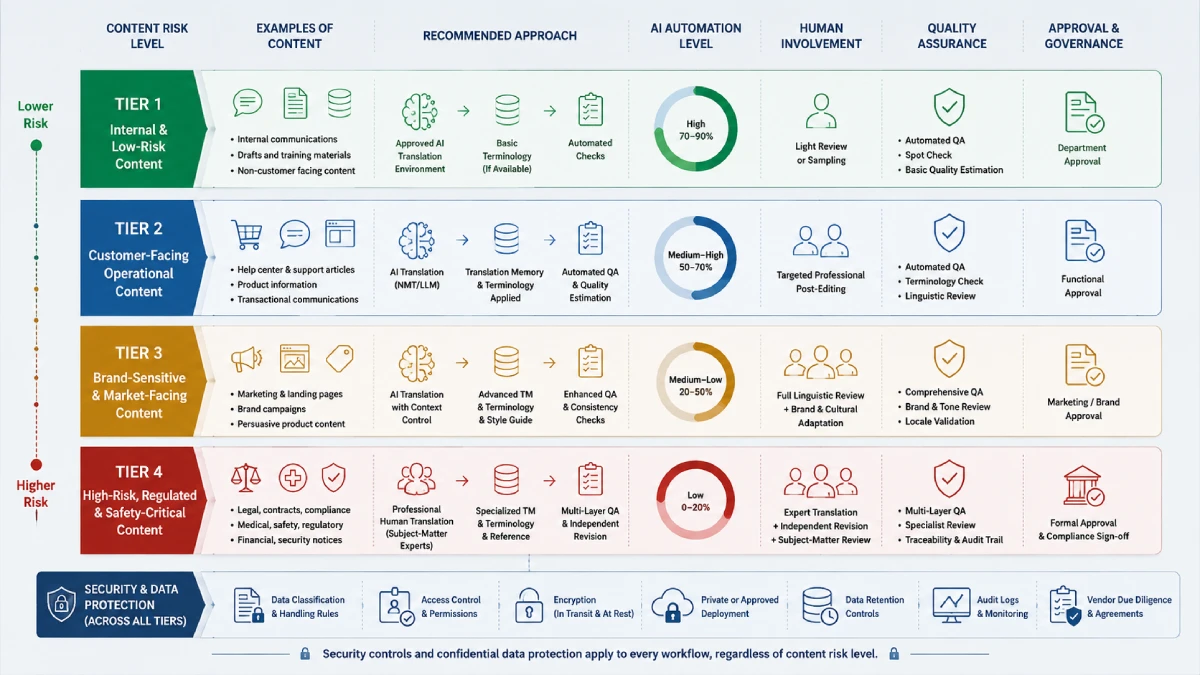
AI Translation Workflow by Content Risk
Content risk and data sensitivity should be assessed separately. A routine internal memo may still contain confidential acquisition plans and therefore require a tightly controlled environment.
| Tier | Typical Content | Recommended Workflow | Avoid |
|---|---|---|---|
| Tier 1: Internal and low consequence | Gisting, research, noncritical internal updates | Approved AI tool, automated QA, and representative sampling | Sending confidential text to an unapproved tool |
| Tier 2: Customer-facing operational | Catalogs, support articles, routine documentation | TM and terminology, validated AI, targeted or full review | Unmonitored automatic publication |
| Tier 3: Brand-sensitive | Homepages, campaigns, executive messages | Human-led translation or transcreation with AI assistance | Publishing a fluent draft without brand review |
| Tier 4: High consequence | Legal rights, patient information, regulatory filings, financial disclosure, safety content | Specialist translation, independent revision, subject-matter approval, and traceability | AI-only output, light review, or approval based solely on a score |
This framework is a decision aid, not a legal classification. Organizations must define ownership, risk tolerance, and approval authority for their own use cases.
A useful principle is that content risk controls quality decisions, while data sensitivity controls where and how the content may be processed. A low-risk translation task can still require strict security if the source contains confidential, personal, or restricted information.
How to Evaluate AI Translation Quality and Accuracy
Begin with a translation specification that defines:
- Purpose.
- Audience.
- Target locale.
- Subject domain.
- Required terminology.
- Tone and style.
- Unacceptable errors.
- Review depth.
- Release threshold.
A formal localization quality management process should examine more than surface fluency.
Human evaluation may consider:
- Accuracy.
- Completeness.
- Grammar and fluency.
- Terminology.
- Tone and style.
- Locale suitability.
- Document-level consistency.
- Functional effect.
- Error severity.
Automated methods answer narrower questions.
BLEU and chrF compare output with reference translations. They are useful for controlled benchmarking but may penalize valid alternative translations or overlook some serious meaning errors.
Learned metrics such as COMET attempt to model semantic similarity and human quality judgments. They can provide useful evidence, but performance can still vary by language, domain, and error type.
Quality estimation predicts likely translation quality without requiring a reference translation. It can help route difficult segments, identify probable errors, or prioritize human review.
None of these methods is a publication certificate.
A practical evaluation program should:
- Use representative production content.
- Include difficult as well as routine segments.
- Classify minor, major, and critical errors.
- Test every required language direction.
- Include names, numbers, units, and terminology.
- Reassess performance after meaningful model, prompt, or workflow changes.
The most useful question is not “What is the model’s accuracy percentage?” but “Does this workflow meet the agreed quality threshold for this content, audience, and consequence of error?”
Data Privacy and Security in AI Translation
Content should be classified before an AI translation tool is selected.
Identify whether the source or output contains:
- Personal data.
- Trade secrets.
- Unreleased product information.
- Legal material.
- Medical information.
- Credentials.
- Security-sensitive instructions.
- Client-protected content.
Then verify the exact product, plan, endpoint, processing region, and configuration—not only the provider’s brand.
Public and enterprise AI products can differ substantially in data retention, model-training policies, regional processing, logging, access controls, and contractual protections. Even within the same provider, a consumer interface, business plan, translation API, and generative-model API may follow different rules.
Supplier due diligence for secure AI translation should cover:
- Input and output retention.
- Use for model training or service improvement.
- Processing region and data residency.
- Encryption and key management.
- SSO, MFA, and role-based access.
- Prompt, response, and diagnostic logging.
- Subprocessors.
- Human-review access.
- Deletion procedures.
- Incident response.
- Contractual protections.
- Audit evidence.
- Private or otherwise approved deployment options.
An NDA is useful, but it does not replace technical controls, access governance, secure transfer, or appropriate file handling.
Data-protection, AI-governance, and copyright requirements also depend on jurisdiction and use. Businesses handling regulated, personal, confidential, or rights-sensitive content should verify current requirements and obtain qualified advice where necessary rather than assuming that a particular AI product automatically satisfies every legal obligation.
AI Translation in Localization Workflows
AI localization is not simply the automatic translation of isolated text. It involves connecting translation technology with language resources, content systems, reviewers, and release controls.
A typical workflow may look like this:
Content source → TMS → translation memory and terminology → NMT, LLM, or human routing → automated QA → human review → in-context testing → publication
Translation memory reuses approved wording. A termbase controls product and domain vocabulary. A style guide defines tone and locale conventions. Content connectors move updates between a CMS, repository, support platform, or product environment.
For website localization, the workflow may also need to address navigation, metadata, SEO elements, forms, images, and page layout.
For app and software localization, variables, character limits, interface context, screenshots, builds, and functional testing may be equally important.
Automated QA checks formal requirements, while qualified reviewers resolve questions of meaning, audience, and risk.
Approved corrections may update translation memory, terminology, evaluation sets, and routing rules. They do not automatically retrain the model unless a deliberate and controlled adaptation process has been implemented.
How to Choose the Right Translation Workflow
When evaluating AI translation software or services, assess the workflow against the content—not against a generic product promise.
Consider:
- Purpose, audience, and consequence of error.
- Language direction, domain, and proven performance.
- Volume, repetition, and deadline.
- Terminology and translation-memory coverage.
- Brand sensitivity.
- Data sensitivity.
- Available bilingual or subject-matter reviewers.
- Required level of accountability.
- Total cost, including integration, QA, correction, and error impact.
1. AI-Only in an Approved Environment
This can be appropriate for validated, low-risk use where imperfect wording will not create a significant consequence and users understand the limitations.
2. AI Plus Targeted Human Review
This can suit workflows where most content is routine but particular segments, terms, markets, or risk indicators require human attention.
3. AI Plus Full Post-Editing or Bilingual Revision
This is appropriate for publishable operational content that benefits from automated scale but still requires complete source-to-target verification.
4. Human-Led Specialist Translation
This is generally preferable where interpretation, persuasion, professional responsibility, or the consequence of an error dominates the decision.
Before scaling, run a pilot using real production material rather than only clean demonstration sentences. Include long passages, specialized terms, names, entities, numbers, units, ambiguous wording, tables, and difficult source text.
Evaluate the results against a defined threshold and document who is authorized to approve release.
Common Misconceptions About AI Translation
Fluent Output Is Always Accurate
Fluency can conceal omissions, invented details, incorrect entities, or altered meaning. A translation can sound natural and still be wrong.
A Large Context Window Solves Document Translation
A larger window increases input capacity. It does not guarantee consistent use of every part of the document or prevent terminology and reference errors.
One Model Works Equally Well in Every Language
Quality varies by language direction, subject domain, source quality, training data, and model design.
Human Review Removes Every Risk
Results depend on reviewer competence, assigned scope, available time, source context, and final QA. Human review is a control, not a guarantee.
AI Automatically Preserves Formatting
Tags, tables, variables, images, and layout still require file-level or in-context validation.
AI Translation Is Always Cheaper
Total cost may include integration, governance, terminology preparation, review, rework, and the consequences of errors. Low generation cost does not necessarily mean low total workflow cost.
An Enterprise Product Is Automatically Secure
Security depends on the exact service, endpoint, configuration, contract, logging behavior, and organizational controls.
Translation Memory and AI Translation Are the Same
Translation memory retrieves previously approved segments. A translation model generates new output.
FAQ
Is AI translation the same as machine translation?
Machine translation is automated source-to-target translation. AI translation may refer to modern NMT, LLM translation, or a wider workflow that includes terminology, quality estimation, automation, and human review.
How accurate is AI translation?
There is no responsible universal percentage. Results vary by language direction, model, domain, source quality, terminology, context, and error severity. Businesses should test representative content against a documented specification.
Can AI replace human translators?
AI can automate some translation tasks and assist with many others. Human expertise remains important when work requires interpretation, cultural judgment, creativity, specialist knowledge, accountability, or approval of high-consequence content.
Is AI translation safe for confidential documents?
It can be, but only when the environment has been approved for that data. Verify retention, training use, processing region, encryption, access, logging, deletion, subprocessors, and contractual terms for the exact service.
Which content is suitable for AI translation?
Strong candidates are clear, repetitive, low consequence, supported by a validated language direction, and processed with appropriate terminology and QA. Audience, intended use, and data sensitivity must still be considered.
Does AI translation work for every language?
Many systems support numerous languages, but technical support does not mean equal quality. Test each source-to-target direction, domain, and locale separately, especially for lower-resource languages.
What is human-in-the-loop translation?
Human-in-the-loop translation is a workflow in which people define requirements, review output, resolve exceptions, or approve release. Human participation may range from representative sampling to full post-editing, independent revision, and specialist approval.
How should businesses evaluate AI translation quality?
Define the purpose and acceptance criteria first. Use representative test content, qualified human evaluation, error-severity categories, automated QA, and appropriate metrics. Reassess the workflow after significant model, prompt, terminology, or integration changes.
A Practical Starting Point
AI translation is neither a universal replacement for professional translators nor a technology without practical business value. It is a set of production options whose usefulness depends on governance.
Start with representative content. Classify the consequences of an error and the sensitivity of the data. Define the required quality, test an approved workflow, and assign qualified reviewers.
Scale only when the complete process—not merely a model demonstration—meets the organization’s requirements.