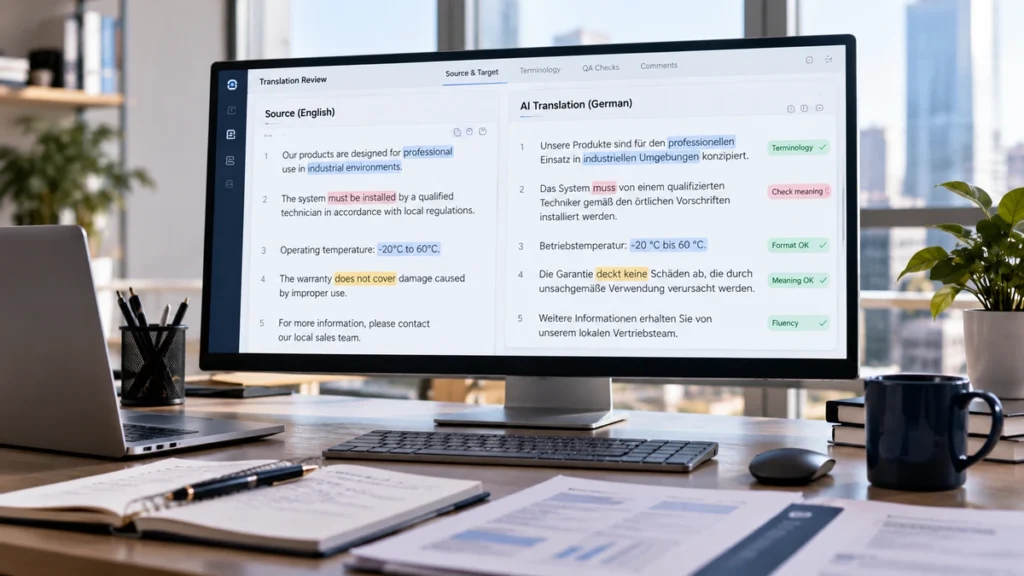
If you search for AI translation vs machine translation, you may come away with the impression that machine translation is an older technology and AI translation is its modern replacement.
That is not quite right.
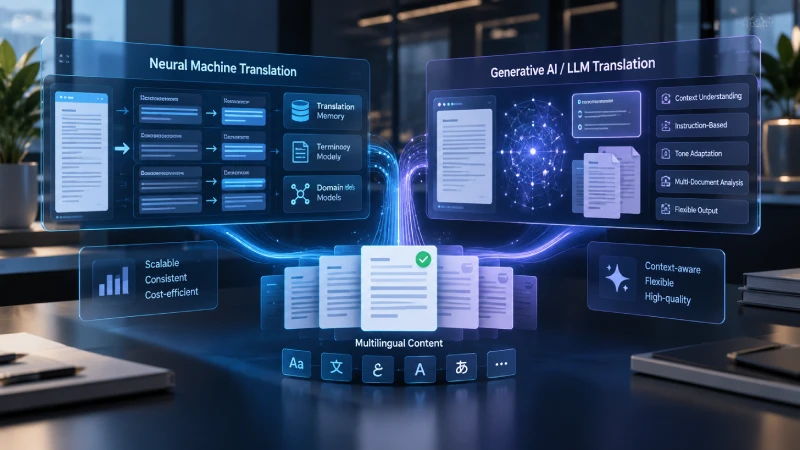
Machine translation has used artificial intelligence and machine-learning techniques for years. Modern neural machine translation, or NMT, is itself a form of AI. What has changed more recently is the arrival of generative AI and large language models that can also perform translation—often with broader contextual understanding and more flexible instructions.
So the real question for a business is not simply:
“Should we use AI translation or machine translation?”
A more useful question is:
“Which translation technology and workflow best fit this content, language pair, risk level, volume, terminology and security requirement?”
That distinction matters because a product catalog, marketing campaign, software interface and regulated document may all require different approaches.
This guide explains the terminology, compares dedicated NMT systems with LLM-based translation, and provides a practical framework for deciding where each approach fits in an enterprise localization workflow.
For a broader introduction to the technology itself, see What Is AI Translation and How Does It Work?
AI Translation vs Machine Translation: The Direct Answer
Machine translation is the automated translation of content from one language into another. Modern machine translation already uses AI.
The term AI translation, however, is broader and less technically precise. Depending on the product or vendor, it may refer to:
- neural machine translation;
- generative AI translation;
- large language model translation;
- translation-specific language models;
- AI-assisted post-editing;
- or a wider localization workflow that combines several AI technologies.
This means AI translation and machine translation are not mutually exclusive categories.
A useful way to think about the terminology is:
| Term | What It Usually Describes |
|---|---|
| Machine translation | The automated translation task |
| Neural machine translation | A neural-network-based approach to machine translation |
| Generative AI translation | Translation generated by a generative model |
| LLM translation | Translation produced using a large language model |
| AI translation | A broad commercial term that may include NMT, LLMs and AI-assisted workflows |
| AI localization | The use of AI across a wider localization process, not only translation |
For enterprise buyers, the more useful technical comparison today is often dedicated NMT vs LLM-based translation.
Why “AI Translation” and “Machine Translation” Get Mixed Up
Part of the confusion comes from comparing two terms that describe different things.
Machine translation describes a task.
It answers the question:
How can software automatically translate text from one language into another?
AI describes a family of technologies.
It answers a different question:
What type of computational system is being used to perform that task?
Modern machine translation engines generally rely on artificial intelligence, particularly neural networks. Therefore, saying that a system uses “AI translation” does not automatically tell a buyer what type of translation technology is operating underneath.
“AI Translation” Is Also a Marketing Term
The phrase has become even less precise since generative AI became widely available.
One vendor may use “AI translation” to describe a conventional neural machine translation engine.
Another may mean translation with a general-purpose LLM.
A third may use several technologies together—for example:
- translation memory retrieval;
- terminology injection;
- an NMT engine;
- an LLM for post-editing;
- automated quality checks;
- human review.
All of those workflows could reasonably be marketed as AI-powered translation.
That is why procurement and localization teams should ask:
“What actually generates and controls the translation?”
rather than simply:
“Does this platform use AI?”
Machine Translation Did Not Start with Generative AI
Machine translation has evolved through several technological generations.
Understanding that evolution helps explain why the idea of “machine translation vs AI” is misleading.
Rule-Based Machine Translation
Early rule-based machine translation, or RBMT, relied heavily on:
- dictionaries;
- grammatical rules;
- linguistic models;
- manually created language rules.
These systems could be highly structured but required significant linguistic engineering.
Statistical Machine Translation
Statistical machine translation, or SMT, learned translation probabilities from large bilingual corpora.
Instead of relying mainly on manually programmed linguistic rules, SMT attempted to determine which target-language words or phrases were statistically likely to correspond to source-language content.
Neural Machine Translation
Neural machine translation changed the field by using neural networks to learn source-to-target relationships more holistically.
NMT systems generally produce more fluent output than earlier statistical systems and have become the foundation of many large-scale commercial translation platforms.
The Transformer architecture, which later became foundational to modern large language models, was itself originally developed in the context of neural machine translation.
Generative AI therefore did not suddenly make translation “AI-powered.”
AI had already become central to machine translation long before general-purpose LLMs became mainstream.
So What Is Generative AI or LLM Translation?
Large language models approach translation differently from traditional dedicated MT systems.
A general-purpose LLM is not trained only to translate.
It may also be able to:
- answer questions;
- summarize content;
- rewrite text;
- extract information;
- classify content;
- generate new text;
- follow natural-language instructions.
Translation becomes one capability within a much broader language system.
That difference can be useful.
Instead of providing only a source sentence and target language, an LLM can potentially receive instructions such as:
Translate this product announcement into German for B2B procurement managers. Keep the tone professional, preserve product names, use the supplied terminology list and avoid adding claims that do not appear in the source.
This creates more flexibility around:
- tone;
- register;
- audience;
- terminology;
- formatting;
- surrounding context;
- rewriting constraints.
But flexibility also introduces new variables.
Output may depend on:
- the model;
- prompt;
- context window;
- system instructions;
- temperature or generation settings;
- terminology handling;
- retrieval workflow.
It can therefore be harder to treat all “LLM translation” as one consistent category.
There is also another complication: translation-specific LLMs are emerging.
This further blurs the line between traditional NMT and generative AI. The market is moving toward a mixed landscape of dedicated translation models, general-purpose LLMs, translation-tuned LLMs and hybrid workflows.
NMT vs LLM Translation: The Comparison That Actually Matters
For most enterprise buyers, this is more useful than comparing “machine translation” with “AI translation.”
| Decision Factor | Dedicated NMT | LLM-Based Translation |
|---|---|---|
| Predictability | Often easier to standardize in established translation pipelines | Can vary more with model, prompt and configuration |
| Context | Traditionally optimized for translation segments, although modern systems increasingly support broader context | Can use substantial surrounding context when the workflow provides it |
| Terminology | Mature glossary and custom-engine controls are common | Terminology can be supplied through prompts, retrieval or platform controls, but enforcement must be tested |
| Instructions | Usually controlled through translation-specific settings | Strong at handling detailed natural-language instructions |
| Hallucination risk | Can mistranslate, omit or distort source content | Can additionally produce fluent but unsupported additions or reformulations |
| Speed | Often well suited to high-throughput production | Usually more computationally intensive, although performance varies by model |
| Cost structure | Often optimized for large-volume translation | Pricing may depend on provider, tokens, characters, model tier or workflow |
| Integration | Mature APIs and strong TMS/CAT integration | Integration is improving rapidly but may require additional orchestration |
| Privacy | Depends on product, provider and deployment | Also depends on product, provider and deployment |
One mistake is to reduce this comparison to:
“Which one sounds more natural?”
Naturalness is only one dimension of translation quality.
An LLM may generate highly fluent output while:
- changing meaning;
- weakening a contractual statement;
- modifying a number;
- replacing approved terminology;
- adding information that was not in the source.
A dedicated MT engine may produce less elegant language in one scenario but be more predictable for a large, repetitive and tightly controlled workflow.
Translation quality therefore has to be judged against the actual purpose of the content.

Where Dedicated MT and Generative AI Fit in Real Business Content
Technology selection becomes clearer when companies stop looking for one universal engine and start evaluating specific content types.
| Content Type | Likely Starting Point | Why | Main Control |
|---|---|---|---|
| Product catalogs | NMT or hybrid | High volume and repeated terminology | TM, terminology and QA |
| Marketing content | LLM-assisted workflow | Tone, context and audience instructions matter | Style guide and human review |
| Business documents | Depends on content risk | Formatting, context and confidentiality vary | File QA, terminology and review |
| Customer support | Hybrid | High volume but variable context and risk | Routing and escalation rules |
| Software UI | NMT or LLM depending on available context | Short strings can be highly ambiguous | Metadata, terminology and in-context QA |
Structured Product and Catalog Content
Consider a manufacturer translating tens of thousands of product descriptions, specifications or attribute values.
The source content may contain repeated structures such as:
- material;
- dimensions;
- pressure rating;
- installation method;
- product series;
- component names.
In this environment, consistency may matter more than stylistic creativity.
A workflow based on translation memory, terminology management and dedicated MT can remain highly valuable.
An LLM may still be used selectively—for example, to rewrite poor source text or review unusual segments—but there may be little reason to regenerate every repeated specification with a general-purpose model.
Marketing Content
Marketing creates a different problem.
A literal translation may preserve the words but fail to preserve:
- intent;
- tone;
- persuasion;
- audience expectations;
- brand voice.
LLMs can be useful because they can respond to instructions about target audience, tone and context.
However, this should not be confused with professional transcreation.
A model may generate attractive copy while subtly changing:
- product claims;
- positioning;
- technical meaning;
- legal wording.
Human review therefore becomes more important as creative freedom increases.
Business Documents
Document translation can involve much more than replacing sentences.
A useful workflow may need to preserve:
- headings;
- tables;
- numbers;
- units;
- references;
- terminology;
- document relationships;
- formatting.
The best model may depend on whether the document is an internal memo, engineering manual, sales proposal, compliance document or contract.
Security requirements may also be more important than model sophistication.
Customer Support
Customer-support content often combines large volume with unpredictable context.
A company may have:
- low-risk repetitive questions;
- technical troubleshooting;
- complaints;
- account issues;
- safety questions;
- contractual disputes.
It may therefore make sense to automate low-risk messages while routing higher-risk conversations to more controlled workflows or human agents.
Software UI
Short strings are not necessarily easy to translate.
A label such as:
“Save”
could mean:
- save a file;
- save money;
- save a draft;
- save a configuration;
- rescue something.
Without metadata, screenshots or UI context, even a powerful language model may choose the wrong interpretation.
Good localization engineering therefore remains essential.
The Translation Engine Is Only One Part of the System
One of the biggest mistakes in AI translation discussions is treating the model as if it were the entire localization workflow.
Enterprise translation quality often depends just as much on the assets surrounding the model.
Translation Memory
A translation memory stores previously approved source-target segments.
It can help organizations:
- reuse approved translations;
- maintain consistency;
- avoid translating identical content repeatedly;
- reduce unnecessary model generation;
- preserve established wording.
In AI workflows, translation memories can also become sources of contextual examples.
Terminology
A terminology database or glossary helps control:
- product names;
- technical terms;
- brand terminology;
- legal terminology;
- do-not-translate terms;
- locale-specific vocabulary.
LLMs do not make terminology management obsolete.
In fact, flexible generative systems make terminology governance more important because the model may otherwise choose a plausible synonym that is linguistically valid but commercially wrong.
Style Guides
A multilingual style guide can define:
- tone;
- formal vs informal address;
- punctuation;
- capitalization;
- date format;
- units;
- brand voice;
- sentence length;
- writing conventions.
LLMs can use these instructions effectively—but only if the workflow provides them.
Translation Management Systems
The TMS increasingly acts as the orchestration layer.
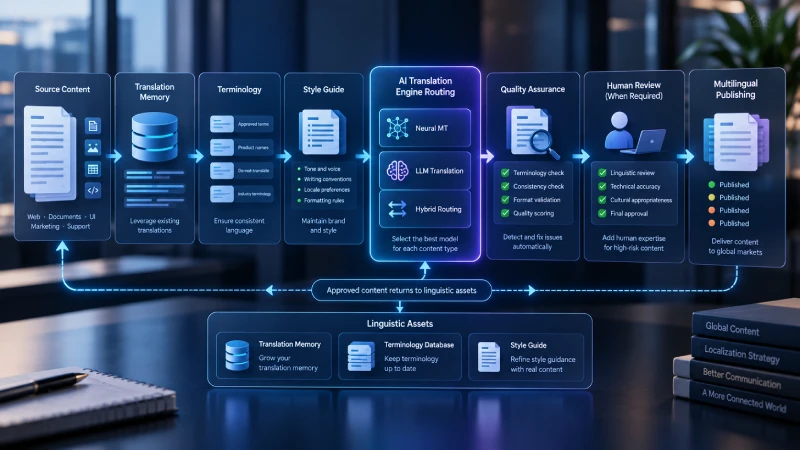
A mature workflow might look like:
Source content → translation memory lookup → terminology and context → model routing → automated QA → human review where required → publishing → approved translations returned to linguistic assets
Seen this way, the question is no longer simply:
“Which AI model should we use?”
It becomes:
“How should our entire multilingual content system be designed?”
Privacy, Data Retention and Enterprise Deployment Matter More Than the AI Label
Security discussions often fall into another false binary:
NMT is secure; LLMs are risky.
That is too simplistic.
Privacy depends more on the specific product and deployment configuration than on whether the underlying model is classified as NMT or an LLM.
A company might translate content through:
- a public consumer chatbot;
- a SaaS translation platform;
- an enterprise API;
- a regional cloud endpoint;
- a private cloud deployment;
- a locally hosted model.
These options have very different risk profiles.
Before submitting confidential business content, procurement and security teams should ask:
- Is customer content used to train models?
- Is input or output logged?
- How long is the data retained?
- Can retention be reduced or disabled?
- Where is the data processed?
- Are regional processing options available?
- Which subprocessors are involved?
- How are uploaded documents stored?
- How and when is data deleted?
- What encryption, IAM and audit controls are available?
Do not rely on assumptions based on brand reputation or the phrase “enterprise AI.”
Major cloud providers publish product-specific data-handling documentation, but policies differ by service, endpoint, account type and deployment.
They also change.
Security reviews therefore need to verify the current policy for the exact product being used, not a generic policy for the provider.
How Should an Enterprise Choose Between NMT and LLM Translation?
Rather than selecting one technology for the entire organization, evaluate each content category against seven factors.
1. Content Risk
Ask:
What happens if the translation is wrong?
The consequences of a minor error in an internal knowledge-base article are very different from an error in:
- medical content;
- safety instructions;
- a contract;
- regulated product documentation;
- financial disclosures.
Higher-consequence content usually requires stronger review controls regardless of which model produced the first draft.
2. Language and Locale
Translation performance varies significantly by:
- language pair;
- direction;
- domain;
- terminology;
- model.
A system that performs well for English to Spanish cannot automatically be assumed to perform equally well for English to Japanese, Arabic to French or German to Thai.
Evaluate the exact language combinations you actually use.
3. Volume and Latency
Consider whether you are translating:
- ten campaign pages per month;
- 100,000 product records;
- real-time chat;
- millions of support messages;
- occasional technical documents.
Dedicated MT remains attractive for many high-volume and low-latency scenarios.
4. Required Context
Ask how much information is needed to translate correctly.
Does the translator need:
- the preceding paragraph?
- product metadata?
- a screenshot?
- customer history?
- a full document?
- brand positioning?
The more context-dependent the content is, the more valuable contextual model capabilities may become.
5. Terminology Requirements
Some organizations can tolerate synonyms.
Others cannot.
If a manufacturer requires one approved term for every component across 30 markets, terminology enforcement may be more important than stylistic flexibility.
6. Security Requirements
Assess:
- confidentiality;
- retention;
- data residency;
- access controls;
- deployment model;
- auditability.
A technically excellent model may still be unsuitable if it cannot satisfy the organization’s security policy.
7. Human Review Requirements
Do not wait until after selecting the technology to decide whether humans will review the output.
Define the review level first.
A practical routing model might look like this:
Dedicated NMT is a strong starting point when:
- translation volume is very high;
- latency matters;
- content is repetitive;
- terminology is well controlled;
- instructions are relatively stable.
LLM-based translation becomes attractive when:
- broader context is available;
- detailed instructions matter;
- tone or audience adaptation is important;
- content is less repetitive.
Hybrid workflows make sense when:
- the organization manages several content types;
- different language pairs behave differently;
- risk levels vary;
- no single model performs best everywhere.
The best enterprise architecture may therefore use multiple models rather than selecting one winner.
Why Human-in-the-Loop Still Matters
Human review is sometimes discussed as though it proves AI translation has failed.
That is the wrong framing.
Human-in-the-loop workflows are fundamentally about risk control and quality governance.
A reviewer may need to check:
- accuracy;
- omissions;
- unsupported additions;
- terminology;
- numbers;
- names;
- legal meaning;
- tone;
- locale conventions;
- character limits;
- UI fit;
- brand requirements.
The required review level should depend on the consequences of an error.
For low-risk internal content, organizations may accept unedited machine output.
For public marketing content, they may require linguistic review.
For high-risk legal, medical, technical or regulated material, more stringent verification may be required.
Standards such as ISO 11669 emphasize translation-project requirements and risk assessment, while ISO 5060 provides a framework for evaluating translation output—including human translation, post-edited machine translation and unedited machine translation.
The important point is simple:
Fluent output is not the same as verified output.
For a broader comparison of when human translators and AI systems should be used, see Human Translation vs AI Translation.
The Bottom Line
So, is there a difference between AI translation and machine translation?
Yes—but not in the way the phrase is often presented.
Machine translation is the automated translation task, and modern machine translation already uses AI.
“AI translation” is a broader term that may refer to NMT, generative AI, LLM translation or an AI-enhanced localization workflow.
For businesses, the meaningful comparison is usually not:
AI vs machine translation.
It is:
- NMT vs LLM;
- dedicated engines vs general-purpose models;
- one model vs hybrid routing;
- automated output vs reviewed production;
- standalone translation vs an integrated localization workflow.
The best choice depends on the content’s risk, language, scale, context, terminology, security requirements and review process.
In many organizations, the future will not be one technology replacing another.
It will be NMT, LLMs, translation memory, terminology, workflow automation and human expertise working together—with different components used for different types of content.
If your organization manages several languages and content types, the most useful next step is usually not choosing a model from a generic demo. It is testing representative content, defining measurable quality requirements and designing a workflow around the real risks and constraints of your business.
FAQ
Is machine translation a form of AI?
Yes. Modern neural machine translation uses AI and neural-network techniques to translate text automatically between languages.
Is AI translation the same as neural machine translation?
Not necessarily. AI translation is a broader term that may refer to NMT, LLM-based translation, generative AI or an AI-assisted localization workflow.
Is LLM translation considered machine translation?
Yes in the broad sense that software is automatically translating text, although LLMs are general-purpose language models rather than traditional dedicated MT engines.
What is the difference between NMT and LLM translation?
NMT is typically optimized specifically for translation, while LLMs support broader language tasks and can respond to detailed context and instructions. Their relative performance depends on the language pair, content, workflow and model.
Is LLM translation better than neural machine translation?
Not universally. LLMs may be stronger for context-heavy or instruction-sensitive content, while dedicated NMT can remain valuable for predictable, high-volume and terminology-controlled workflows.
Why are dedicated machine translation engines still used?
They are often efficient for large-scale translation, integrate well with localization systems and provide mature terminology, customization and production controls.
Can AI translation use translation memories and glossaries?
Yes. Modern localization workflows can combine AI or MT with translation memories, terminology databases, style guides and TMS-based orchestration.
Which is safer for confidential business documents: NMT or LLM translation?
Security depends on the specific provider, product tier, deployment, retention policy and contractual controls rather than the model category alone.
Do AI-translated documents still need human review?
It depends on content risk. High-consequence, public-facing, regulated or terminology-sensitive content often requires human review even when the initial translation is machine-generated.