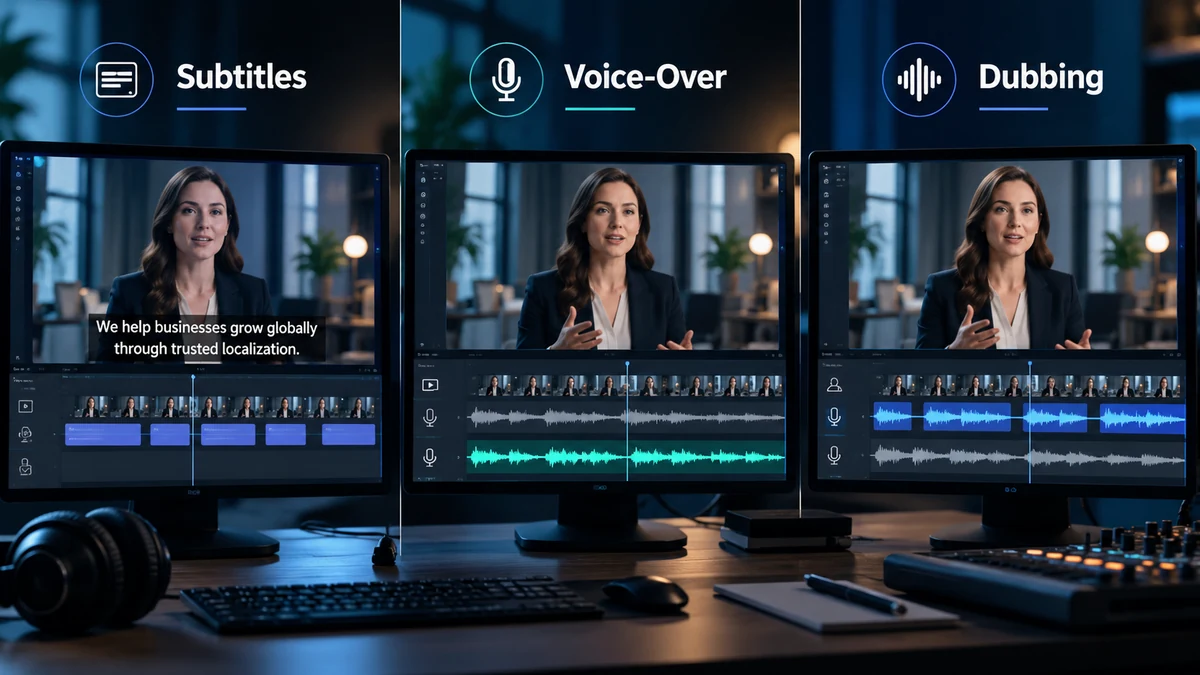
Choosing between subtitles, dubbing, and voice-over is more than a production decision. It determines how international audiences experience your video, how easily they understand its message, and how much localization work your team needs to manage.
A corporate interview may benefit from subtitles that preserve the speaker’s original voice. A software tutorial may work better with translated narration because viewers need to focus on the screen. A character-driven advertisement may require dubbing to recreate the intended emotional performance.
The best video localization method depends on your audience, content, viewing conditions, accessibility requirements, and production priorities.
This guide compares the three approaches, explains when each works best, and provides a practical decision framework for selecting the right format.
Subtitles vs Dubbing: The Best Choice in 30 Seconds
Choose subtitles when preserving original voices, supporting sound-off viewing, or providing translated text is the priority. Choose voice-over for narration-led training, explainers, and product demonstrations. Choose dubbing when dialogue, character performance, and a natural target-language listening experience are central to the video.
The distinction matters because these methods are not interchangeable.
Subtitles require viewers to read while watching. Voice-over lets them listen to translated speech without requiring close synchronization with visible mouth movements. Dubbing replaces the original dialogue and may involve more extensive performance and synchronization work.
None is automatically the highest-quality option.
A well-produced subtitle track may serve an international interview better than an expensive dub. Conversely, subtitles alone may be inconvenient when viewers must closely follow complex visual instructions.
Start with the viewing experience you want to create, then select the production method that supports it.
Five Terms to Understand Before Choosing
Video localization terminology can be confusing, particularly when comparing quotes from different production providers.
Subtitles are time-synchronized text displayed over video. In multilingual localization, translated subtitles allow viewers to understand speech in another language while retaining the original audio.
Closed captions are selectable text tracks designed to communicate speech and meaningful non-speech audio information, such as sound effects and speaker identification. Unlike closed captions, open captions are permanently visible. Accessibility terminology varies by region.
Voice-over provides spoken target-language content without normally requiring close lip synchronization. Documentary-style voice-over may retain the original speech quietly underneath, while localized narration may replace the original narration track.
Dubbing replaces original spoken dialogue with target-language speech. It may require dialogue adaptation, voice casting, performance direction, and synchronization.
Lip-sync dubbing is a more synchronization-intensive form of dubbing in which the translated performance is adapted to align closely with visible mouth movements.
The distinction between voice-over and dubbing is particularly important. As Nimdzi explains, voice-over has different meanings in filmmaking and audiovisual translation.
When requesting services, specify how much original audio should remain and how closely the new speech must match the picture.
Subtitles vs Voice-Over vs Dubbing: Side-by-Side Comparison
The following table compares the main video localization methods from a business and production perspective.
| Criterion | Subtitles | Voice-Over | Dubbing |
|---|---|---|---|
| Viewer experience | Read translated text while watching | Listen to localized narration | Hear target-language dialogue |
| Original voice | Preserved | May remain underneath or be replaced | Original dialogue replaced |
| Production complexity | Translation, timing, formatting, QA | Adds recording, editing, and mixing | May add casting, adaptation, and synchronization |
| Cost drivers | Word volume, timing, language, formatting | Voice talent, recording, audio editing | Speakers, performance, synchronization, retakes |
| Turnaround | Often fewer production stages | Depends on recording and approvals | Depends on casting and synchronization |
| Accessibility | Can support language access; accessible captions may need additional content | Separate captioning and accessibility planning needed | Separate captioning and accessibility planning needed |
| Mobile viewing | Useful without sound; text must remain readable | Useful when viewers can listen and focus on visuals | Useful for spoken-language viewing |
| Brand impact | Preserves original speaker identity | Introduces a localized narration voice | Recreates dialogue and vocal performance |
These are qualitative differences, not fixed rankings for price or delivery speed.
A subtitle project involving difficult audio and complex formatting may require substantial preparation. A simple single-speaker voice-over may be less demanding than dubbing a conversation involving several characters.
The relevant question is not which method is generally better, but which production requirements are necessary for your intended audience experience.
Which Format Works Best for Different Video Types?
Content type provides a useful starting point, although it should not determine the final choice by itself.
| Video Type | Recommended Starting Point | Main Consideration |
|---|---|---|
| Marketing videos | Subtitles, voice-over, or dubbing | Brand personality and creative concept |
| Corporate training | Voice-over with appropriate captions | Following instructions while watching demonstrations |
| E-learning | Localized narration with accessible text | Comprehension and learner needs |
| Product demonstrations | Voice-over or subtitles | Interface complexity and visual attention |
| Corporate interviews | Subtitles or documentary-style voice-over | Authenticity and speaker identity |
| Entertainment | Subtitles or performance-focused dubbing | Dialogue, audience expectations, emotional delivery |
| Social media | Readable subtitles or localized audio | Viewing conditions and platform presentation |
Marketing Videos and Social Media
For marketing videos, the original creative concept matters.
A founder speaking directly to customers may be more credible with subtitles that preserve their natural delivery. A product advertisement built around narration may work well with a localized voice-over. Dialogue-heavy storytelling may benefit from dubbing.
Social media introduces additional considerations. Viewers may encounter videos without sound, and text must remain legible on small screens without conflicting with platform interface elements.
A practical marketing strategy may therefore require different outputs for different placements rather than one universal format.
Corporate Training and E-Learning
Training videos often require viewers to concentrate on actions, equipment, interfaces, or instructional graphics.
Voice-over can be valuable because learners receive spoken instructions while keeping their attention on the demonstration. However, appropriate captions, transcripts, or other accessible alternatives may still be required.
For e-learning, consider the learner’s language proficiency, reading ability, the complexity of the visuals, and whether the course will be updated regularly.
A narrated training module with synchronized captions may offer more flexibility than choosing either audio or text alone.
Product Demonstrations and Corporate Interviews
Product demonstrations frequently combine spoken instructions with software interfaces, machinery, or product features.
When viewers must watch specific actions, translated narration can reduce the need to switch attention between subtitles and visual details.
Corporate interviews involve a different priority. The original speaker’s voice may contribute to authenticity and trust.
Subtitles or documentary-style voice-over can preserve that connection while making the content understandable internationally.
Entertainment and Character-Driven Content
Entertainment often places greater importance on dialogue, emotional delivery, timing, and character identity.
Dubbing may be appropriate when the audience expects to hear performances in the target language.
However, subtitles remain a valid choice, particularly when preserving the original performances is important.
The decision should reflect the intended audience, genre, distribution environment, and creative objectives rather than a general assumption that one format is universally preferred.
When Are Subtitles the Right Choice?
Subtitles are especially useful when the original spoken performance is worth preserving and viewers can comfortably read while watching.
Consider a video featuring an international customer discussing their experience with a product. Replacing the customer’s voice could change the perceived authenticity of the interview.
Translated subtitles allow the audience to understand the message while hearing the original speaker.
Subtitles can also be practical when the video will appear in environments where sound is unavailable or undesirable.
They are particularly suitable for interviews, presentations, selected marketing content, and videos distributed across multiple languages without producing separate audio performances.
However, subtitle translation involves more than translating dialogue word for word.
Subtitles must fit available screen space, follow natural reading patterns, and remain synchronized with the video. Fast dialogue, overlapping speakers, and complex visuals can make them harder to follow.
Choose subtitles when reading supports the viewing experience. Reconsider them when reading competes with information viewers must see.
When Is Voice-Over the Better Option?
Voice-over is often the stronger choice when viewers benefit from hearing instructions or narration in their own language without requiring detailed lip synchronization.
Consider a software tutorial that explains account setup while displaying menus and configuration steps.
If viewers must read subtitles and inspect small interface elements simultaneously, they may miss important information.
Localized narration allows them to focus more closely on the demonstrated actions.
Other suitable applications include corporate training, technical explainers, e-learning modules, product demonstrations, and narrated presentations.
Voice-over production should still address natural pacing, technical terminology, pronunciation, and audio quality.
An important distinction is how the original audio will be handled.
For documentary-style interviews, the original speaker may remain audible at a reduced volume. For corporate narration, a clean replacement voice track may provide a better listening experience.
Voice-over is most useful when clear spoken communication matters more than reproducing visible dialogue performance.
When Is Dubbing or Lip-Sync Dubbing Worth It?
Dubbing becomes more relevant when the translated speech must feel like part of the original audiovisual performance.
This may apply to entertainment, animation, character-driven marketing, or videos involving substantial on-camera dialogue.
Unlike conventional narration, dubbing must consider how speakers interact, where pauses occur, how emotions are expressed, and how new dialogue fits the visual sequence.
Projects involving multiple speakers may require distinct voices, consistent casting, and dialogue adaptation.
Lip-sync dubbing introduces additional requirements when close-up facial movements make synchronization especially noticeable.
However, precise lip synchronization should not override every other quality consideration.
A peer-reviewed study published in Transactions of the Association for Computational Linguistics emphasizes the importance of natural speech and translation quality alongside synchronization constraints. See Dubbing in Practice.
For business buyers, this leads to a practical rule:
Commission the level of dubbing synchronization your content actually requires, rather than treating maximum synchronization as the default.
Five Factors That Can Change Your Localization Decision
Even when a format appears suitable, audience and production constraints can change the recommendation.
1. Multiple Speakers
A video with several speakers introduces additional complexity.
Subtitles may require clear speaker identification, particularly when speakers overlap or change rapidly.
Dubbing can require multiple voices and consistent characterization. Voice-over may also need distinct speakers or an agreed narration treatment.
Before selecting the format, identify how many speakers appear and whether distinguishing their voices is essential.
2. Children and Reading Ability
For audiences who cannot yet read comfortably, spoken localization may be more practical than relying entirely on subtitles.
However, age alone should not determine the approach.
Reading fluency, language familiarity, accessibility needs, and the learning environment should all influence the decision.
3. Cultural and Audience Expectations
Viewing preferences can vary between markets, audience groups, genres, and distribution platforms.
Some audiences may be accustomed to dubbed entertainment but prefer original-language interviews with subtitles.
Instead of assuming an entire country prefers one method, evaluate expectations for the specific content and audience.
4. Accessibility Requirements
Subtitles and accessibility captions are related but not identical.
Translated subtitles may communicate spoken dialogue without including meaningful sound effects or speaker identification.
Captions designed for deaf and hard-of-hearing viewers need to communicate relevant audio information. Audio description addresses important visual information that may not otherwise be available to people who cannot see the video adequately.
The W3C Web Accessibility Initiative explains these distinctions and provides guidance on accessible timed text.
A dubbed video may still require captions. A subtitled video may require additional accessibility work.
Accessibility should therefore be defined independently of the main localization format.
5. On-Screen Text and Visual Information
A localized audio track does not necessarily create a fully localized video.
Product labels, charts, animated titles, software interfaces, and calls to action may remain in the original language.
These elements can create confusion even when the spoken translation is accurate.
Review the visual content before production and determine which elements need translation, replacement, or redesign.
This is especially important for instructional and product-focused videos where on-screen text carries essential information.
Should You Use AI Voice-Over or AI Dubbing?
AI-assisted tools can support transcription, translation, synthetic narration, and automated dubbing.
They may be useful for selected content, but their suitability depends on the source material, target language, quality expectations, and publishing requirements.
AI is a production approach, not a substitute for deciding what experience the audience needs.
Before approving an AI-based workflow, evaluate five questions.
Voice authorization: Do you have permission to use, reproduce, or synthesize the relevant voice, including for the intended languages and distribution channels?
Linguistic quality: Can the system handle technical terminology, pronunciation, regional language variations, and contextual meaning?
Performance quality: Does the resulting voice sound appropriate for the speaker, emotional context, and brand?
Human review: Can qualified reviewers correct translation, timing, pronunciation, and audio problems before publication?
Data handling and disclosure: How does the provider process recordings and voice data, and what contractual, legal, or platform-specific requirements apply?
For example, YouTube’s automatic dubbing documentation identifies feature limitations and content eligibility conditions. Its AI disclosure guidance also distinguishes different forms of AI assistance and realistic synthetic content.
Do not assume every AI-assisted voice track requires identical disclosure or that every generated dub achieves publication-ready quality.
For high-visibility or business-critical material, evaluate a representative sample before approving large-scale production.
How Should Budget and Turnaround Affect the Choice?
Budget matters, but choosing the lowest apparent production cost can create the wrong viewing experience.
Subtitles generally avoid recording and replacing spoken dialogue, although transcription, translation, timing, accessibility work, and review still require resources.
Voice-over adds script adaptation, voice production, audio editing, and mixing.
Dubbing may introduce further requirements involving casting, dialogue performance, synchronization, and retakes.
These are differences in production scope, not guaranteed price or turnaround rankings.
The number of languages, speakers, revisions, and required output formats also affects the overall effort.
Future maintenance is another consideration.
A video that changes frequently may be easier to maintain when scripts, subtitle tracks, graphics, and audio assets are separately organized.
Before comparing quotations, define the complete deliverable and acceptance requirements. For a deeper breakdown, see the Video Translation Cost Guide.
The objective is to avoid both unnecessary production complexity and an insufficient localization scope.
Which Video Localization Method Should You Choose? A Practical Decision Tree
Use the following decision framework before commissioning production.
| Decision Question | If Your Answer Is Yes | Recommended Direction |
|---|---|---|
| Must viewers understand the video without sound? | The audience may watch muted | Provide suitable subtitles or captions |
| Must viewers closely follow complex visual instructions? | Reading may compete with visual attention | Consider localized voice-over |
| Is preserving the original speaker important? | Authenticity and identity matter | Consider subtitles or documentary-style voice-over |
| Does visible dialogue drive the experience? | Performance and synchronization matter | Consider dubbing |
| Are close-up mouth movements especially important? | Timing differences may be noticeable | Evaluate lip-sync dubbing |
| Do different audience groups need different experiences? | No single format meets all requirements | Consider a hybrid approach |
This is a starting framework rather than an automatic selection rule.
For example, imagine a product demonstration intended for customers in several markets.
The source video contains one narrator, detailed interface instructions, and several English on-screen labels.
A reasonable starting solution is localized voice-over, translated interface text, and appropriate captions.
Now consider an interview featuring the company’s founder. The original speaker’s personality and delivery are central to the message.
Subtitles may be more appropriate, even if the available budget would support dubbing.
When two formats appear equally suitable, test a short representative segment with the intended audience or qualified local reviewers before committing to the full production.

Hybrid Video Localization: When One Format Is Not Enough
Organizations do not always need to choose one method exclusively.
A hybrid strategy can combine formats to support different viewing needs.
Subtitles plus voice-over: A training video may use localized narration while retaining captions for accessibility, comprehension, or sound-off viewing.
Dubbing plus captions: Entertainment or dialogue-heavy marketing can provide localized spoken performances alongside appropriate caption tracks.
Different formats for different markets: A business may choose localized audio for selected priority audiences and translated subtitles for other language groups, based on actual audience requirements and production priorities.
Some platforms support this flexibility without requiring separate video uploads for every language.
For example, YouTube supports multiple language audio tracks for eligible creators, allowing viewers to switch between available languages.
Nevertheless, platform capabilities and delivery requirements should be confirmed before finalizing the project.
Hybrid localization works best when each additional format meets a clearly identified audience need.
Video Localization Project Brief: What Should You Prepare?
A clear production brief helps prevent unnecessary revisions and allows providers to recommend an appropriate format.
Before requesting production, confirm the following information:
- Video purpose: Is the content intended for marketing, training, product education, internal communication, or entertainment?
- Target audience: Who will watch it, and in which markets?
- Languages and locales: Which specific language varieties are required?
- Source material: Are the final video, transcript, approved script, and editable assets available?
- Speakers: How many people speak, and does the identity of each voice matter?
- Localization method: Are subtitles, voice-over, dubbing, lip-sync, or multiple formats under consideration?
- On-screen content: Which titles, graphics, captions, screenshots, or interface elements require localization?
- Accessibility: What captions, transcripts, audio descriptions, or other deliverables are needed?
- Voice and AI requirements: Are there approved voices, usage permissions, technology restrictions, or disclosure obligations?
- Publishing and review: Where will the video appear, which formats are required, who approves the output, and how will updates be managed?
If the format has not yet been selected, share a representative video and explain the intended viewing experience rather than specifying a service prematurely.
For complex multilingual projects involving audio production, subtitles, or synchronized media, professional localization support can help define the appropriate production scope.
Textsprime’s Subtitling & Voice Over Services cover multilingual subtitle production, voice-over, dubbing, and related media localization requirements.
FAQ
Is dubbing better than subtitles for business videos?
Not necessarily. Dubbing can provide a more natural target-language listening experience for dialogue-led content, while subtitles preserve original voices and support sound-off viewing. The better choice depends on audience needs, video content, and production priorities.
What is the difference between voice-over and dubbing?
Voice-over delivers translated narration or speech without usually requiring close lip synchronization. Dubbing replaces original dialogue with target-language performances and may require more detailed timing, casting, and synchronization.
Are translated subtitles the same as closed captions?
No. Translated subtitles typically communicate dialogue in another language. Accessibility captions also convey relevant non-speech audio information and speaker identification. A translated track can be designed to include accessibility information, but this must be specified and reviewed.
Should training videos use subtitles or voice-over?
Voice-over can be useful when learners must concentrate on visual demonstrations or technical procedures. Subtitles may be sufficient for simpler content. Appropriate captions and other accessibility deliverables should be assessed separately.
Can AI dubbing replace human dubbing?
AI dubbing may be suitable for selected projects, but quality depends on the language, content, voice requirements, and available review controls. Human evaluation remains important for terminology, pronunciation, performance, and business-critical information.
Can the same video include both dubbing and subtitles?
Yes. A video can offer localized audio together with translated subtitles or accessible captions. Depending on the publishing platform, viewers may be able to select different audio and text tracks.
Final Takeaway: Choose the Experience Before the Format
Subtitles, voice-over, and dubbing are different ways of helping international audiences understand and experience video content.
Subtitles preserve original speech and support text-based viewing. Voice-over provides localized spoken communication without demanding close lip synchronization. Dubbing recreates dialogue when performance and spoken-language immersion are important.
The right decision starts with the audience, not the production technology.
Evaluate what viewers must see, hear, read, and understand. Then consider accessibility, speaker identity, cultural expectations, technical requirements, and production complexity.
The best localization method is the one that makes the video clear, natural, and appropriate for its intended audience—without adding work that does not improve the result.