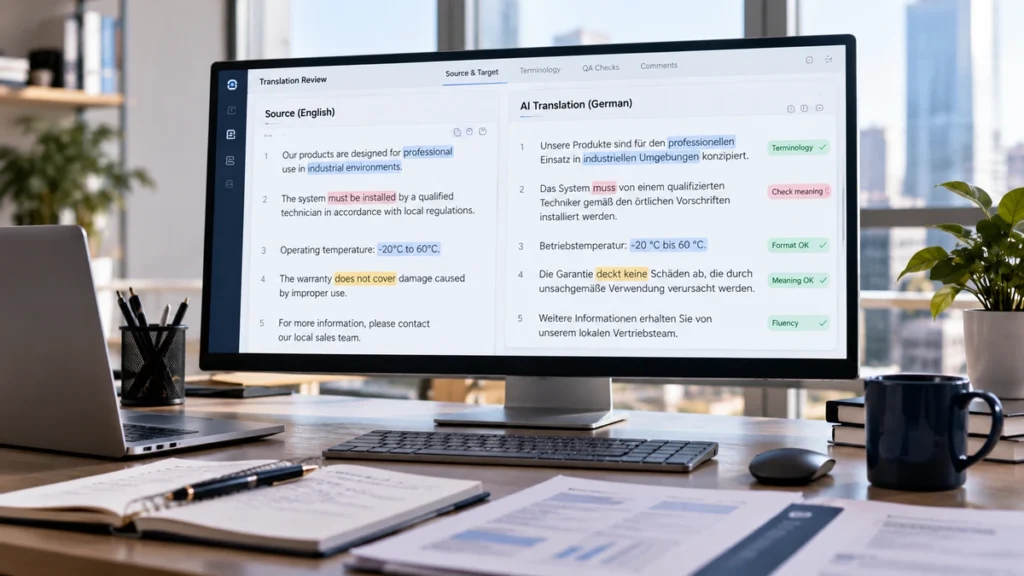
Generative AI can translate a product manual, adapt marketing copy, or produce multilingual content from a single set of instructions. The output may look polished enough to publish immediately. But natural language is not necessarily an accurate translation.
A model might omit a warranty condition, change a technical term, or introduce a claim that never appeared in the source. Such errors can be difficult to spot when the target text reads fluently.
For enterprises, the question is not simply whether large language models (LLMs) can translate. It is where their flexibility creates value, what can go wrong, and which safeguards make the results suitable for business use.
What Is Generative AI Translation?
Generative AI translation uses large language models to produce translations from source content, often guided by context, terminology, audience requirements, and style instructions. Unlike systems designed primarily for translation, general-purpose LLMs can combine translation with other language tasks, including rewriting, summarization, and adaptation.
Tools such as ChatGPT demonstrate this flexibility. A user can provide source text, identify the target audience, request a particular level of formality, and supply terminology preferences within the same interaction.
However, generating a plausible translation is different from verifying that it faithfully represents the source.
For enterprise use, LLM translation must be evaluated against source meaning, approved terminology, document completeness, target-locale requirements, and the consequences of errors.
The distinction matters most when translated content will guide customer decisions, support technical operations, or become part of an organization’s official communications.
How Does LLM Translation Differ From Dedicated NMT?
Neural machine translation (NMT) and large language model translation both use neural networks, but they are not necessarily optimized for the same tasks.
Dedicated NMT systems focus on translation between languages. General-purpose LLMs support broader language generation and can incorporate translation instructions alongside contextual material.
This gives LLMs useful flexibility. An organization may ask a model to maintain a specific brand voice, explain ambiguous wording, or adapt language for a defined audience without building a separate model for each task.
Yet flexibility does not guarantee better translation.
Dedicated NMT may remain preferable for predictable, high-volume content, while an LLM may be useful when context or controlled adaptation matters. Performance also varies by language direction, domain, model, and implementation.
Microsoft’s guidance on LLMs for translation discusses these operational differences.
For a broader comparison, see AI Translation vs Machine Translation.
Where Generative AI Translation Adds Value
Context Helps Resolve Ambiguous Meaning
A word rarely has only one possible translation.
Consider the English word “port.” In logistics documentation, it may refer to a maritime facility. In software documentation, it may describe a network connection. The surrounding material determines the intended meaning.
LLMs can use information such as product descriptions, previous paragraphs, audience profiles, and domain terminology to interpret ambiguous expressions.
This can be particularly useful when translating product information, customer-support content, and material containing references across sentences.
The quality of that context still matters. Missing, outdated, or irrelevant information may encourage the model to make an incorrect interpretation.
More context should improve the opportunity for correct interpretation, not be treated as proof of correctness.
Instructions Enable Controlled Style Adaptation
Generative AI can also follow instructions about tone, formality, and presentation.
For example, a global marketing team might request:
- A professional, restrained tone for enterprise buyers.
- Consistent use of approved product terminology.
- Natural phrasing for the target market.
- Preservation of numerical claims and technical specifications.
- No additional promises, benefits, or unsupported statements.
These instructions can help produce translations that align more closely with brand expectations.
However, style adaptation introduces another risk: the model may improve readability by changing the underlying message.
A translation instruction should therefore distinguish between permitted linguistic changes and information that must remain unchanged.
For controlled marketing localization, the objective is not merely natural copy. It is natural copy that preserves approved claims, product positioning, and intended meaning.
The Biggest Risk: Fluent Translation That Changes the Source
The most consequential LLM translation errors are not always grammatically obvious.
A translation may sound convincing while omitting a condition, exaggerating a benefit, or introducing information absent from the original.
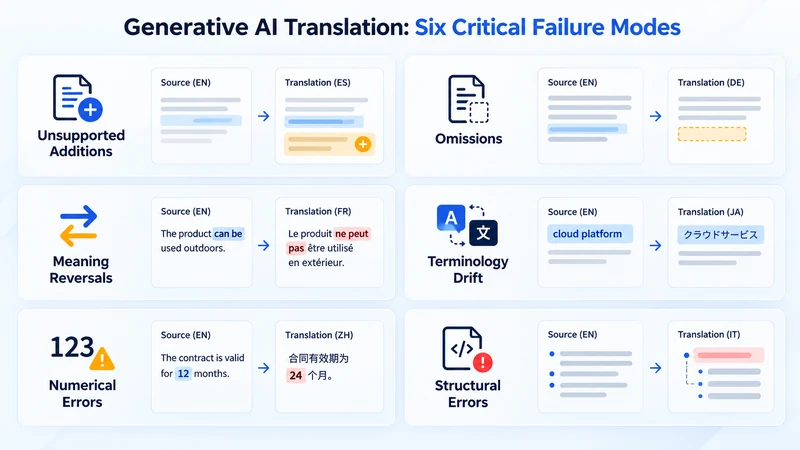
Unsupported Additions, Omissions, and Meaning Reversals
Consider this illustrative source statement:
Replacement is available only when the claim is submitted within 30 days and the original receipt is provided.
An inaccurate translation might convey:
Customers can request a replacement within 30 days.
The second sentence sounds reasonable, but it removes the receipt requirement and weakens the conditional nature of the policy.
An LLM might also introduce a product capability that was not stated, interpret a possibility as a guarantee, or change a negative instruction into a positive one.
These failures are especially dangerous because the resulting text may be stylistically polished.
Research continues to investigate this problem. The 2026 paper STAR: Sentence Translation Alignment Rate for Document-to-Document Machine Translation examines omissions and unsupported generation in document-level translation.
Common LLM Translation Failure Modes
| Failure Mode | Typical Problem | Recommended Detection |
|---|---|---|
| Unsupported addition | New claim or qualification appears | Source–target comparison |
| Omission | Condition, sentence, or exception disappears | Coverage and alignment checks |
| Meaning reversal | Negation or obligation changes | Bilingual accuracy review |
| Terminology drift | Product terms change across sections | Approved terminology validation |
| Numerical distortion | Amount, unit, or threshold changes | Numerical QA |
| Structural error | Placeholder, footnote, or tag is altered | File and markup validation |
| Locale mismatch | Wrong regional terminology is used | Target-locale review |
These categories align with established translation quality concerns, including those addressed by the MQM error typology.
The practical lesson is that fluency review and accuracy review are different activities. A reviewer who reads only the translated output may miss a serious change in meaning.
Why Long-Document Translation Remains Challenging
A large context window allows an LLM to process more information, but it does not guarantee that every sentence, table, or cross-reference will be translated correctly.
Long documents create multiple challenges.
A technical term introduced early in a report may be translated differently several sections later. A paragraph may refer to a definition established on a previous page. Tables, captions, footnotes, and warnings must remain connected to the correct source material.
Output limits, file extraction problems, and chunk boundaries can introduce further omissions or structural errors.
For example, translating a product manual in separate chunks may create conflicting translations of the same component name. Translating the entire manual in one operation may make missing sections harder to detect.
A controlled AI document translation workflow should therefore preserve document structure, track source-to-target coverage, share approved terminology between segments, and validate the reconstructed file.
Human reviewers also need access to the complete source document, not merely isolated translated paragraphs.
Document-level reliability requires both linguistic consistency and structural verification.
Five Practical Uses of Generative AI Translation
The strongest applications are those where the model’s flexibility provides a clear benefit and the organization can manage the remaining uncertainty.
| Use Case | Potential Benefit | Essential Safeguard |
|---|---|---|
| Draft translation | Produces an editable starting version | Appropriate bilingual review |
| Internal content | Supports multilingual understanding | Confidentiality and accuracy controls |
| Marketing adaptation | Adjusts register and audience fit | Approved claims and brand review |
| Summarization-assisted workflow | Helps identify important content for reviewers | Separate summary from translation |
| Terminology preparation | Suggests candidate terms and definitions | Terminologist approval |
Draft Translation and Internal Understanding
An LLM-generated draft can support professional translators by providing an initial version for evaluation and correction.
It may also help authorized employees understand routine internal material when perfect publication quality is unnecessary.
However, internal distribution does not automatically make content low-risk. Confidential documents, operational instructions, and material used for consequential decisions may still need strict controls.
Adaptation, Summarization, and Terminology Work
Generative AI can help marketing teams explore alternative wording while preserving defined information.
It can also summarize source documents to support project preparation, identify ambiguous expressions, and suggest terminology candidates for expert review.
These tasks should remain distinct.
A summary is intentionally selective. A translation is generally expected to preserve the information required by its specification. Using a summary as though it were a complete translation can create serious information gaps.
Likewise, an automatically generated terminology list is a draft resource, not an approved glossary.
Which Content Requires Stronger Safeguards?
Not every translation carries the same consequences.
An awkward phrase in an internal presentation is different from an incorrect safety instruction or an altered contractual obligation.
Organizations should classify content according to error consequences, audience, confidentiality, and release requirements before selecting an AI workflow.
| Content Type | LLM Suitability | Recommended Review |
|---|---|---|
| Routine internal reference | Conditional, often useful | Risk-appropriate checks |
| Marketing content | Useful for drafts and adaptation | Brand and linguistic approval |
| Technical documentation | Conditional on tested reliability | Technical and bilingual review |
| Contracts and financial disclosures | Restricted, controlled assistance | Qualified specialist approval |
| Medical or safety-critical instructions | Only within specifically authorized, validated workflows | Domain-specialist verification |
| Confidential business documents | Depends on approved data environment | Security authorization plus linguistic controls |
This matrix is a practical decision aid, not a universal industry classification.
Content may be relatively simple to translate but too confidential for an unapproved platform. Conversely, publicly available information may still require intensive review because an error could cause harm.
For broader guidance on assigning translation methods by content risk, see Localization Workflow by Content Type.
Why Prompting Alone Is Not a Quality System
A carefully constructed prompt can guide LLM behavior, but instructions do not guarantee compliance.
A model may still ignore a terminology preference, omit a sentence, or interpret a stylistic instruction too broadly.
Reliable enterprise workflows need controls that operate before, during, and after generation.
Language Assets and Retrieval-Based Context
Translation memory, approved glossaries, style guides, and validated reference documents provide an organization’s existing language knowledge.
For example, an approved glossary may specify that a product feature must retain the same name across documentation, websites, and customer-support materials.
These assets can be supplied through prompts, integrated terminology systems, or retrieval-based context augmentation.
Retrieval can bring relevant product definitions and previously approved translations into the model’s working context.
However, retrieved material can also be outdated, irrelevant, contradictory, or untrusted.
The workflow must establish which resources are authoritative, resolve conflicting terminology, and prevent untrusted reference text from overriding translation instructions.
A glossary included in a prompt is also not equivalent to an independently enforced terminology constraint.
Controls Beyond Generation
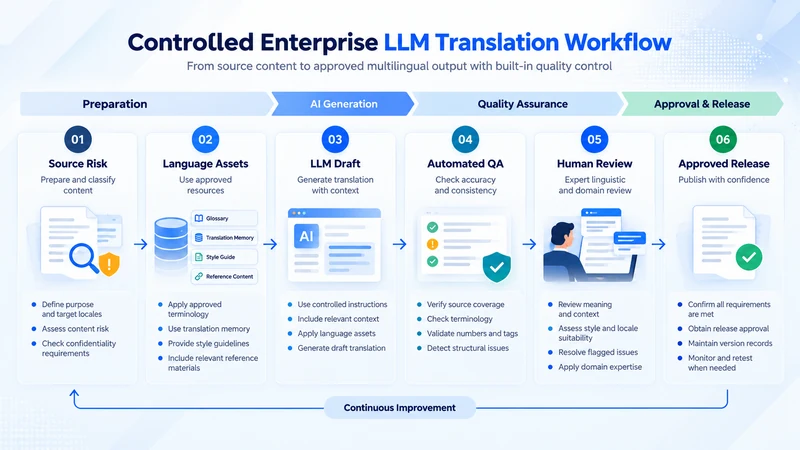
A practical enterprise AI translation workflow can follow six stages:
Source classification → Language assets → LLM generation → Automated QA → Human review → Release approval
Automated checks should identify missing content, numerical differences, terminology violations, altered placeholders, and file-structure problems.
Qualified reviewers then assess meaning, contextual suitability, and issues that automated checks cannot reliably resolve.
Finally, the organization needs documented acceptance criteria and an accountable release owner.
The purpose is not to add review steps indiscriminately. It is to ensure that the workflow can detect and correct errors that matter to the intended use.
Data Privacy: Public Chatbots vs Enterprise AI Translation
Data protection is a separate requirement from linguistic accuracy.
A model might produce excellent translations while operating in an environment that an organization is not authorized to use for customer records, contracts, or proprietary information.
Public chat interfaces, managed enterprise workspaces, APIs, and specialized translation platforms can have different policies and technical controls.
For example, OpenAI’s ChatGPT data controls documentation distinguishes personal-account settings from managed business workspaces. Its API data controls documentation separately addresses training use, retention, application state, and eligible data-retention configurations.
These distinctions illustrate an important principle: not using customer content for model training does not necessarily mean that no content is retained or processed elsewhere.
Before approving an LLM translation environment, procurement and security teams should establish:
- Whether submitted content may be used for model training.
- How long inputs, outputs, uploaded files, and logs are retained.
- Which users, administrators, providers, and subprocessors may access the data.
- Where processing and storage occur.
- Whether deletion, audit, and contractual requirements can be met.
- Which integrations or external services receive document content.
Organizations processing personal data must also evaluate applicable legal obligations, including GDPR requirements where relevant.
No product should be considered automatically suitable for confidential translation solely because it carries an enterprise label.
How to Evaluate LLM Translation Quality
An impressive demonstration is not sufficient evidence for production deployment.
Enterprises need repeatable evaluation using representative source content, relevant language directions, and clearly defined quality expectations.
Test Source Fidelity Separately From Fluency
A strong test set should include routine material alongside difficult examples: ambiguous wording, negation, numerical conditions, specialized terminology, cross-references, and long documents.
Human evaluators should assess whether the translation accurately represents the source—not merely whether it sounds natural.
ISO 5060:2024 provides guidance for human evaluation of translation output, including error-based assessment, evaluator competence, and sampling.
The MQM framework offers categories for identifying accuracy, terminology, linguistic, style, locale, and structural issues.
Organizations can use these approaches to develop project-specific severity definitions and escalation rules.
Measure Production Readiness
Evaluation should compare an LLM workflow against an appropriate baseline, such as an existing approved translation process or dedicated NMT workflow.
Useful measures include:
- Critical and major source-fidelity errors.
- Terminology compliance.
- Document completeness and structural integrity.
- Human correction effort.
- Repeatability across representative inputs.
- Security and operational acceptance.
- Total cost of approved deliverables.
Automated quality metrics can support evaluation, but should not be the only release criterion. An LLM should not be trusted to certify its own output without independent validation.
A 2026 study, The Blindness of Document-Level Translation Evaluation, also highlights limitations in evaluation protocols that do not adequately capture cross-segment consistency.
For deeper methodology, see Localization Quality Metrics.
What Does Generative AI Translation Actually Cost?
The price of generating translated text is only one part of the total cost.
LLM-based systems may charge according to processed input and output tokens. Repeated instructions, long reference documents, retrieval, and additional processing passes can affect consumption.
Other costs arise from preparing source files, maintaining terminology, integrating systems, checking output, correcting errors, reconstructing documents, and meeting security requirements.
A low generation cost can become unattractive if extensive rework is required. Conversely, a more expensive initial model may be justified if it measurably reduces subsequent editing without creating unacceptable risks.
The relevant purchasing metric is therefore total cost per accepted deliverable, not simply cost per generated word.
Procurement teams should compare complete workflows using the same source material, approval requirements, and cost boundaries.
How to Run a Controlled Enterprise LLM Translation Pilot
A controlled pilot allows an organization to test generative AI on its own content before committing to large-scale deployment.
Step 1: Define a Narrow Use Case
Select a specific content category, language direction, audience, and intended use.
Avoid evaluating an entire multilingual content portfolio in one undifferentiated experiment.
Step 2: Establish the Baseline
Collect representative source documents and compare results against the currently approved workflow.
Include difficult examples instead of relying only on short, straightforward text.
Step 3: Fix the Test Configuration
Record the model or service version, instructions, terminology resources, retrieval configuration, data environment, and review requirements.
Without configuration records, results may be difficult to reproduce.
Step 4: Evaluate Quality and Operational Effort
Use qualified bilingual reviewers to classify errors and record correction effort.
Check terminology, completeness, formatting, and other document requirements independently.
Include security and cost evidence in the same evaluation.
Step 5: Apply Acceptance Criteria
Use predefined rules to determine the result.
Go: The workflow satisfies mandatory quality, security, cost, and operational requirements.
Revise and retest: Correctable issues remain, but a revised workflow may be viable.
Reject: Critical risks, unacceptable errors, or operational constraints make the workflow unsuitable for the intended use.
Step 6: Monitor Production Changes
A successful pilot does not guarantee that future model versions, language pairs, or content types will perform identically.
Material configuration changes and new use cases should trigger proportionate retesting.
ISO 11669:2024 provides relevant guidance on translation project specifications, needs analysis, risk assessment, and workflow planning.
Generative AI Translation Production Checklist
Before releasing an LLM-assisted translation workflow, verify the following:
- Source documents and target locales are clearly defined.
- Content risk and confidentiality have been classified.
- The translation environment is authorized for the data involved.
- Model configuration and instructions are documented.
- Approved terminology and reference materials are available.
- Source completeness, numbers, and protected elements are checked.
- Qualified human review is assigned where required.
- Critical errors have a defined escalation procedure.
- Quality and total production cost meet acceptance criteria.
- Release ownership, traceability, and retesting rules are established.
A workflow should move into production only when the controls match the consequences of potential errors.
FAQ
Can ChatGPT Translate an Entire Business Document Reliably?
ChatGPT can support document translation, but completeness, consistency, and formatting must be verified. Long documents may contain omitted sections or altered references. Reliability depends on the model, file-processing workflow, language pair, and review controls.
Why Can LLMs Invent Information During Translation?
LLMs generate language rather than mechanically transferring verified source units. They may introduce plausible but unsupported details, especially when interpreting ambiguity or following broad adaptation instructions. Source-aligned evaluation is necessary to detect these additions.
Can a Glossary Guarantee Consistent LLM Translation?
No. A glossary provides valuable terminology guidance, but prompt-based instructions may not be followed consistently. Reliable terminology control also requires approved resources, appropriate integration, independent checking, and review of exceptions.
Is Enterprise LLM Translation Safer Than Using a Public Chatbot?
Enterprise environments may offer additional contractual, administrative, and technical controls. However, security depends on the specific service, configuration, data flows, retention policies, and organizational requirements. Enterprise branding alone is not sufficient assurance.
How Can a Business Know Whether LLM Translation Is Worth Deploying?
Run a controlled pilot against an existing workflow. Compare source fidelity, serious errors, terminology compliance, human review effort, security acceptance, and total delivered cost. Expand only when results meet predefined requirements.
Where Generative AI Belongs in Enterprise Translation
Generative AI translation is most valuable when contextual flexibility, language adaptation, and workflow assistance solve a real business problem.
Its limitations are equally important. Fluent language cannot substitute for faithful meaning, an extensive prompt cannot replace quality assurance, and a successful pilot cannot eliminate the need for ongoing oversight.
Organizations should adopt LLM translation selectively, using approved language assets, measurable evaluation, secure processing, and human judgment appropriate to the content.
For teams developing controlled multilingual production workflows, Textsprime’s MTPE, AI Post-Editing & Translation Engine Solutions provide a relevant starting point for understanding how translation technology, quality evaluation, and professional review can work together.
The goal is not to generate more translations with less oversight. It is to produce reliable multilingual content through a workflow that can demonstrate why its output is ready to use.