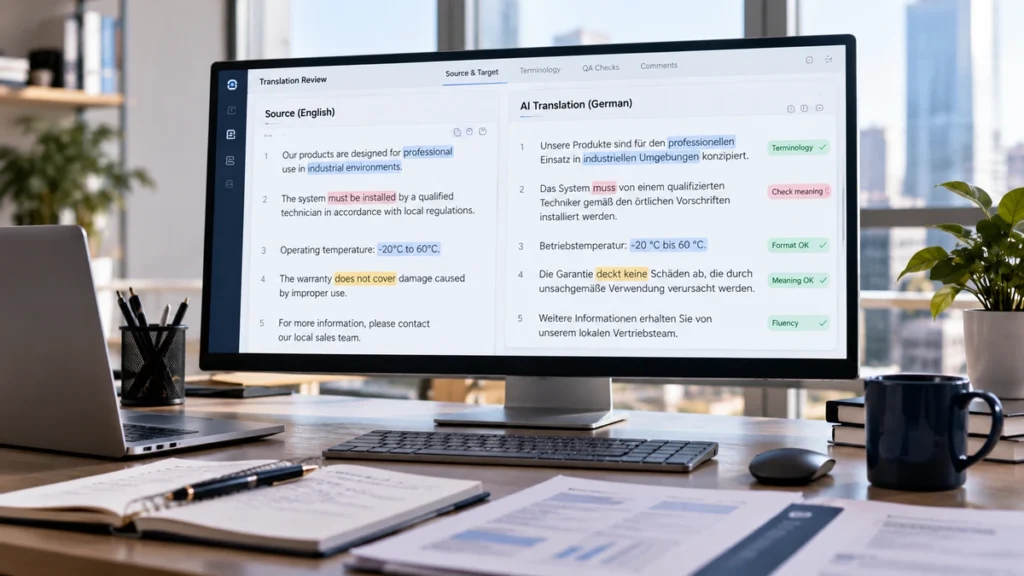
A company expanding into international markets may need to translate hundreds of product descriptions, customer support articles, software interfaces, legal agreements, and marketing campaigns.
Should every document go through a professional human translator? Can AI handle some content independently? Or is a combination of AI translation and human review the better choice?
The answer depends on more than translation accuracy.
Different content carries different business risks. A minor wording issue in an internal research summary may be acceptable, while an incorrect safety instruction, contractual obligation, or product claim could have serious consequences.
The most useful way to compare human translation vs AI translation is to determine which workflow fits each content type—not to declare one method universally better.
This guide compares the practical differences, explains five translation workflows, and provides decision matrices and a controlled testing framework for enterprise teams.
Which Is Better: Human Translation or AI Translation?
AI translation is generally most appropriate for low-risk content requiring speed and scale. AI translation with qualified human review can suit repetitive business content when its quality has been validated. Professional human translation is often preferable when specialist knowledge, complex context, or brand-sensitive judgment matters. High-consequence material may also require independent revision and subject-matter approval.
The decision is not limited to two options.
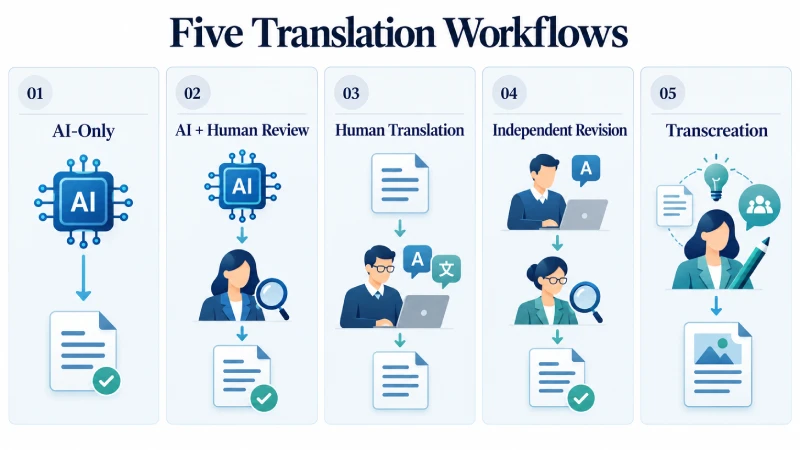
Businesses can choose among five workflows:
- AI-only translation: Automated output without routine linguistic review.
- AI translation + human review: AI-generated output checked or post-edited by qualified reviewers.
- Professional human translation: A qualified translator produces the target-language content.
- Human translation + independent revision: A second qualified professional checks the translation against the source.
- Transcreation: Language specialists creatively adapt messaging for the expectations of a target market.
These are different production models, not five consecutive quality levels. Transcreation, for example, prioritizes intended audience impact rather than strict textual equivalence.
The objective is to achieve fit-for-purpose translation quality while maintaining appropriate cost, speed, confidentiality, and accountability.
Human Translation vs AI Translation: Nine Practical Differences
AI translation can generate large quantities of multilingual text rapidly. Human translators contribute linguistic judgment, specialist knowledge, and the ability to clarify ambiguity.
However, neither approach guarantees acceptable results without the right inputs and controls.
| Factor | AI Translation | Professional Human Translation |
|---|---|---|
| Speed | Produces an initial draft rapidly; review may extend delivery time | Requires professional production time, scheduling, and potentially revision |
| Scale | Supports high-volume and recurring content, subject to system capacity | Depends on qualified linguist availability and workflow coordination |
| Context | Uses context supplied or accessible to the system; may misinterpret ambiguity | Can investigate context, ask questions, and interpret intended meaning |
| Terminology | Can use glossaries and instructions, but adherence needs validation | Can apply terminology while making context-sensitive decisions |
| Creativity | Can generate stylistic alternatives, but needs careful verification | Supports deliberate creative judgment and cultural adaptation |
| Predictability | Output depends on the model, settings, instructions, and input | Consistency depends on translator competence, specifications, and review |
| Confidentiality | Depends on provider contracts, deployment, and data-handling policies | Depends on confidentiality agreements, access controls, and supplier practices |
| Accountability | Requires defined human and organizational ownership | Responsibilities can be assigned to translators, revisers, and providers |
| Cost structure | Processing, software, integration, review, correction, and QA | Translation, project management, revision, and QA |
One important distinction is initial translation speed versus time to approved delivery.
An AI system may generate a translation almost immediately, but the business may still need several review rounds before publishing it. Conversely, a professional translator working with approved terminology and established reference materials may deliver content requiring relatively little rework.
Translation quality should therefore be assessed against the content’s intended use, not simply whether the first draft reads fluently.
Five Translation Workflows and the Human Role in Each
Choosing between a human translator and AI is easier when the actual production process is defined.
1. AI-Only Translation: For Low-Risk Comprehension
AI-only translation can be appropriate when the goal is to understand information rather than publish an authoritative translation.
Examples include reading publicly available foreign-language articles, monitoring general industry discussions, or translating non-sensitive internal notes for informal comprehension.
This workflow is most suitable when inaccuracies have limited consequences and users can recognize uncertainty or seek clarification.
It becomes less appropriate when recipients may treat the output as an official instruction, contractual statement, or verified technical document.
Decision rule: Use AI-only translation when the content is permitted for the tool, the consequences of errors are low, and formal approval is unnecessary.
2. AI Translation + Human Review: For Repeatable Business Content
This workflow combines automated translation with human verification.
It can suit product descriptions, recurring knowledge-base updates, structured business information, and selected website content.
However, human review must be defined clearly.
A reviewer might check only selected samples, examine terminology and critical facts, or perform full bilingual post-editing. These activities provide different levels of assurance.
Full post-editing requires checking the translated output against its source and correcting problems involving meaning, omissions, terminology, language, and other agreed requirements.
ISO 18587:2017 establishes requirements for full human post-editing of machine translation output and the competence of post-editors. It should not be interpreted as a blanket certification of every AI-assisted review workflow.
For more detail on these operational distinctions, see Textsprime’s MTPE, AIPE & Translation Engine solutions.
Decision rule: Use AI with human review when pilot results demonstrate acceptable quality and the correction effort remains commercially reasonable.
3. Professional Human Translation: For Specialist Judgment
Professional human translation places a qualified translator in responsibility for producing the target-language text.
It is particularly valuable when meaning depends on technical knowledge, cultural understanding, nuanced instructions, or the ability to resolve ambiguous source material.
For example, a technical translator may need to distinguish between a component’s operating capacity and its maximum permitted load. Both expressions might appear plausible without sufficient engineering context.
The translator can request clarification, consult reference materials, and apply approved terminology.
Human translation is not automatically error-free. Quality still depends on expertise, specifications, and verification.
4. Human Translation + Independent Revision: For Higher Assurance
Some projects justify a second qualified professional independently checking the completed translation against the source.
This additional revision can identify mistranslations, omissions, terminology problems, and inconsistencies that the original translator may have overlooked.
It is particularly relevant to high-consequence technical documentation, important legal materials, and certain medical or regulatory communications.
ISO 17100:2015 establishes requirements for professional translation services, including relevant processes and resources. Its scope excludes raw machine translation output followed by post-editing.
Independent linguistic revision may still need to be supplemented by legal, clinical, engineering, or regulatory approval.
Decision rule: Increase independent assurance when translation errors could have significant consequences and ordinary production checks are insufficient.
5. Transcreation: For Brand and Marketing Impact
Transcreation is appropriate when the objective is to preserve a message’s intended effect rather than reproduce its wording closely.
A slogan that relies on humor, cultural references, or wordplay may require substantial rewriting to resonate with another audience.
The creative specialist may change sentence structure, imagery, or expressions while retaining the approved brand position and essential claims.
That freedom should not extend to inventing product capabilities or altering legally significant statements.
Transcreation is therefore a distinct creative workflow—not a substitute for accurate translation where exact meaning is essential.
Which Translation Workflow Fits Your Business Content?
A single organization rarely needs one translation approach for every department.
Consider a manufacturer launching a product internationally. Product attributes may be suitable for AI-assisted translation with review, safety instructions may require specialist translation and independent revision, and advertising headlines may need transcreation.
The following table provides a starting point.
| Content Type | Recommended Starting Workflow | Main Considerations |
|---|---|---|
| Internal | AI-only for non-sensitive, low-risk comprehension | Confidentiality, intended use, and consequences of errors |
| Customer support | AI + qualified human review | Accuracy of instructions, terminology, and escalation |
| Ecommerce | AI + review for suitable structured information | Product specifications, claims, measurements, and purchasing decisions |
| Website | AI + review for routine information; human-led for critical messaging | Search intent, brand consistency, and commercial importance |
| Software | AI-assisted with contextual linguistic review | Interface context, placeholders, usability, and release testing |
| Marketing | Human translation or transcreation | Brand voice, persuasion, cultural relevance, and claims |
| Technical | AI + expert review for suitable routine material; human-led for higher-risk documents | Technical accuracy, instructions, and safety |
| Legal | Specialist human translation with independent revision where justified | Legal effect, confidentiality, jurisdiction, and recipient requirements |
| Medical | Specialist human translation with enhanced assurance where justified | Patient safety, clinical terminology, and applicable regulations |
These recommendations are not universal legal rules. The appropriate workflow depends on the specific document and its destination.
Why Content Classification Matters More Than Department Labels
Not every marketing asset requires transcreation. A straightforward event schedule may be translated through a controlled AI-assisted process.
Likewise, not every internal document is low-risk. Confidential financial forecasts, employee information, and safety procedures may demand stronger safeguards than publicly available website copy.
For multilingual websites, translation decisions also affect the customer experience and search visibility. High-value landing pages may need language specialists who understand the local audience’s terminology and search intent.
Google’s multilingual website guidance recommends separate URLs for language versions and appropriate hreflang annotations. These are implementation requirements separate from linguistic quality.
Google also identifies low-value, large-scale translated content produced primarily to manipulate rankings as a potential form of scaled content abuse. Using AI itself is not automatically a spam-policy violation.
For a fuller discussion of website scope, see Website Translation vs Localization.
A Risk-Based Decision Matrix: What Happens If the Translation Is Wrong?
The most important question in translation procurement is often not how fluent the result sounds, but what happens if it contains an error.
Three dimensions help determine the necessary assurance:
Impact: Could an error cause confusion, financial loss, contractual problems, reputational damage, or physical harm?
Detectability and reversibility: Can the problem be discovered and corrected before users rely on the incorrect information?
Exposure: How many people will encounter the translation, and how much authority will they assign to it?
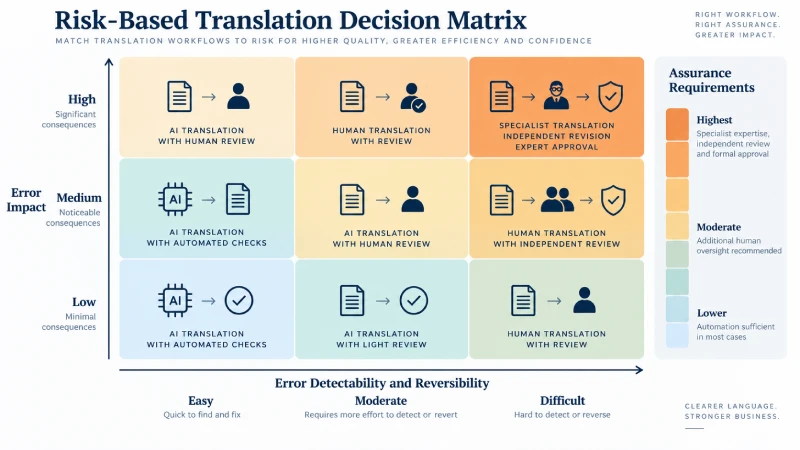
A practical starting matrix is:
| Error Impact | Easy to Detect and Reverse | Moderate Detectability | Difficult to Detect or Reverse |
|---|---|---|---|
| Low | AI-only may be appropriate | AI + targeted review | AI + qualified bilingual review |
| Medium | AI + human review | Full post-editing or human-led translation | Human-led translation with stronger assurance |
| High | Specialist human translation | Human translation + independent revision | Specialist translation + independent revision + relevant professional approval |
This is an illustrative enterprise decision framework, not a risk classification prescribed by ISO.
A mistranslated promotional description that can be corrected immediately is different from an incorrect maintenance instruction that may remain in circulation for years.
Risk evaluation should also account for who can detect an error. Fluent target-language text may conceal an omission or incorrect technical relationship from a reviewer who cannot read the source.
When consequences are high, competent source-aware review becomes especially important.
Why Language Pairs and Low-Resource Languages Change the Decision
AI translation accuracy is not uniform across languages.
A workflow that performs well from English into French cannot automatically be assumed to perform equally well from English into Japanese, Arabic, or an underrepresented language.
Translation direction also matters. Performance from Language A into Language B may differ from performance in the opposite direction.
Factors include available linguistic resources, grammar, writing systems, domain-specific terminology, and the particular system being used.
Research published in the ACL Anthology on low-resource translation documents challenges that vary with language resources, model behavior, and the availability of relevant linguistic context.
Locale Matters Beyond the Language Name
Businesses must also identify the intended locale.
For example:
fr-CAidentifies Canadian French.pt-BRidentifies Brazilian Portuguese.zh-Hantidentifies Chinese written in Traditional characters without specifying a particular region.
These identifiers follow language-tag conventions described by W3C and Unicode.
Locale differences may affect terminology, spelling, units, conventions, and audience expectations.
Practical recommendation: Validate workflows separately for every commercially important language direction and target locale, especially where linguistic resources or qualified reviewers are limited.
Two Controls That Deserve Special Attention: Brand Voice and Confidentiality
Preserving Brand Voice Across Languages
A translation can be grammatically correct while sounding inconsistent with the brand.
A company positioning itself as approachable and straightforward may not want overly formal messaging. A specialist industrial supplier may need precise, restrained language rather than exaggerated promotional expressions.
Both AI and human translators benefit from approved terminology, reference content, and multilingual style guidance.
For example, Microsoft’s localization resources illustrate how terminology and locale-specific style conventions can be documented.
The strongest approach is to define brand expectations before translation and involve qualified target-market reviewers where necessary.
A style guide can improve consistency, but it cannot replace local judgment about whether a message is persuasive, appropriate, or culturally relevant.
Protecting Confidential Business Information
Confidentiality is not simply an AI-versus-human question.
Before using an AI translation platform, organizations should evaluate the applicable agreement and settings concerning data retention, model training, access, subprocessors, processing locations, and deletion.
Professional human translation workflows also require appropriate confidentiality agreements, access restrictions, and secure file handling.
For organizations processing personal data, relevant data protection requirements may include contractual obligations between controllers and processors. The UK’s Information Commissioner’s Office provides guidance on these responsibilities.
Neither an AI product’s marketing claims nor a translation provider’s general assurances should replace a review of actual contractual and operational controls.
The Real Cost of Translation Includes Review and Rework
Comparing AI translation and human translation solely by the initial price can produce misleading procurement decisions.
AI generation may involve relatively low direct processing costs, but the business may still need qualified reviewers, corrections, formatting, technical QA, and additional approval cycles.
Human translation may carry a higher initial production cost but require less downstream correction for certain content.
The relevant measure is total cost per approved, usable translation.
A practical cost model is:
Total translation cost = Initial production + preparation + human review + correction + quality assurance + project management + ongoing updates
For digital content, integration, formatting, and testing may also be material costs.
Consider an ecommerce catalog requiring translation into several languages. If AI-generated descriptions repeatedly contain incorrect product terminology, reviewers may spend considerable time correcting individual entries.
For another language pair, the same system may follow the terminology successfully and reduce manual effort.
Neither outcome should be assumed without testing.
Useful procurement measurements include reviewer minutes per 1,000 source words, recurring error types, rework frequency, and time from submission to final approval.
The calculation should also consider business consequences where these can be responsibly assessed.
For a broader explanation of translation pricing structures, see Translation Services Cost: How Professional Pricing Works.
How to Run a Controlled AI vs Human Translation Pilot
A controlled pilot provides stronger evidence than a vendor demonstration or a general claim about accuracy.
The objective is to identify which workflow produces acceptable results for the organization’s actual content.
Step 1: Select Representative Content and Language Pairs
Build a sample covering the content types the business expects to translate.
Include short interface strings, longer paragraphs, technical terminology, ambiguous source sentences, and relevant file formats.
Test each important language direction and locale independently.
Exclude material that cannot lawfully or contractually be processed by a proposed tool.
Step 2: Compare Workflows Under Consistent Conditions
Provide the same source content, project brief, approved terminology, reference materials, and quality requirements wherever applicable.
Compare AI-generated translation, AI translation with qualified human review, and professional human translation. Include independent revision when that represents the intended production requirement.
Keep track of differences in workflow scope. Comparing raw AI output with independently revised human translation is informative only when those differences are made explicit.
Where practical, use qualified evaluators who do not know which workflow produced a particular sample.
Step 3: Measure Quality and Reviewer Effort
Evaluation should examine source fidelity, omissions, unsupported additions, terminology, fluency, style, locale conventions, and relevant technical requirements.
The Multidimensional Quality Metrics (MQM) framework provides a structured taxonomy for classifying translation errors.
ISO 5060:2024 also provides guidance for evaluating human translation, post-edited machine translation, and unedited machine translation output.
Record error severity, correction time, reviewer comments, and whether the translation satisfies its intended purpose.
Do not reduce all results to a single accuracy percentage without explaining the evaluation method.
Step 4: Establish Acceptance and Escalation Rules
Define acceptable outcomes before interpreting the results.
A workflow might be approved for routine product metadata but rejected for safety instructions because of serious omissions or terminology errors.
Critical problems should trigger escalation regardless of average performance.
The review policy should identify who can approve content, request corrections, or require a different production method.
Step 5: Compare Total Cost and Document the Decision
Evaluate the final approved output—not merely the first translation.
Track:
- Total delivery cost and completion time.
- Human review and correction effort.
- Quality issues by severity and category.
- Rework and additional approval cycles.
- Stakeholder acceptance and unresolved risks.
Create a workflow policy for each tested content class and locale.
Reevaluate when the translation system, language requirements, source content, or operational conditions change significantly.
ISO 11669:2024 provides useful guidance on translation project specifications, needs analysis, risk assessment, and workflow planning.
An Enterprise Decision Framework for Translation Buyers
Before selecting an AI translation service or professional translation provider, procurement and localization teams should answer five questions.
1. What is the content intended to achieve? Identify whether the purpose is internal comprehension, customer information, persuasion, contractual certainty, or safety-critical communication.
2. Which expertise is necessary? Specify the language direction, target locale, industry knowledge, and required terminology.
3. What level of assurance is appropriate? Define review responsibilities, independent revision needs, and any necessary subject-matter approval.
4. Can the workflow meet confidentiality and accountability requirements? Examine data handling, ownership, escalation, and documentation.
5. What did representative testing demonstrate? Compare quality, reviewer effort, rework, and total approved-deliverable cost.
A capable language partner should be able to explain the proposed production workflow, identify its limits, and define how quality will be verified.
The goal is not simply to purchase translated words. It is to establish a reliable process for producing multilingual content that meets the organization’s needs.
FAQ
Is AI translation as accurate as professional human translation?
There is no universal accuracy comparison. Results depend on the system, language pair, content complexity, professional expertise, and evaluation criteria. AI may perform well on suitable repetitive content, while specialist human judgment and revision can be important for context-dependent or high-consequence material.
Will AI replace human translators?
AI can automate many translation tasks and change how professional translators work. However, human expertise remains important for verification, specialist interpretation, creative adaptation, and accountability. The amount of human involvement required depends on the content and its consequences.
Can AI translate legal or medical documents?
AI may assist with permitted stages of legal or medical translation workflows, but suitability depends on confidentiality, accuracy, professional oversight, and applicable requirements. High-consequence documents often justify specialist translation, independent revision, and additional legal or clinical approval.
When is AI translation with human review preferable to human translation from scratch?
It may be preferable when content is repetitive, terminology can be controlled, qualified reviewers are available, and testing demonstrates acceptable quality with reasonable correction effort. If post-editing becomes extensive, human-led translation may be more practical.
How can a company test AI translation accuracy for a specific language pair?
Use representative source material, the exact target locale, qualified bilingual evaluators, and documented quality criteria. Measure errors by type and severity, record human correction effort, and compare final approved outputs across the workflows being considered.
Conclusion: Choose the Workflow, Not Just the Technology
Human translation and AI translation are not mutually exclusive business strategies.
AI can provide speed and scale. Professional translators contribute context, expertise, and judgment. Independent revision and subject-matter approval provide additional assurance where the consequences of errors justify it.
The best translation workflow is the one that consistently meets the content’s quality, risk, confidentiality, and business requirements at an acceptable total cost.
For organizations managing multiple content types and markets, Textsprime’s language translation solutions provide a starting point for exploring how language expertise, translation technology, and human review can work together.