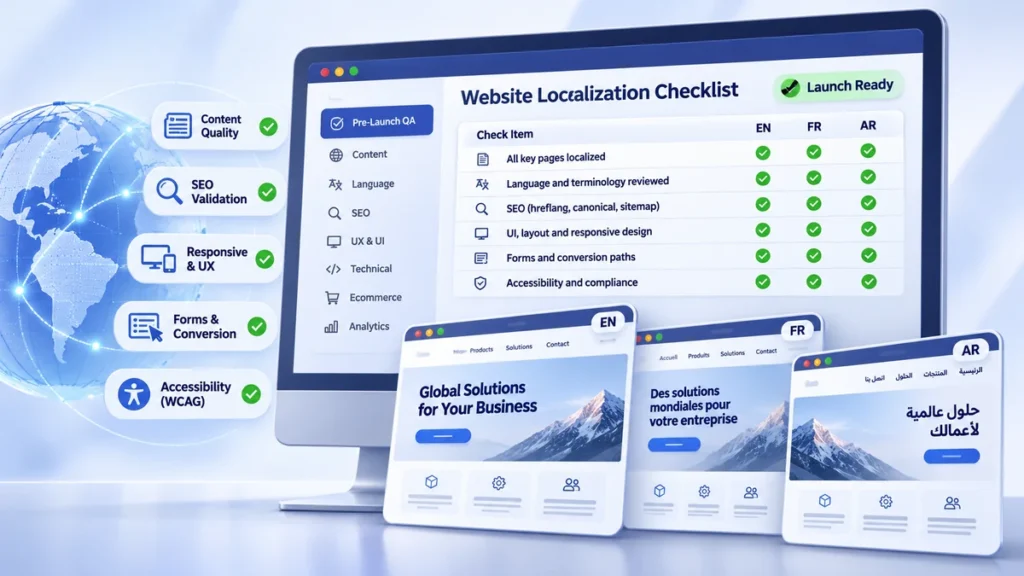
Website localization cost depends on more than translation volume. A complete budget includes language work, market-specific adaptation, technical implementation, multilingual SEO, design adjustments, quality assurance, and ongoing maintenance. There is no reliable universal price for localizing a website: an estimate must reflect the target locales, content inventory, existing technology, required user journeys, and responsibilities after launch.
The practical question is not simply How many words need translating? It is What must change for the website to work in each market?
How Much Does Website Localization Actually Cost?
Start with five components: language work + market adaptation + technical implementation + testing + maintenance. For procurement, allocate them across six budget categories—language, engineering, SEO, design, testing, and maintenance—without counting an activity twice.
A brochure-style website with stable pages may require content adaptation and limited template adjustments. A multilingual ecommerce platform may also need localized catalogs, search, checkout, transactional emails, integrations, and release testing. Scope matters more than page count.
Ask prospective suppliers for an itemized estimate, assumptions about the existing website, exclusions, and a separate view of initial and recurring charges. A project total cannot establish scope completeness.
Website Translation Cost vs Website Localization Cost
Translation and localization overlap, but their budgets answer different questions. Translation pricing primarily concerns producing accurate target-language content. Localization budgeting concerns making the complete website appropriate, discoverable, usable, and maintainable in a particular market.
| Budget dimension | Website translation | Website localization |
|---|---|---|
| Main deliverable | Target-language content | Market-ready website experience |
| Typical cost drivers | Volume, language pair, specialization, review | Content plus engineering, SEO, UX, QA, ongoing operation |
| Technical work | File preparation or publishing only if scoped | CMS, routing, components, integrations as needed |
| SEO | Specified text and metadata | Local research, URLs, implementation and verification |
| Testing | Language and content checks | Linguistic, visual, functional and SEO checks |
| After launch | Revised or new translations | Updates, systems support, monitoring and regression tests |
These are scope distinctions, not fixed supplier packages. Always check the statement of work. For a broader explanation of when each approach is appropriate, see website translation vs localization.
Build a Content Inventory Before Calculating Costs
Count more than published webpages
A sitemap misses content users encounter. Inventory navigation, buttons, form labels, validation messages, FAQs, pop-ups, downloadable PDFs, campaign landing pages, SEO titles, descriptions, image text, and automated confirmation emails. Ecommerce sites should also include product attributes, filters, stock messages, and transactional content.
Record each item’s source, owner, format, approximate volume, change frequency, and priority. Identify content stored in the CMS separately from strings in code, third-party widgets, or external product systems. Extraction and file preparation may need their own budget line.
Separate reusable and market-specific content
Not everything should be translated. Retire obsolete pages; reuse approved terminology and previously translated material; mark pages that require local examples, compliance review, or original market-specific writing. This avoids irrelevant work without neglecting buyer journeys.
How the Number of Languages and Locales Changes the Budget
A language is not always a sufficient specification. French for France (fr-FR) and French for Canada (fr-CA) can share substantial content but may need different terminology, commercial details, keyword research, and reviewer approvals. Portuguese for Portugal (pt-PT) and Brazil (pt-BR) present a similar planning decision.
Another locale can reuse infrastructure and translations while requiring new review, SEO, and maintenance. Costs therefore neither necessarily double nor remain constant with every new locale.
Create a locale matrix identifying what is shared, adapted, or written from scratch for each target market. Verify locale identifiers against the relevant standards and platform requirements rather than assuming a country code alone is sufficient.
Budget for Translation and Market Adaptation
Language expenditure covers more than generating a first draft. It may include terminology preparation, translation, independent review, specialist subject-matter checks, and adaptation of calls to action or persuasive messaging. A technical specifications page may need tightly controlled terminology; a homepage campaign may require creative rewriting.
Translation memory can reduce repeated language work when suitable approved matches exist, but savings depend on content and contract terms. Machine translation or AI-assisted workflows may also be appropriate for selected content. Evaluate the total effort, including setup, post-editing, quality review, and data protection—not just the apparent unit price.
Specify quality expectations by content risk. A low-impact knowledge-base update does not necessarily require the same workflow as a payment instruction or regulated claim. Detailed word-rate comparisons belong elsewhere.
Internationalization Readiness: The Hidden Engineering Cost
What developers may need to change
Internationalization (i18n) is the underlying ability of a website to accommodate different languages and locale conventions. As the W3C explains, it prepares a product for localization; it is not the localization itself.
Developers may need to externalize hard-coded strings, fix language routing, adjust templates, connect translation resources, and handle Unicode, dates, numbers, currencies, addresses, or plural forms correctly. Existing architecture determines whether these are configuration tasks or substantial code changes. Ask for a readiness audit before accepting a development estimate.
UI adaptation and right-to-left requirements
Translated text may expand, wrap differently, or break fixed-width buttons. Arabic and Hebrew interfaces can require right-to-left layouts and proper handling of mixed-direction numbers, URLs, and product codes. The W3C guidance on bidirectional text illustrates why text direction requires implementation and testing, not just translation.
Budget for component-level corrections and responsive checks, especially across shared headers, forms, navigation, and mobile layouts.
CMS, Connectors and API Integration Costs
A multilingual CMS may support language variants natively or through extensions. That does not establish the full project cost. Check licensing, content-field compatibility, plugin or platform limits, role permissions, publishing approval, media handling, and support obligations.
Manual export/import can work for small, infrequently updated sites. Frequent releases may justify a translation management system, CMS connector, or API workflow—but integration, mapping, testing, and exception handling cost money too.
Ask who maintains the connection after updates and who resolves failed imports, missing fields, or changed source content. Automation is a financial decision: compare the setup and operating cost with the recurring manual work it replaces.
Design, Graphics and Multimedia Localization Costs
Website graphics can contain embedded text, region-specific references, or screenshots of outdated interfaces. These assets may require new copy, redesign, image production, subtitles, or adapted downloads. Some visuals should be replaced rather than translated.
Estimate the number of unique assets and reusable design templates, not just the number of pages displaying them. Give designers editable source files where possible and include mobile checks and accessibility considerations. A reusable component correction should not be billed as a complete redesign of every page where it appears.
Multilingual SEO: Costs Beyond Translating Keywords
Market-specific search research
Search demand and terminology do not transfer automatically between languages. Budget for local keyword research, page-intent mapping, localized headings, metadata, internal linking, and decisions about whether a market needs new content rather than a translated source page.
Keep this work separate from basic linguistic translation in the proposal, while avoiding duplicate charges for the same copy-editing task. Assign an owner for local search performance and post-launch optimization.
Hreflang, URLs and technical validation
Google recommends distinct URLs for language versions. When suitable, hreflang annotations help Google understand related language or regional variants; they are not a ranking guarantee. Google supports implementation through HTML, HTTP headers, or XML sitemaps, subject to its documented requirements.
Technical SEO costs can include locale URL architecture, alternate annotations, canonical alignment, crawlable navigation, sitemap checks, indexing checks, and verification after releases. Simply translating a meta description does not complete multilingual SEO.
Ecommerce and Local Market Requirements That Increase Costs
Ecommerce adds operational dependencies
An ecommerce localization budget may involve product information systems, attributes, filters, regional product availability, currency presentation, taxes, shipping notices, payment methods, checkout, refunds, and order emails. The website’s commerce platform and integrations determine which requirements are configuration versus custom engineering.
Displaying a different currency is not the same as supporting transactions in that currency. Include functional testing with the relevant payment and market configurations.
Legal and market-specific pages need specialist ownership
Privacy notices, terms, returns, regulated product claims, warranties, and disclosure language may require jurisdiction-specific review. Translation does not make an underlying policy legally suitable for a new market.
Define who supplies legally approved source content, who adapts it, and who authorizes publication. External legal advice, if required, should be budgeted separately or explicitly assigned—not silently included under proofreading.
Budget for Four Types of Website Localization QA
QA should test the website as customers experience it, not just a spreadsheet of translated text.
- Linguistic QA: meaning, terminology, tone, completeness, variable handling, and in-context readability.
- Visual QA: overflow, broken layouts, typography, graphics, mobile responsiveness, and accessibility issues.
- Functional QA: language switching, links, search, forms, validation, checkout, notifications, and integrations.
- SEO QA: localized URLs, page language, metadata, indexability, canonicals, internal links, sitemaps, and
hreflangrelationships.
Define representative page types, devices, supported locales, severity levels, acceptance criteria, and retest responsibilities. A defect identified during QA may require a developer or content owner to fix it; confirm whether correction and retesting are included in the initial quotation.
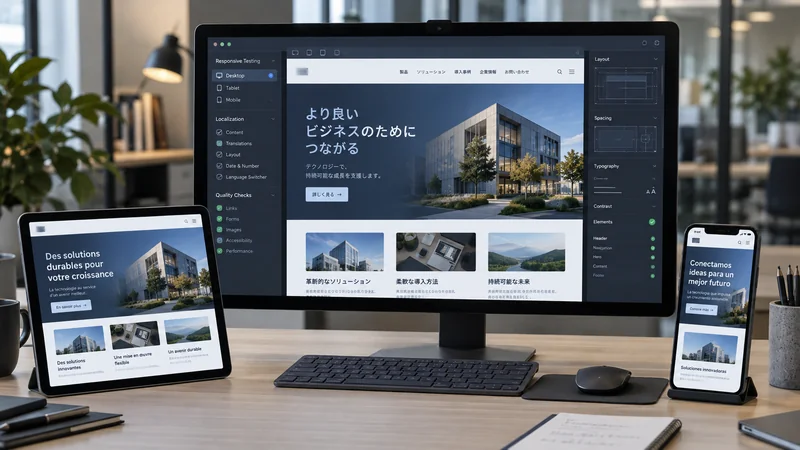
A Six-Category Website Localization Cost Model
Use six workstreams to turn an ambiguous estimate into comparable supplier and internal budgets.
| Category | What to budget | Practical estimating basis |
|---|---|---|
| Language | Translation, adaptation, terminology, review | Content volume, complexity, agreed workflow |
| Engineering | I18n, templates, routing, CMS and integrations | Scoped hours, deliverables, milestones |
| SEO | Local research, content optimization, technical setup | Pages, locales, specialist work packages |
| Design | UI changes, graphics, media and layout | Components, assets, design effort |
| Testing | Linguistic, visual, functional and SEO QA | Test cases, journeys, locales, devices |
| Maintenance | Updated content, subscriptions, monitoring, regression QA | Update frequency, software fees, support scope |
Build each estimate from quantities multiplied by agreed unit rates, or fixed fees attached to verifiable deliverables. Include internal staff time, coordination, specialist legal review, and contingency where applicable. Assign activities to one category only.
Initial project cost = launch language work + engineering + SEO + design + launch QA + other scoped expenses.
First-year total cost = initial project cost + first-year operating expenses.
A procurement comparison should show assumptions, included revision rounds, out-of-scope work, deliverable acceptance, billing units, and ownership of future fixes. A lower quotation may simply transfer more work to your internal team.

Three Website Localization Project Complexity Models
The following hypothetical models describe relative scope, not market-average prices or actual Textsprime quotations.
| Dimension | A: Small marketing website | B: Growing B2B website | C: Enterprise ecommerce or SaaS |
|---|---|---|---|
| Content | Mostly static pages | CMS pages, resources, forms | Large catalogs or application strings |
| Engineering | Existing multilingual templates | Integrations and several page types | Complex systems and release dependencies |
| SEO | Priority pages and locale URLs | Country-specific journeys and content | Larger inventories and governance |
| Testing | Main pages and contact forms | Multiple templates and conversion paths | Transactions, roles, releases and regression |
| Operations | Occasional updates | Regular publishing | Continuous changes across teams |
Model A: Cost is often dominated by language work and content publishing if the website is already localization-ready. Verify that forms and basic SEO are included.
Model B: More stakeholders, content types, lead-generation journeys, and regional SEO decisions create coordination and testing needs. Set explicit approvals for local market content.
Model C: Engineering, system integrations, complex UX, and repeatable QA can become major workstreams. The operating model matters as much as the launch.
A complex small site can exceed a standardized large site in implementation effort; these are not pricing tiers.
One-Time Costs vs Ongoing Website Localization Costs
Separate foundation work from the activities that recur every time the website changes.
| Initial investment | Ongoing expense |
|---|---|
| Content audit and locale planning | New-page and changed-content localization |
| I18n fixes, templates and integrations | Software subscriptions and technical support |
| Launch translation and market adaptation | Language reviews and terminology upkeep |
| Initial SEO configuration | Search monitoring and page updates |
| Launch testing and defect correction | Release-based regression and SEO QA |
For a reliable localization budget, estimate your expected update frequency, product releases, campaign schedule, and approval capacity. Define how source changes trigger downstream localization and how obsolete localized pages are handled.
This is the economics of continuous localization: recurring content flows need predictable ownership, reuse, monitoring, and quality control. A launch-only quote may be accurate for the launch yet inadequate for first-year planning.
Website Localization Budget Planning Checklist
Before requesting comparable proposals, confirm:
- Markets: Target languages, regional variants, and phased priorities are documented.
- Inventory: Pages, strings, metadata, files, emails, and assets are counted.
- Content treatment: Translate, adapt, create, reuse, or exclude decisions are recorded.
- Technical audit: CMS, code, routing, integrations, and accessibility requirements are understood.
- SEO: Research, metadata, URL architecture, and validation responsibilities are allocated.
- Quality: Linguistic, visual, functional, and SEO acceptance tests are specified.
- Commercial scope: Ecommerce journeys, legal reviews, and local business information have owners.
- Delivery: File formats, milestones, review cycles, and revision allowances are agreed.
- Ownership: Client, vendor, developer, and local reviewers have clear responsibilities.
- Maintenance: Update volumes, software fees, monitoring, and support are estimated.
- Comparison: Every proposal lists inclusions, exclusions, assumptions, and change-request rules.
Evaluate bids against the same work breakdown. If one supplier includes publishing and QA while another quotes translation files only, normalize the scopes before comparing totals.
How to Reduce Website Localization Costs Without Sacrificing Quality
The strongest savings usually come from avoiding unnecessary effort and rework:
- Launch priority journeys first. Localize the pages and functions that allow a target audience to evaluate, contact, or buy from you.
- Clean the source content. Remove duplicate, outdated, or inconsistent material before extraction.
- Design for reuse. Shared templates, terminology, translation memories, and content models reduce repeated work when appropriate.
- Choose technology proportionately. Do not buy and integrate an elaborate workflow for a small, rarely updated site; do not rely indefinitely on manual copying for a fast-changing one.
- Match review to risk. Use controlled automation where suitable, with stronger human and specialist review for consequential content.
- Fix defects at the source. Repair shared components or source strings before reproducing problems across locales.
Compare projected savings with setup fees, operating costs, additional review, and risk. Cutting essential checkout or SEO testing may lower the launch invoice while increasing later remediation costs.
When a Professional Localization Team Becomes Valuable
Professional coordination becomes particularly useful when multiple locales, technical integrations, market reviewers, specialized terminology, and release schedules must stay aligned. The right team should define handoffs and acceptance criteria with internal developers and marketing owners—not merely deliver translated files.
If your project includes multilingual content, CMS workflows, market adaptation, and quality assurance, explore Textsprime’s website localization services to understand the available support and the information needed to scope a project responsibly.
FAQ
Is website localization more expensive than website translation?
A localization project may include engineering, SEO, design, functional testing, and maintenance that a translation-only quotation excludes. Compare the specific deliverables, not the labels or headline prices.
Do I need a developer to localize a website?
Not always. Some localization-ready CMS sites need mainly configuration and publishing support. Custom routing, hard-coded strings, integrations, complex forms, or RTL interfaces may require developer work.
How much does it cost to maintain a localized website?
Maintenance depends on update volume, supported locales, workflow, subscriptions, search monitoring, and retesting requirements. Request a separate recurring-cost estimate rather than assuming the initial translation budget covers future releases.
Can AI translation reduce website localization costs?
It may reduce some language-production effort for suitable content, but outputs can require review and technical validation. It does not remove engineering, market SEO, design, legal review, or functional testing costs. Evaluate tool privacy and data-use terms before processing sensitive material.
What is needed for an accurate website localization quotation?
Provide target locales, a content inventory or representative export, CMS information, technical constraints, required user journeys, SEO goals, quality requirements, expected update frequency, and launch priorities. Ask for a workstream-level estimate that distinguishes one-time expenses from ongoing commitments.