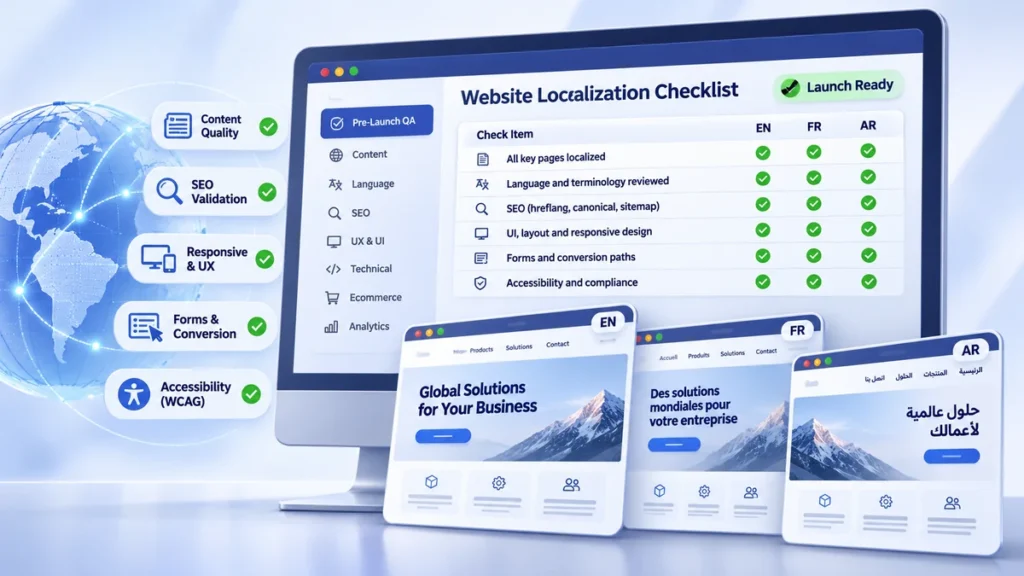
A website translation company can deliver accurate sentences and still leave your international launch with broken forms, untranslated interface messages, inconsistent SEO metadata, or pages your team cannot update. For a business website, translation quality matters—but so does what happens between content extraction and a visitor completing an enquiry or purchase.
To choose a website translation company, first decide whether you need translation or full localization. Then verify its target-market expertise, compatibility with your CMS, multilingual SEO capabilities, content coverage, terminology and QA processes, AI and security policies, ongoing update workflow, and asset ownership terms. Test shortlisted providers on a representative website pilot before committing to a larger rollout.
This guide shows what to ask, what evidence to request, and how to compare providers on equivalent terms.
1. Define the Website Scope: Translation or Full Localization
Before contacting vendors, decide what the target-language website must actually do. An informational page that communicates a standard corporate policy may need careful translation. A lead-generation website entering a new country may also need local keyword research, appropriate calls to action, regional formatting, functional forms, and market-specific review.
| Decision point | Translation-focused project | Localization-focused project |
|---|---|---|
| Main goal | Communicate existing content accurately | Make the wider website relevant and usable in a target market |
| Typical content | Pages, navigation, selected assets | Content plus forms, UX, SEO, formats, and customer journeys |
| Technical scope | Extract and reintegrate agreed text | Potential CMS, routing, layout, and integration changes |
| Key acceptance test | Is the meaning correct? | Can local users find, understand, and use the site? |
Most websites need a combination. For example, a manufacturer might translate its company-history page but localize product landing pages and enquiry forms for Germany and Japan. This is a hypothetical planning example, not a customer case study.
Create a brief listing target locales, priority URLs, site functionality, content owners, and launch expectations. For a deeper scope comparison, see website translation vs localization.
2. Test Market-Specific Language and Industry Experience
“Supports German and Japanese” tells you little about a provider’s suitability for an industrial, financial, healthcare, or software website. Ask who will translate and review your content, whether they understand your sector, and which regional language conventions they will follow.
A useful sample should contain more than a generic homepage paragraph. Include product terminology, a marketing headline, a navigation label, and a call to action. Assess accuracy, audience-appropriate tone, terminology choices, and how the vendor resolves ambiguous source text.
Ask for relevant work samples that can be shared lawfully, reviewer qualifications, and a process for incorporating feedback from your in-market team. More general advice about evaluating language service providers belongs in How to Choose a Translation Company; website buyers need evidence tied to actual page types and user journeys.
3. Verify CMS and Website Architecture Compatibility
A vendor’s claim that it “works with WordPress” or “integrates with enterprise CMS platforms” needs qualification. Compatibility depends on your theme, plugins, page builder, custom fields, content models, APIs, permissions, and publishing process—not the CMS brand alone.
WordPress and CMS-Plugin Websites
For WordPress, request a demonstration using a representative page with custom fields, reusable blocks, menus, SEO fields, and form strings. Confirm whether the provider works through a multilingual plugin, structured exports, or another agreed process. WordPress’s own multilingual documentation describes different plugin models; it does not imply that every plugin can handle every custom website configuration.
Ask who creates translated pages, maintains page relationships, prevents source-language overwrites, and verifies changes on staging before publication.
Enterprise, Headless, and Custom Websites
For enterprise or custom environments, inspect content IDs, locale-aware fields, API or repository workflows, versioning, approval states, and fallback rules. A connector may support standard articles while missing product feeds or deeply nested components.
| Delivery approach | Useful when | Proof to request |
|---|---|---|
| File export and import | Content changes infrequently | Correct round-trip mapping of fields and formatting |
| CMS connector | Supported content types and workflows are available | Live demonstration using your actual configuration |
| API or repository workflow | Headless or custom sites require automation | Working locale mapping, approvals, and rollback |
| Proxy-based delivery | A managed external localization layer is being considered | Review of URLs, rendered pages, performance, ownership, and SEO controls |
Minimum test: export one real page, translate it, reimport it, preview it, and make a source-language update. If the workflow fails here, the full launch will not solve the underlying incompatibility.
4. Check Coverage Beyond Visible Page Copy
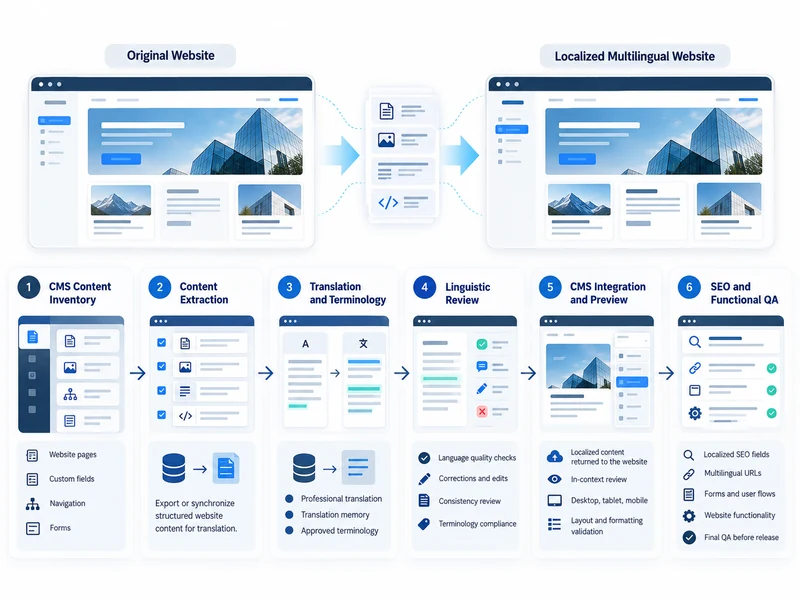
The text displayed in a CMS editor is rarely the entire website. A good website translation provider inventories content that visitors encounter throughout a journey, including strings stored in plugins, templates, databases, and third-party tools.
Forms, System Strings, and Transactional Messages
Check navigation, buttons, field labels, placeholders, error messages, consent notices, success confirmations, account emails, and downloadable documents. A translated “Contact Us” page is not complete if its form still rejects local phone formats or displays errors in the source language.
Dynamic Content and Third-Party Integrations
Product filters, dynamically generated descriptions, site search, booking widgets, help centers, and external customer systems may require separate extraction or integration. Determine which content the vendor can translate, which functions developers must adapt, and which third-party components cannot be changed without additional access.
Request a content coverage matrix showing each component, source location, target language, assigned owner, and test method. This simple document prevents small but commercially important elements from disappearing between teams.
5. Make Multilingual SEO a Verifiable Deliverable
A website localization company should understand that translating a page does not automatically make it relevant to local searchers. The provider must either deliver the agreed search-facing content and technical checks or clearly coordinate with the teams responsible for them.
Keyword Localization and Search Metadata
Ask how the team determines which terms potential buyers use in each market. An English product keyword may have several accurate translations, but only some may match local commercial search intent. For priority pages, request a target-language keyword map explaining term choices and page intent.
The scope should identify responsibility for SEO titles, meta descriptions, headings, URLs where applicable, internal anchor text, and relevant image descriptions. These are editorial deliverables; rankings and the exact snippets Google displays are not guaranteed.
Technical SEO, URL Architecture, and Launch Validation
Google recommends distinct URLs for different language versions. Its localized-version guidance explains how hreflang can identify alternatives. Ask who owns localized URLs, canonical tags, hreflang relationships, sitemap inclusion, indexability, redirects, and language-switcher links.
Locale codes deserve particular care: en-GB is appropriate for British English in Google’s hreflang, while en-UK is not. Broader locale identifiers used in software are not automatically valid Google annotations.
For JavaScript websites, the team must also examine whether localized content appears in crawlable, rendered pages. Google’s JavaScript SEO documentation explains the rendering considerations.
Require a written SEO responsibility matrix. The localization vendor might handle copy and metadata, your SEO team might approve keyword targeting, and developers might implement routing and technical signals. Every task needs an owner and an acceptance test.
6. Inspect Translation Memory, Terminology, and Linguistic QA
Translation memory (TM) stores previously translated segments for potential reuse. A terminology database records approved terms, definitions, and preferred usage. Both can support consistency as a site grows, provided they are maintained and reviewers understand the context.
Consistency Across Pages and Future Updates
Ask for a sample termbase, a TM update procedure, and an explanation of how approved terminology reaches translators. Check how the provider handles brand names, product models, measurement units, abbreviations, and changes to previously approved wording.
A matching TM segment is not necessarily correct in a new context. Require review where meaning, market, or interface constraints differ.
Quality Assurance That Goes Beyond Spell-Checking
Linguistic QA should address meaning, grammar, terminology, omissions, tone, and consistency. Technical checks should examine placeholders, links, HTML, numeric formats, and untranslated strings. Define how defects are classified, corrected, and accepted.
ISO 5060:2024 provides guidance on evaluating translation output, but it does not replace functional website testing. For a deeper look at severity and measurement, see localization quality metrics.
7. Demand In-Context Review and Developer Collaboration
A grammatically correct translation can still make a button overflow, hide a tab label, break a mobile menu, or confuse a user at checkout. Translation files alone cannot demonstrate readiness for publication.
Ask whether linguists can review a working staging environment or accurate screenshots. Test desktop and mobile layouts, text expansion, right-to-left behavior where relevant, accessibility-related labels, forms, confirmation messages, and the complete conversion journey.
Define a shared defect log with page URL, locale, screenshot, severity, owner, fix, and retest status. Developers should address layout and functional defects; linguistic reviewers should approve language corrections. The vendor does not need to employ every specialist internally, but the handoffs must be clear.
8. Examine Security, Confidentiality, and AI Use
Website exports may contain unpublished products, customer-facing messages, internal links, or personal data. Ask vendors to describe access controls, secure transfer, permissions, subcontractors, retention periods, and deletion procedures. For regulated or personal data, involve your privacy and legal teams before approving the workflow.
AI-assisted translation requires a specific written policy—not a generic assurance that the company “uses AI responsibly.” Ask which tools and account tiers are used, whether content can be used for model training, where it is processed, how long it is retained, and which content types receive human review.
Make approval conditional on your actual data classification and contractual requirements. A security certification or translation-service standard may support due diligence, but neither proves that every AI workflow, CMS connector, or project is compliant by default.
9. Assess Continuous Updates and Multilingual Scalability
A website launch is not the end of localization. Product information changes, campaigns expire, new articles appear, and existing claims require correction. The selection process should test what happens after the first publication.
Ask how the provider detects changed content, avoids retranslating unchanged material unnecessarily, manages terminology updates, and schedules releases across languages. Check whether editors can preview changes, delay publication, retire outdated pages, and issue urgent corrections without losing version history.
For a growing site, request a small update demonstration: revise a source page and follow that change through translation, approval, deployment, and QA. The appropriate localization workflow by content type may differ for SEO pages, technical documentation, and frequently updated product feeds.
10. Compare Quotes and Protect Your Localization Assets
The lowest price is not necessarily the lowest cost of delivering a working multilingual website. A translation-only quote should not be compared directly with one that includes keyword research, CMS configuration, developer coordination, and testing.
What the Website Translation Quote Includes
| Scope item | What to clarify before signing |
|---|---|
| Content inventory and linguistic work | What content, languages, and review levels are covered? |
| Keyword research and metadata | Are market research and on-page optimization included? |
| CMS integration and publishing | Who imports, previews, and releases localized pages? |
| Functional, visual, and SEO QA | Which devices, journeys, and checks are included? |
| Updates and technology charges | Which recurring fees, licenses, and change requests apply? |
| Handover | Which files, configurations, and language assets can be exported? |
Request itemized assumptions, exclusions, correction terms, and initial versus recurring charges. See the related website translation cost guide for detailed budgeting considerations.
Who Owns the Content, Translation Memory, and SEO Assets?
Specify contractual rights to approved translations, termbases, TM files, localized keyword maps, metadata, and deliverable exports. Ask whether materials can be provided in usable formats if you change vendors or tools, and whether third-party licenses restrict portability.
Ownership and access depend on negotiated terms; neither should be assumed from a subscription or per-word rate.
11. Interview Vendors and Run a Representative Website Pilot
A polished proposal is useful, but a pilot reveals how the provider works with your content and team. Use the same brief and evaluation criteria for each shortlisted supplier.
Questions to Ask a Website Translation Company
- Can you demonstrate an export-to-preview workflow in our CMS configuration?
- Which forms, custom fields, metadata, and dynamic components are included?
- Who performs local keyword research and verifies the technical SEO implementation?
- How are translators given page context and reviewer feedback?
- Which AI systems and subcontractors can access our content?
- How are update requests, defects, and asset exports handled?
- What work is excluded, and who is accountable for it?
What a Useful Pilot Should Prove
Select one important search landing page, an enquiry form with validation and confirmation messages, and a dynamic component. Where possible, test a market that presents meaningful linguistic or technical challenges.
Expect a localized preview, metadata and keyword decisions, a content coverage report, a defect log, and a clear account of what the vendor could not complete. Agree in advance whether the pilot is paid, who can reuse its outputs, and what constitutes acceptance.
12. Spot Website Translation Provider Red Flags
Treat the following as reasons to investigate further, not automatic proof of incompetence:
- “We support every CMS” without a demonstration in your environment.
- A quote based only on visible page word counts, with no discussion of forms or metadata.
- Guaranteed SEO rankings from translation alone.
- Unclear use of AI tools, subprocessors, or data retention practices.
- No plan for in-context QA or developer-reported defects.
- Unexplained recurring platform costs or limited export rights.
- No documented way to handle source-content changes after launch.
A credible provider should be comfortable describing limitations, responsibilities, and corrective actions.
13. Score Shortlisted Vendors with a Website-Specific Scorecard
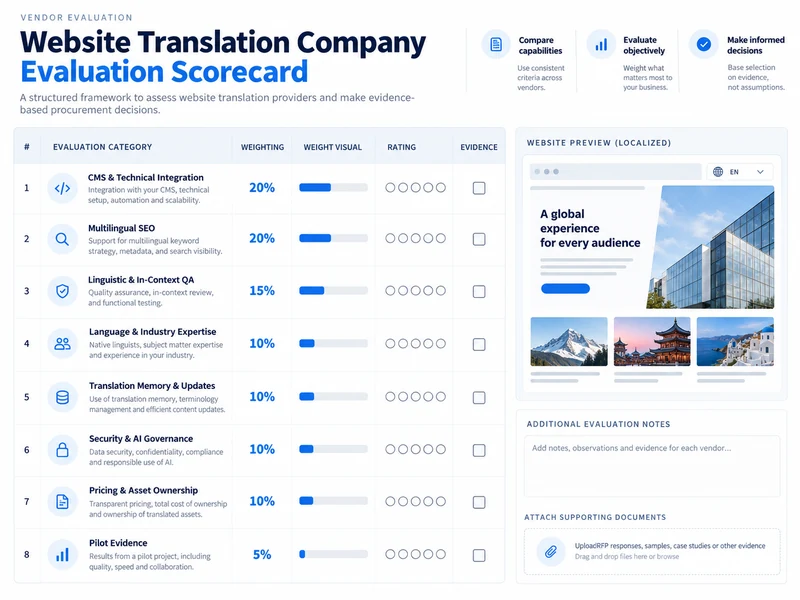
Use a consistent weighted scorecard after mandatory requirements have been checked. The example below is a suggested buying tool, not an industry benchmark.
| Evaluation criterion | Suggested weight |
|---|---|
| CMS and technical integration | 20% |
| Multilingual SEO capability | 20% |
| Linguistic and in-context QA | 15% |
| Target-market and industry expertise | 10% |
| Translation memory and updates | 10% |
| Security and AI governance | 10% |
| Pricing transparency and asset ownership | 10% |
| Pilot evidence | 5% |
| Total | 100% |
Rate each criterion from 1 (poor) to 5 (excellent). For each category, calculate (rating ÷ 5) × weight, then add the points for a score out of 100. Record the evidence behind each rating instead of scoring sales presentations alone.
Before ranking vendors, apply pass/fail gates for essential CMS compatibility, critical content coverage, acceptable security terms, workable SEO responsibilities, and agreed handover rights. A high weighted score should never override a failed critical requirement.
FAQ
Can a website translation company work with WordPress?
Yes, but ask it to demonstrate support for your specific WordPress setup, including page builders, custom fields, multilingual plugins, SEO fields, and forms. Platform familiarity is not the same as verified compatibility.
Who is responsible for multilingual SEO?
Responsibility should be assigned in the project scope. Linguists or localization specialists may handle keyword and metadata adaptation, while SEO and development teams manage URL structure, canonicalization, `hreflang`, and indexing checks.
Can a translation agency handle dynamic website content?
Potentially, if the content is accessible through supported exports, APIs, connectors, or agreed developer workflows. Ask for a representative test involving the relevant dynamic components.
Should we allow AI translation for our website?
That depends on the content, risk, and approved controls. Define permitted tools, confidentiality and data-processing terms, human-review requirements, and accountability for defects before production begins.
Can we change providers without losing our translations?
You can reduce migration risk by agreeing on ownership, access, portable export formats, and a handover process upfront. Confirm whether any third-party platform restricts access or reuse.
Is a paid website translation pilot worth considering?
For technically complex or commercially important sites, a scoped pilot can reveal integration and QA issues before a full commitment. Its value depends on realistic test content, documented acceptance criteria, and clear rights to the resulting work.
Choosing well means selecting a partner that can support the complete website experience—not simply supply translated words. If your team needs help defining the language and technical scope of a multilingual rollout, explore Textsprime’s website localization services.