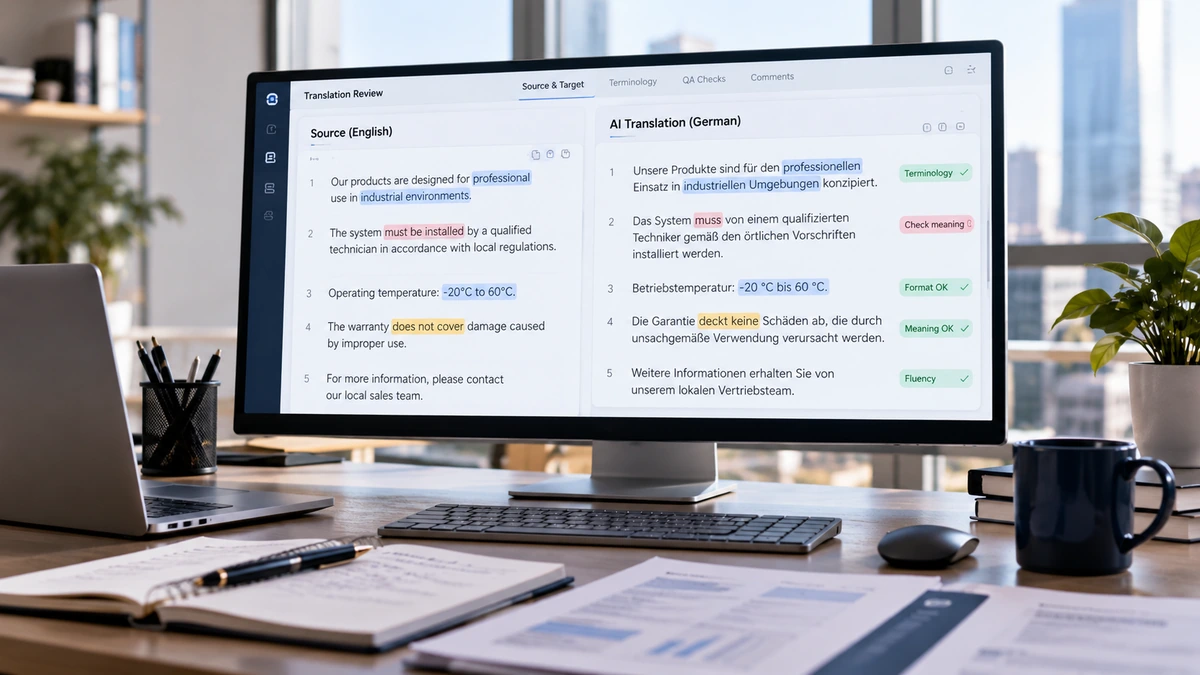
An AI-translated product description can read naturally while changing a technical specification. A customer-support answer can sound helpful while omitting an exception. For business teams, these are not merely language preferences: they can affect purchasing decisions, product use, and customer trust.
The useful question is not whether AI translation is generally accurate. It is whether a specific translation workflow produces dependable results for a particular language, document, audience, and level of business risk.
How Accurate Is AI Translation? The Short Answer
AI translation accuracy cannot be expressed as one universal percentage. Results depend on the language pair, content domain, source quality, available context, model, and evaluation method. A fluent translation can still omit important information or change critical details. Businesses should test representative content, assess errors with qualified bilingual reviewers, and apply human approval wherever mistakes could have significant consequences.
A high benchmark score can help identify promising technology. It cannot establish that a supplier’s system will handle your contracts, product specifications, or multilingual website correctly. If you need an introduction to the underlying technology, see what AI translation is and how it works.
What Does AI Translation Accuracy Actually Mean?
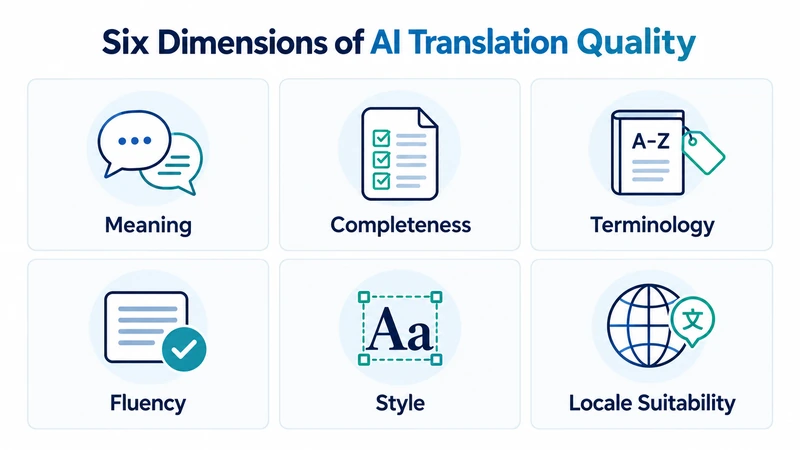
Business buyers often use accuracy to describe the overall quality of translated text. In a structured evaluation, however, different kinds of quality must be examined separately.
| Quality dimension | What reviewers should ask | Illustrative failure |
|---|---|---|
| Meaning | Does the translation preserve the source’s intended message? | “May be installed” becomes “must be installed.” |
| Completeness | Is information missing, duplicated, or added? | A warranty limitation disappears. |
| Terminology | Are technical and approved business terms correct? | The wrong component name appears in a manual. |
| Fluency | Is the target-language text clear and grammatical? | An instruction is awkward or difficult to follow. |
| Style | Does the language fit the brand, audience, and required register? | Formal procurement copy sounds excessively casual. |
| Locale suitability | Are regional wording and conventions appropriate? | A date or measurement format creates confusion. |
Examples are hypothetical and are not results from a Textsprime test.
These dimensions interact, but they are not equivalent. A translation may be grammatically excellent while reversing an obligation. Conversely, a faithful translation may need editing for readability or brand voice.
The Multidimensional Quality Metrics (MQM) framework distinguishes source-to-target accuracy from terminology, linguistic conventions, style, and locale-related issues. That distinction helps reviewers explain why an output is unsuitable instead of assigning one unexplained quality label.
For marketing adaptation, also establish whether the assignment is faithful translation or approved localization and rewriting. An intentional adaptation should not be mistaken for an accidental addition—or vice versa.
Why AI Translation Accuracy Studies Cannot Be Compared Directly
The Same Percentage Can Measure Different Outcomes
One study may count the proportion of sentences judged acceptable. Another may report an automated similarity score, a severity-weighted error score, or the percentage of documents containing no identified errors. These are different measures, even when each is presented as evidence of “accuracy.”
A useful example comes from a BMJ Quality & Safety study of machine-translated emergency-department instructions. Researchers evaluated 50 instruction sets containing 316 sentences, translated from English into Spanish, Chinese, and Russian using specified tools and a 2023 testing setup. The researchers examined both individual sentences and complete instruction sets. Their findings illustrate why relatively strong sentence-level performance does not remove the cumulative risk of mistakes across a document.
These were clinical instructions, not general business materials. The study cannot supply a universal accuracy figure for enterprise translation or establish how today’s versions of those systems will perform.
The Testing Conditions Determine What the Result Means
Before accepting a benchmark, ask what languages and directions were tested, which content types appeared in the dataset, whether evaluators saw document context, and how an error was defined. Also check the model version, prompt, glossary, reference translations, reviewer expertise, and testing date.
Research on expert human evaluation with full-document context has shown that different evaluation procedures can produce materially different system rankings. Two supplier scores are therefore not directly comparable unless their methods and content are sufficiently aligned.
What Factors Affect AI Translation Accuracy?
Language Pair and Available Language Resources
Performance can vary between language directions, even within the same language pair. Systems may have stronger training and evaluation coverage for widely used directions than for less-resourced ones. Regional variations introduce another requirement: a translation intended for one market may not use the wording expected in another.
A peer-reviewed study of multilingual translation hallucinations examined more than 100 language pairs and identified important differences across resource levels and translation directions. That finding supports testing each relevant language direction, rather than assuming quality transfers automatically from an English-to-European-language benchmark.
Domain, Source Quality, and Terminology
An engine that handles everyday correspondence competently may struggle with specialized manufacturing terminology, contractual conditions, or regulated product information. Ambiguous source wording, inconsistent abbreviations, faulty OCR, and poorly structured tables add uncertainty before translation begins.
Approved glossaries, translation memories, and reference documents can support consistency. But their presence is not proof that a system follows them. Test the terms that would cause real problems if rendered incorrectly, including product models, material specifications, and defined contractual terms.
Context and Document Length
Short software strings often lack clues about who is speaking or what a button does. Long documents introduce different risks: missing sections, drifting terminology, inconsistent pronouns, and incorrectly carried-over references.
Supplying context can help, but longer prompts or larger context windows do not guarantee completeness. For document translation, test the entire output against the entire source, not just selected polished sentences.
Model Type and Instructions
Dedicated neural machine translation systems and large language models approach translation differently. An LLM may also rewrite, summarize, or adjust tone when instructed; that flexibility becomes a liability if the requirement is strict fidelity. Detailed prompts can specify target locale, terminology, permitted adaptation, and preservation of numbers and formatting, but compliance still needs verification.
There is no defensible permanent winner between model types. For more background on LLM-specific capabilities and limitations, see generative AI translation.
Which AI Translation Errors Are Most Dangerous for Business?
Unsupported Additions, Hallucinations, and Omissions
An AI system may produce wording that is plausible but absent from the source, or leave out a condition that changes the reader’s interpretation. Hallucinations are not limited to visibly strange text. An invented technical feature or omitted exception can blend into an otherwise polished document.
Numbers, Names, Negation, and Technical Details
A reviewer should explicitly check quantities, units, prices, dates, model numbers, names, warning labels, and words that express obligation or prohibition.
Consider three hypothetical source-to-target changes:
- Negation: “Do not operate above 40°C” loses the word not.
- Commercial terms: “Payment is due within 30 days” becomes a 60-day condition.
- Product identity: A component designated “AB-120” is rendered as “AB-210.”
These examples are not evidence that a specific model made the errors. They illustrate why apparently small changes can carry disproportionate consequences.
Fluent Language That Fails the Business Context
An AI translation may preserve the basic facts but use an unacceptable regional term, inconsistent product vocabulary, or the wrong degree of formality. In a software interface, it may also break placeholders or exceed available space. Those issues call for terminology, market, and functional checks—not only proofreading.
How Can Businesses Measure AI Translation Quality?
Human Evaluation and Source-to-Target Review
Qualified bilingual reviewers should compare translated output against the source with enough context to understand the intended meaning. For specialized materials, linguistic competence may need to be combined with subject-matter expertise. Reviewers should follow agreed instructions, record concrete errors, and resolve disagreements about severity.
A professionally prepared reference translation can be useful, but it is not always necessary for a competent bilingual reviewer to detect an error. Nor should an alternative yet valid translation automatically be penalized for differing from one reference.
MQM, Error Categories, and Severity
MQM provides a configurable structure for categorizing translation defects and assigning severity. ISO 5060:2024 provides guidance for human analytic evaluation of human, post-edited, and unedited machine translation, including evaluator qualifications and sampling.
For a practical business pilot, distinguish minor issues that have limited impact, major errors that significantly damage usability or meaning, and critical errors that make content unsuitable or create serious consequences. Define severity against the actual content purpose. A single critical error can justify blocking release even when the rest of the document reads well.
For the broader measurement approach, see Textsprime’s localization quality metrics guide.
Automated Metrics: Useful Signals, Not Publication Guarantees
| Method | Useful for | Important limitation |
|---|---|---|
| BLEU or chrF | Comparing outputs with reference translations | Text similarity is not verified semantic correctness. |
| COMET or MetricX | Model-based quality assessment and comparison | Results depend on the metric version, evaluation conditions, and calibration. |
| Reference-free quality estimation | Flagging potentially weak translations without a reference | Predicted quality can miss consequential errors. |
| Automated QA rules | Detecting mismatched numbers, tags, placeholders, or required terms | Rules cannot determine every contextual or semantic issue. |
Google Cloud’s translation evaluation documentation explains the roles of BLEU, COMET, and MetricX and warns against comparing BLEU results across unrelated datasets and language directions. None of these scores should be casually relabeled as “percentage accurate.”
Can AI Judge Another AI Translation?
LLM-based evaluators can identify suspected errors, compare candidate outputs, and prioritize human review. The WMT 2026 evaluation shared task found strong LLM-as-judge performance on its specified translation-quality tasks and test sets. This is meaningful evidence of utility, not proof that an unvalidated judge can authorize business publication.
Test the evaluator itself against qualified human judgments, especially for omissions, specialized terminology, and high-severity mistakes. Avoid treating a model’s judgment of its own output as independent quality assurance.
Which Business Content Is Safe to Translate with AI?
The appropriate review level depends on what can happen if the translation is wrong, how visible it is, and whether errors can be corrected before they cause harm.
| Business content | Potential impact | Suggested quality control |
|---|---|---|
| Low-consequence internal research notes | Reversible misunderstanding | Approved AI environment; sampling or targeted checks |
| Routine support knowledge | Incorrect customer advice | Automated QA plus risk-based bilingual review |
| Product specifications and commercial terms | Wrong purchases, obligations, or product use | Full checking of consequential details; specialist review as needed |
| High-visibility marketing | Brand or market-positioning damage | Linguistic and local-market editorial approval |
| Legal, medical, regulated, or safety-critical materials | Potentially serious harm or liability | Qualified specialists and appropriate independent approval |
This is a practical decision framework, not a universal standard or a substitute for applicable legal requirements.
“Low risk” also does not mean “safe to upload anywhere.” Confidential documents, customer data, and proprietary content require an approved processing environment. Check the actual supplier’s contractual terms and current policies on retention, model training, subprocessors, and data location before uploading material.
How to Run an AI Translation Accuracy Pilot Before Deployment
A controlled pilot is more useful than asking a supplier whether its technology is accurate. The objective is to test the workflow against the content you intend to use and reach a documented release decision.
Step 1: Define the Use Case and Acceptance Rules
Record the source language, target language and locale, audience, domain, publishing channel, and consequences of error. Decide which terms, numerical details, and statements require exact preservation. Assign an owner who can approve or reject the output.
Set acceptance criteria before looking at results. Define which errors are critical, which require correction, what review effort is acceptable, and which cases must be escalated.
Step 2: Build a Representative Sample
Include ordinary and difficult content: short strings, complete documents, technical terms, ambiguous sentences, tables, formatting, numbers, and negative instructions. Sample across relevant language directions and document types rather than selecting only convenient examples.
Where available, include approved human translations for comparison. Keep an untouched test set separate from any examples used to develop or refine prompts and terminology resources.
Step 3: Compare Controlled Workflows
Translate the same sample using the candidate configurations and an appropriate baseline. Keep input, context, terminology instructions, and evaluation conditions comparable where possible. Record model or engine identifier, testing date, prompt version, segmentation, and supporting resources.
Where feasible, ask reviewers to assess outputs without seeing the supplier or model names. This reduces the chance that brand expectations influence their judgments.
Step 4: Evaluate Errors and Correction Effort
Have qualified reviewers identify each material defect, its source and target span, category, severity, and required correction. Review complete documents for omissions and consistency. Use automated checks for placeholders, figures, and other structured elements, but confirm flagged issues manually.
Measure the effort needed to bring the output to the required standard, not just the raw output score. A workflow with attractive automated metrics may still require substantial specialist correction.
Step 5: Decide: Pass, Revise and Retest, or Reject
- Pass: Agreed quality gates are met, no unresolved critical errors remain, and review responsibility is assigned.
- Revise and retest: Correctable problems indicate a need to improve source text, glossary, prompts, or routing.
- Reject: Unacceptable risk, repeated consequential errors, or insufficient evidence prevents approval.
Do not apply a result from one language, domain, or configuration to another without validation. Retest after material model, glossary, prompt, content, or workflow changes. ISO 11669:2024 provides broader guidance on translation-project specifications, needs analysis, and risk assessment; it is not itself an output-scoring procedure.
Pilot scorecard: Record sample scope, model configuration, reviewer qualifications, error types, severity, correction effort, acceptance criteria, decision owner, and retest date. The scorecard should explain why a workflow was approved—not merely display an aggregate score.

When Is Human Review Still Necessary?
Human involvement should reflect the consequence of an error, not an assumption that every sentence requires the same treatment. Lower-consequence content may be managed through validated automation and sampling. Public-facing or specialist material may require full bilingual review, post-editing, local-market checks, or independent subject-matter approval.
Review also needs to fit the task. A linguist can confirm faithful translation, while a product engineer may need to verify technical relationships. Legal, regulated, and safety-related materials may require additional qualified approval. A polished target text alone is insufficient when the source contains commitments or hazards.
ISO 18587:2017 covers the process and competencies for full human post-editing of machine translation output. To compare broader production options rather than only acceptance testing, see human translation versus AI translation workflows.
What Should You Ask an AI Translation Supplier About Accuracy?
A supplier’s strongest evidence is not a generalized performance claim. It is a repeatable evaluation relevant to your documents and languages. Use these questions in procurement discussions:
- What exactly was tested? Which language directions, content domains, document lengths, and source conditions?
- How was quality measured? What were the error categories, severity rules, sampling process, and acceptance thresholds?
- Who reviewed the results? Were evaluators qualified, independent of generation, and provided full context?
- What failed? Can the supplier show consequential errors, omissions, terminology problems, and corrective actions—not only average scores?
- Which configuration produced the results? Was it the same model, prompt, glossary, and workflow proposed for our use?
- How is change controlled? What triggers regression testing after an engine or workflow update?
- How is our content protected? What do the current agreement and product documentation say about storage, retention, training, access, and subprocessors?
- Can we run a representative pilot? Will we receive an auditable scorecard and a defined human-review plan?
If the supplier cannot explain its methodology, treat its accuracy statement as a claim to investigate—not as procurement evidence.
FAQ
Is ChatGPT More Accurate Than DeepL or Google Translate?
No universal ranking applies. Different tools and model versions can perform differently by language direction, domain, prompt, and evaluation method. Compare the configurations on your own representative content using the same criteria and independent review.
Can Back-Translation Prove an AI Translation Is Correct?
No. Translating the output back into the source language may reveal some discrepancies, but errors can survive the round trip or be masked by fluent rewording. Direct bilingual review against the original remains important.
Does a High Automated Quality Score Mean a Translation Is Ready to Publish?
Not necessarily. Automated metrics provide useful comparative or predictive signals, but they can overlook errors that matter to your business. Approval also depends on critical defects, document completeness, intended use, and required human checks.
Can AI Translation Be Used for Legal, Medical, or Technical Documents?
It may support a controlled production workflow, but unsupervised publication can be inappropriate when errors carry serious consequences. Use qualified domain specialists, suitable review procedures, and any additional controls required by applicable rules or contracts.
How Often Should Businesses Retest AI Translation Accuracy?
Retest when a model, prompt, glossary, source domain, language direction, or workflow changes materially. Scheduled sampling can also detect recurring problems in production. The frequency should reflect content volume, risk, and observed defects rather than an arbitrary universal interval.
The Decision to Make Before Publishing AI-Translated Content
Translation accuracy is not one universal percentage. The practical standard is whether the specific workflow has demonstrated acceptable quality for the content, market, and consequences involved.
Define what must remain correct. Test representative material. Evaluate actual errors and their severity. Then decide what can be released, what needs correction, and where human expertise must retain final authority.
For organizations evaluating a controlled AI-assisted approach, professional post-editing and translation quality workflows can provide a useful next step once the content requirements and acceptance criteria are clear.