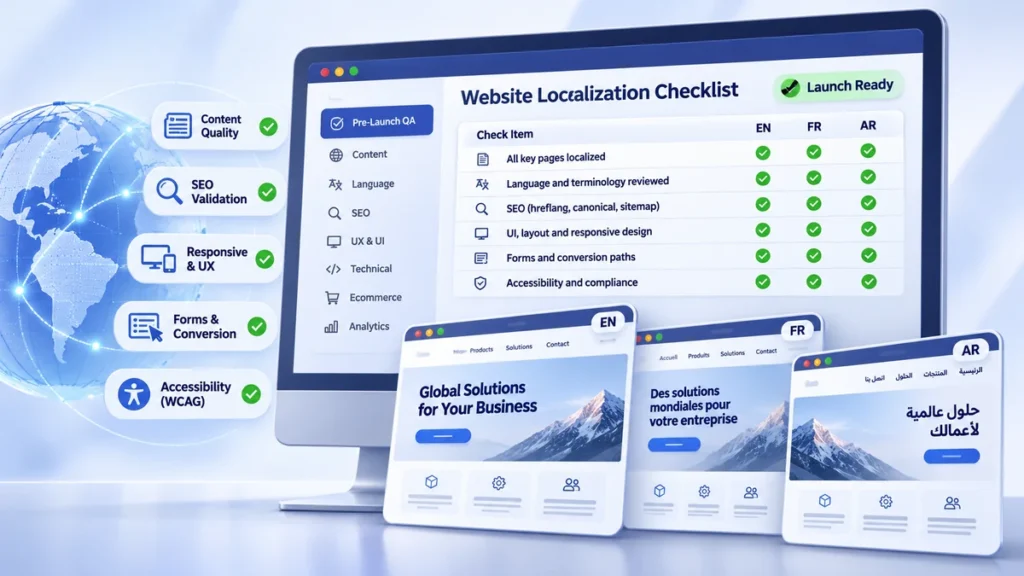
Launching a multilingual website involves more than translating pages and publishing them under new language URLs. A company can have accurate translations and still encounter broken forms, inconsistent product terminology, untranslated interface elements, incorrect SEO signals, or outdated regional content.
A reliable website localization process connects business planning, content preparation, internationalization, translation, CMS integration, quality assurance, international SEO, and ongoing maintenance.
This guide explains 12 practical steps for localizing a website, including the responsibilities, deliverables, dependencies, and approval criteria that help website, localization, development, and marketing teams coordinate a successful launch.
Quick Answer: What Is the Website Localization Process?
The website localization process is a structured workflow for preparing, translating, adapting, testing, and launching a website for different languages and markets.
It begins with defining target markets and auditing existing content, followed by internationalization, content planning, translation, technical integration, quality assurance, multilingual SEO validation, and deployment. After launch, ongoing maintenance keeps localized versions accurate and consistent.
Translation alone is not enough. A localized website must also display content correctly, support regional user expectations, provide functional conversion paths, and remain accessible to search engines.
Website Localization Process at a Glance
A typical website localization workflow consists of nine connected phases:
Strategy → Audit → Preparation → Translation → Integration → QA → SEO Validation → Launch → Maintenance
These phases can be expanded into 12 implementation steps:
| Step | Process Stage | Primary Outcome |
|---|---|---|
| 1 | Define target markets | Approved localization scope |
| 2 | Audit the existing website | Complete content and functionality inventory |
| 3 | Evaluate internationalization readiness | Technically prepared website |
| 4 | Prioritize content | Approved localization backlog |
| 5 | Prepare language assets | Consistent terminology and style |
| 6 | Prepare multilingual SEO | Local keyword and URL strategy |
| 7 | Extract and localize content | Reviewed target-language content |
| 8 | Integrate localized content | Functional multilingual staging website |
| 9 | Conduct localization QA | Linguistic and functional approval |
| 10 | Validate international SEO | Verified search-related configuration |
| 11 | Launch localized versions | Approved production release |
| 12 | Maintain localized content | Sustainable update workflow |
These steps are connected, but not every activity must happen strictly in sequence. Technical remediation, terminology development, and local keyword research can sometimes proceed in parallel.
The important requirement is that each stage produces the information and approved assets the next stage needs.
For example, translating a product page before approving its target-market keywords can lead to unnecessary rewriting. Likewise, approving translations before testing them inside the CMS leaves layout and functionality problems undiscovered.
Step 1: Define Target Markets and Business Requirements
Objective: Establish which markets the website will serve, what users need, and what the localized versions must accomplish.
Identify Target Markets, Languages, and Locales
Start by defining target markets and audiences rather than simply selecting languages.
A language does not always represent a single market. French content intended for France may need different terminology, product information, or commercial messaging from content intended for French-speaking Canada.
A locale combines language requirements with relevant regional conventions. For example, fr-CA identifies Canadian French, while fr identifies French without specifying a particular region.
Market planning should consider customer demand, available products or services, regional requirements, existing business operations, and the website’s intended audience.
Define Business and Conversion Goals
Decide what users should accomplish on each localized website.
For a B2B manufacturing website, this may include submitting product inquiries, downloading specifications, requesting technical consultations, or contacting regional sales representatives.
Document which pages, languages, features, and customer journeys belong to the initial release.
Handoff: The business owner approves a localization brief containing the target-locale matrix, conversion goals, project scope, and responsible teams.
Completion criterion: Every target locale has a defined audience, business purpose, and approved release scope.
Step 2: Audit the Existing Website
Objective: Identify all content, functionality, and technical components affected by localization.
Build a Complete Content Inventory
A website localization project should begin with a structured inventory of the existing website.
Record important pages and their content types, including service pages, product descriptions, blog articles, landing pages, support content, and legal information.
The inventory should also cover:
- Navigation menus, footers, and reusable templates.
- Contact forms, validation messages, and confirmation emails.
- Images containing text, videos, and downloadable documents.
- SEO titles, meta descriptions, image alt text, and URL structures.
- CMS custom fields, dynamic components, and third-party integrations.
For each content item, capture its source URL or content ID, owner, update status, and intended localization requirements.
Identify Hidden Content and Technical Limitations
Not every translatable string appears in the visible page editor.
Error messages may be hard-coded in JavaScript. Product specifications may come from an external database. Form notifications may be generated by a plugin.
These elements must be identified before extraction and translation begin.
Handoff: The website manager and developer provide a content inventory and localization coverage map.
Completion criterion: Every in-scope content source has a documented owner and extraction or integration method.

Step 3: Evaluate Website Internationalization Readiness
Objective: Confirm that the website can technically support additional languages and locales.
Website internationalization, often abbreviated as i18n, prepares website architecture and software for localization without requiring separate engineering changes for every language.
Review Encoding, Strings, and Locale Handling
Check whether the system supports Unicode and UTF-8 throughout its content storage, APIs, and rendering pipeline.
Identify hard-coded text that should be externalized into translatable resources.
Review how the application handles dates, times, currencies, numbers, measurement units, and plural forms. Locale-sensitive formatting should use suitable internationalization libraries and conventions, such as those supported by Unicode CLDR, rather than relying on manual string replacements.
Test Layout and Language Architecture
Check whether navigation, buttons, tables, and form elements can accommodate different text lengths.
For languages using right-to-left scripts, verify appropriate HTML directionality and interface behavior. The W3C guidance on right-to-left text explains why text direction should be represented semantically rather than handled through visual alignment alone.
Also review language switching, locale-specific routing, CMS data structures, and fallback behavior.
Handoff: Engineering produces an internationalization readiness report and remediation plan.
Completion criterion: Critical blockers are resolved, and a representative localized page or template passes technical testing.
Step 4: Prioritize Content and Create a Localization Plan
Objective: Convert the website audit into an achievable localization scope and release sequence.
Prioritize High-Value Pages
Not every page needs to be localized at the same time.
For B2B websites, commercial and conversion-focused content often deserves early attention. This may include service pages, product pages, contact forms, and essential supporting documentation.
Existing search and conversion data can inform priorities, but local-market search demand should also be considered.
A source-market article that performs well may not address the same search intent in another language.
Organize Content Into Release Waves
A practical release plan could include:
- Wave 1: Essential commercial pages and complete lead-generation journeys.
- Wave 2: Supporting resources, FAQs, and high-priority educational content.
- Wave 3: Additional articles, long-tail content, and market-specific expansion.
Each content item should have a source identifier, target locale, priority, assigned reviewer, and planned release wave.
Document intentionally excluded pages so that missing translations are not mistaken for completed work.
Handoff: The content owner and localization project manager approve a prioritized localization backlog.
Completion criterion: The initial release contains complete, usable customer journeys rather than a disconnected collection of translated pages.
Step 5: Prepare Terminology and Language Assets
Objective: Establish language consistency before translation production begins.
Create a Shared Language Package
Translation quality depends partly on the quality of the references available to linguists.
Prepare the following assets where applicable:
- A glossary of approved product and industry terminology.
- A locale-specific style guide covering tone and writing conventions.
- Existing translation memory and previously approved translations.
- Brand guidelines, product documentation, and reference materials.
- Screenshots or contextual notes explaining interface strings.
For technical B2B websites, terminology consistency is particularly important.
The same component, specification, or service should not receive conflicting translations across product pages, downloadable documents, and inquiry forms.
Approve Critical Terminology
Market reviewers and technical specialists should resolve high-impact terminology questions before large-scale translation begins.
A translation management system (TMS) can help maintain terminology and translation memory, but responsibility for approving terminology still belongs to designated people.
Handoff: The localization PM delivers approved language assets to translators and reviewers.
Completion criterion: Priority terminology, tone requirements, and review instructions are agreed upon.
Step 6: Prepare Multilingual SEO Before Translation
Objective: Ensure localized content follows actual target-market search behavior and a technically sound URL strategy.
Conduct Local Keyword Research
Multilingual SEO should not begin by translating English keywords word for word.
Users in different markets may search for the same product using different terms, abbreviations, or problem-oriented phrases.
Research local search results, keyword variations, commercial intent, and competing pages before finalizing important localized content.
For each priority page, create a keyword brief identifying its primary search intent, relevant terminology, proposed title, heading direction, and localized internal-link opportunities.
Plan the International URL Structure
Choose a consistent approach for localized URLs, such as:
- Subdirectories:
example.com/de/ - Subdomains:
de.example.com - Country-specific domains:
example.de
Each option has operational implications. The appropriate choice depends on the site’s technology, governance, market strategy, and available resources.
Google recommends using separate URLs for different language versions.
Plan corresponding-page mappings, localized navigation, canonical URLs, and hreflang relationships before publishing.
Handoff: The SEO specialist delivers an approved local keyword map and international SEO specification.
Completion criterion: Priority pages have defined search intent, target URLs, and technical SEO requirements.
Step 7: Extract, Translate, and Localize Website Content
Objective: Produce reviewed target-language content while preserving the website’s technical structure.
Establish the CMS Localization Workflow
Content may move between the website and localization team through a CMS connector, structured export/import, API integration, or repository-based workflow.
The appropriate method depends on the CMS architecture and content types.
For example, a WordPress project may require separate handling of page content, custom fields, and theme or plugin interface strings. A headless CMS may expose localized fields through an API.
Preserve content identifiers, source versions, placeholders, links, and markup requirements throughout extraction and delivery.
Translate and Adapt the Content
Translators should work from approved source material, terminology, style guidance, and local SEO briefs.
Some content may require more than direct translation. Product terminology, calls to action, commercial claims, and supporting examples may need market-specific adaptation.
The review workflow should distinguish initial translation, linguistic revision, market review, and final content approval.
Machine-assisted translation may support parts of the process, but the review level should reflect the content’s business importance and risk.
Handoff: The localization PM delivers approved, version-controlled translations ready for CMS integration.
Completion criterion: All required content has been reviewed, approved, and matched to the correct source records.
Step 8: Integrate Localized Content Into the CMS
Objective: Convert approved translations into functional localized website versions.
Import Content and Configure Localized Pages
Import translations into the correct locale records and templates.
Verify that localized pages retain the intended structure, media, metadata, internal links, and translation relationships.
CMS configuration deserves special attention. A translated page may display correctly while its custom fields, reusable components, or dynamically loaded information remain in the source language.
Content fallback rules should be intentional and tested.
Integrate Forms and Conversion Components
For a B2B website, localization is incomplete if visitors can read product descriptions but cannot complete an inquiry in their language.
Test form labels, validation messages, thank-you pages, notifications, and sales routing.
Consider a hypothetical manufacturer launching German and French versions of its English website. A German-language inquiry should reach the appropriate team with the correct product reference and working confirmation email.
Handoff: Developers deliver an integrated multilingual staging release.
Completion criterion: Localized content displays correctly and essential customer journeys function in the staging environment.

Step 9: Conduct Linguistic and Functional Localization QA
Objective: Find language, layout, and functional problems before production release.
Perform Linguistic and In-Context QA
Linguistic quality assurance evaluates accuracy, completeness, terminology, tone, and market suitability.
In-context review examines the translated content inside the actual website.
This distinction matters because a translation may be correct in a spreadsheet but unsuitable when displayed inside a small button, navigation label, or error message.
Reviewers should inspect representative page templates, high-value content, and critical user journeys.
Test Website Functionality and Accessibility
Functional QA should cover localized navigation, links, forms, notifications, media, dynamic content, and language switching.
Test desktop and mobile layouts for text expansion, wrapping, truncation, and font problems. Include keyboard interaction, accessible labels, language declarations, and RTL behavior where applicable.
Each defect should include its affected locale, location, severity, reproduction steps, and assigned owner.
Handoff: The QA team provides test evidence, a defect log, and release recommendations.
Completion criterion: No unresolved launch-blocking defects remain; accepted minor issues are documented and assigned.
Step 10: Validate International SEO
Objective: Verify that localized pages expose the intended signals to search engines.
Review Crawlability, Indexability, and Canonical URLs
Check that intended localized pages have accessible URLs, appropriate HTTP responses, and no unintended noindex or robots restrictions.
Confirm that canonical signals are consistent with the localization architecture.
Fully translated pages intended to appear independently in search should generally point to the appropriate canonical page in their own language, rather than automatically canonicalizing to the English original.
Same-language regional variants may require additional canonicalization decisions.
Validate Hreflang and Discovery Signals
hreflang helps Google understand relationships between localized versions of a page.
Follow Google’s localized-version guidelines, including supported language/region codes, fully qualified URLs, and reciprocal alternate relationships.
Also verify localized metadata, internal links, XML sitemaps, and language-switching paths.
Remember that the HTML lang attribute serves a different purpose from hreflang: it declares document language for user agents and accessibility-related processing.
Handoff: The SEO specialist delivers an international SEO validation report.
Completion criterion: The intended production configuration passes technical SEO testing without critical blockers.
Actual crawling and indexing must still be monitored after launch.
Step 11: Launch Localized Website Versions
Objective: Release approved localized versions into production without disrupting essential website functionality.
Coordinate Release Approval
A production launch should follow formal approval from the relevant content, localization, engineering, QA, SEO, and business owners.
Before deployment, confirm that the release package, production configuration, backup or recovery arrangements, and rollback procedures are ready.
A named release owner should coordinate deployment and make the final go/no-go decision under the organization’s approval rules.
Verify the Production Release
After deployment, perform focused production smoke testing.
Confirm that priority localized URLs load correctly, language switching works, forms submit successfully, and important conversion events are recorded.
Verify that staging-specific restrictions have not carried into production.
Check published sitemaps, redirects, canonical settings, and localized page relationships.
Search Console should be configured for the relevant site properties, and the team should establish who will monitor indexing and production errors.
Handoff: The release owner records deployment completion and production validation results.
Completion criterion: Critical live journeys pass and the authorized business owner accepts the release.
Step 12: Maintain and Update the Localized Website
Objective: Prevent localized content and functionality from becoming outdated after launch.
Establish Source-Content Synchronization
Website localization is an ongoing process.
When a source product description, specification, service page, or interface message changes, the localization workflow should identify affected translations.
Updates should follow a repeatable process:
Source change → Impact assessment → Translation or adaptation → Review → Integration → Regression QA → Publication
Stable content identifiers and source-version tracking help teams identify which translations require attention.
Monitor Quality and Market Performance
Monitor localized search visibility, indexing, conversions, broken links, and user-reported issues.
For lead-generation websites, evaluate whether visitors can successfully complete inquiries, not simply whether localized pages receive traffic.
Review terminology assets and update workflows as products, services, and market requirements change.
Handoff: Content and localization owners maintain a recurring update process with engineering, QA, and SEO support.
Completion criterion: New and revised content can be localized, verified, and published without restarting the entire project.
Roles and Responsibilities in a Website Localization Project
A reliable multilingual website workflow requires clear ownership across disciplines.
| Role | Primary Responsibility | Main Deliverable |
|---|---|---|
| Content owner | Approves source content, scope, and commercial priorities | Approved content backlog |
| Localization PM | Coordinates translations, reviewers, language assets, and handoffs | Reviewed localization package |
| Translator / localizer | Translates and adapts content | Target-language content |
| Developer / CMS administrator | Prepares systems, integrates content, and supports release | Functional localized website |
| SEO specialist | Researches local search intent and validates international SEO | Keyword and SEO validation reports |
| QA specialist | Tests language implementation, layout, and functionality | QA report and defect records |
| Market reviewer | Confirms regional suitability and business terminology | Market approval |
The localization PM coordinates delivery, but the project should also identify one accountable release owner who authorizes publication after receiving the required specialist approvals.
For organizations managing multiple markets and content teams, a broader multilingual content operating model can define decision rights, governance, and escalation rules.
Common Website Localization Process Failures
Many localization problems originate before translation begins or emerge during system integration.
An incomplete content inventory can leave error messages, product attributes, downloads, or notification emails untranslated. A comprehensive audit reduces this risk.
Hard-coded strings prevent efficient translation and updating. Internationalization testing should identify them before full production.
Literal keyword translation can produce pages that do not reflect local search behavior. Market-specific keyword research should inform important commercial content.
Missing locale-specific review may leave technically correct translations that use unsuitable terminology or inaccurate market claims.
Incorrect canonical or hreflang configuration can confuse the relationship between localized pages and weaken intended search signals.
Incomplete form localization can disrupt lead generation even when visible page content looks correct.
No update workflow allows localized versions to fall behind the source website.
The common pattern is a missing handoff or approval gate. Each failure should be linked to a process owner and corrected before the affected work moves forward.
Website Localization Stage-Gate Matrix
A stage-gate matrix provides a shared reference for project managers, localization teams, developers, and reviewers.
| Stage | Inputs | Owner | Deliverables | QA Gate | Common Failure |
|---|---|---|---|---|---|
| Strategy | Market goals | Business owner | Scope and locale matrix | Scope approved | Unclear requirements |
| Audit | Website and CMS access | Website manager | Content inventory | Coverage verified | Missing assets |
| Internationalization | Audit and codebase | Developer | Readiness report | Blockers resolved | Hard-coded strings |
| Content planning | Inventory and priorities | Content owner | Localization backlog | Release scope approved | Wrong priorities |
| Language assets | Brand and technical references | Localization PM | Glossary and style guide | Terminology approved | Inconsistent language |
| SEO planning | Locale and content plans | SEO specialist | Keyword and URL maps | SEO strategy approved | Literal keywords |
| Localization | Approved source content | Localization PM | Reviewed translations | Language approval | Source-version errors |
| Integration | Approved translations | Developer | Staging release | Core functionality verified | Missing UI content |
| Localization QA | Staging website | QA specialist | QA report | Blocking defects resolved | Untested journeys |
| SEO validation | Staging and URL map | SEO specialist | Technical SEO report | Search configuration approved | Incorrect tags |
| Launch | Approved release | Release owner | Live localized versions | Production tests passed | Deployment defects |
| Maintenance | Live site and updates | Content owner | Updated content and records | Change workflow followed | Outdated translations |
What Happens When a Stage Fails?
A failed gate should return the affected work to the team responsible for correcting it.
For example, if the German contact form displays untranslated validation messages during QA, the issue returns to the content extraction, localization, or integration team, depending on its cause.
After correction, QA repeats the affected tests and records the outcome.
This approach prevents incomplete work from progressing while avoiding unnecessary repetition of already approved activities.
FAQ
What are the main steps in the website localization process?
The main steps include market planning, website auditing, internationalization, content prioritization, language asset preparation, multilingual SEO planning, translation, CMS integration, quality assurance, SEO validation, launch, and maintenance. Each stage produces deliverables that support the next stage.
Should internationalization happen before website translation?
Critical internationalization requirements should be addressed before translated content is integrated into production. Some translation preparation can occur in parallel with engineering work, but unresolved technical issues may require translations or interfaces to be reworked.
How do you localize a WordPress or CMS website?
Start by auditing the content model and selecting a suitable multilingual implementation. Configure locale handling, translation relationships, custom fields, and content workflows. Extract and translate the content, integrate it into staging, and test the pages, forms, templates, and SEO settings before launch.
How long does a website localization project take?
Project duration depends on content volume, number of locales, technical readiness, CMS complexity, review requirements, and available resources. A small, technically prepared website may be simpler to localize than a large website with dynamic content and complex integrations. Timelines should be based on a completed audit and agreed scope.
What is the difference between linguistic QA and website localization testing?
Linguistic QA evaluates translation accuracy, terminology, completeness, tone, and suitability. Website localization testing also examines layout, navigation, forms, accessibility, dynamic components, and user journeys. Both are necessary because accurate translations do not guarantee functional localized pages.
When should multilingual SEO be implemented?
Multilingual SEO planning should begin before translation so target-market keywords and URL structures can influence content preparation. Technical implementation continues during CMS integration, followed by validation before launch and indexing and performance monitoring afterward.
How do you maintain a multilingual website after launch?
Track source-content changes, identify affected localized versions, update translations and language assets, obtain approvals, and run regression testing before publication. Monitor SEO performance, conversion journeys, technical errors, and regional feedback to keep localized websites accurate and useful.
Final Thoughts: Treat Website Localization as a Managed Release Process
A successful website localization process does not end when translated content is delivered.
It succeeds when business requirements, language assets, technical systems, search visibility, and customer journeys work together in the target market.
The most effective approach is to establish clear dependencies, responsible owners, measurable deliverables, and approval criteria throughout the workflow.
Whether a business is localizing a small WordPress website or a complex CMS-driven platform, the same principle applies: plan the market experience, prepare the system, localize the content, validate the complete website, and maintain it after launch.
For companies coordinating multilingual content, CMS integration, and regional launch requirements, Textsprime’s website localization services can support the language and localization components within a broader implementation workflow.