

Choosing a translation company can be surprisingly difficult when several providers appear to offer the same services. Their proposals may list similar languages, turnaround times, and quality commitments, yet the actual translation processes, specialist expertise, security arrangements, and deliverables can differ significantly.
For businesses translating technical documentation, marketing campaigns, software interfaces, or sensitive corporate materials, those differences matter. A low quotation may exclude independent linguistic review. A provider with extensive language coverage may lack specialists in your industry. Another may offer advanced translation technology but limited control over your terminology and translation assets.
The goal is not to find the largest or cheapest agency. It is to identify a provider whose capabilities, processes, and commercial terms match your project.
To choose a translation company, first define your project’s languages, subject matter, content risk, file formats, budget, and deadline. Then compare providers based on relevant expertise, translator qualifications, quality assurance, security, technology, and pricing transparency. Verify certifications and references, clarify ownership of translation memories and terminology, and consider a representative test project before committing to a long-term partnership.
This guide explains how to evaluate translation providers systematically and make a decision supported by evidence rather than marketing claims.
1. Start With Your Project Requirements, Not a Vendor List
Before contacting translation companies, determine what your organization needs translated, how the content will be used, and what could happen if something is translated incorrectly.
A product description intended for an online catalog has different requirements from a safety manual. Software interface translation introduces technical constraints that may not apply to corporate reports.
| Project type | Primary requirement | What to verify |
|---|---|---|
| Technical manuals | Terminology accuracy and subject expertise | Specialist translators, qualified review, consistent terminology |
| Marketing campaigns | Brand voice and cultural relevance | Market-specific language expertise and creative review |
| Software localization | Technical compatibility and context | File handling, integrations, interface testing |
| Legal or sensitive documents | Precision and confidentiality | Relevant qualifications, secure handling, appropriate review |
| Ongoing multilingual content | Consistency and scalability | Translation memory, terminology governance, reliable resources |
Define languages and target locales
Language coverage should be specific. French for France (fr-FR) and French for Canada (fr-CA) may require different terminology, spelling conventions, and audience expectations.
The W3C guidance on language tags provides useful background on identifying language and regional variations.
Prepare a short project brief containing your source and target languages, intended audience, approximate volume, subject matter, file formats, required delivery date, and internal review arrangements.
Also identify whether this is a one-time assignment or the beginning of a recurring multilingual program.
The better your project definition, the easier it becomes to compare providers on equivalent terms.
2. Choose the Right Provider Model—and Look Beyond Language Count
Not every business requires the same type of translation provider.
A specialist translation agency may be suitable for technical documentation involving a small number of languages. A full-service language service provider may be more appropriate when several departments need coordinated multilingual production.
Independent translators can also be effective for narrowly defined projects, particularly when the buyer has sufficient internal capacity to manage coordination and review.
Consider four broad options:
- Full-service translation company: Suitable for coordinating multiple languages, content types, reviewers, and delivery schedules.
- Specialist language service provider: Often appropriate when specific subject-matter competence is a leading requirement.
- Technology-led translation provider: Worth evaluating when workflow automation, integrations, or frequent content updates are important.
- Independent translator or freelance team: Potentially suitable for focused assignments where the buyer can manage continuity and quality controls.
These categories are not mutually exclusive. Many providers combine specialist teams, project management, and technology.
An agency advertising extensive language coverage should still demonstrate that it can assemble qualified teams for your particular language pairs and industry.
Ask about actual resources and experience in the markets you need, rather than treating the total number of supported languages as a quality indicator.
3. Verify Subject-Matter Expertise and the People Behind the Work
Professional translation requires more than general fluency.
A technically accurate manufacturing manual may depend on familiarity with engineering terminology and equipment operation. Financial disclosures require an understanding of specialized concepts, while marketing content demands sensitivity to audience expectations and brand voice.
Look for relevant, demonstrable experience
Ask shortlisted translation companies for examples involving similar content, target languages, and industry requirements.
Useful evidence may include anonymized translation samples, descriptions of comparable assignments, specialist qualifications, and references that can be independently checked.
A provider does not need to disclose confidential client information to demonstrate relevant experience.
For example, when sourcing technical translation services, a manufacturing company should investigate whether the proposed team understands the terminology used in its actual products, not simply whether the agency has previously worked with industrial clients.
Understand translator and reviewer selection
Ask how translators are assessed, assigned, and supervised.
Relevant questions include whether their experience matches the subject, how reviewers are qualified, and whether the same team can support future updates.
A translator’s native-language background may be relevant, but it does not independently establish professional competence.
Also clarify whether revision is performed by a separate qualified linguist when required by the contracted workflow, and how disagreements or terminology questions are resolved.
A strong supplier should be able to explain who will perform the work, why they are qualified, and how the output will be reviewed.
4. Understand ISO Standards and Examine the Actual QA Workflow
Certifications can provide useful evidence of established processes, but they should not replace direct evaluation of a translation company’s capabilities.
Several standards are relevant to translation procurement, and they address different requirements.
| Standard | What it covers | Important limitation |
|---|---|---|
| ISO 17100:2015 | Requirements for translation-service processes and resources | Machine translation followed by post-editing is outside its scope |
| ISO 18587:2017 | Full human post-editing of machine translation output | Does not automatically cover every AI-assisted workflow |
| ISO 5060:2024 | Guidance for evaluating translation output | Does not establish a complete QA production process |
| ISO/IEC 27001:2022 | Information security management systems | Does not certify linguistic accuracy |
These are the published editions identified in October 2026; revisions to ISO 17100 and ISO 18587 are under development.
Verify certification claims
Ask which standard applies to the proposed service, whether the supplier holds certification, and which legal entity, locations, and activities the certificate covers.
According to ISO’s certification guidance, ISO develops standards but does not issue certificates itself. Certification is performed by external bodies.
A supplier stating that its workflow follows a standard is not necessarily making the same claim as holding independently verified certification.
Examine how quality is managed
A credible quality assurance process should explain how content moves through preparation, translation, revision, checks, delivery, and corrective action.
For a human-translation workflow, this might involve:
Project instructions → Terminology preparation → Translation → Qualified revision → Linguistic and technical checks → Delivery → Feedback resolution
The exact workflow should depend on the agreed service and project risk.
Ask how the supplier identifies omissions, mistranslations, terminology inconsistencies, formatting problems, and inappropriate style.
The Multidimensional Quality Metrics (MQM) framework provides a structured way to classify translation errors. However, no single quality score should be treated as universally appropriate without considering content type and evaluation criteria.

5. Check Technology Compatibility Without Getting Distracted by Tool Names
Translation technology can support consistency and workflow efficiency, particularly for recurring projects. However, buyers should evaluate what a system enables rather than whether a supplier advertises a long list of software products.
Key technologies include:
- Computer-assisted translation (CAT) tools: Support segment-based translation, reference materials, and linguistic checks.
- Translation memory (TM): Stores previous translations for potential reuse in appropriate contexts.
- Terminology management: Maintains approved expressions, product names, and industry terminology.
- Translation management systems (TMS): Coordinate project assignments, review stages, deadlines, and delivery.
- Connectors and APIs: Support content exchange between systems such as content management platforms and localization workflows.
For recurring software or website projects, file compatibility may be especially important.
Ask whether the provider can process your original source files, preserve variables and formatting, handle updated content, and return deliverables that work within your existing systems.
Standards such as OASIS XLIFF can support localization data interchange, but compatibility should be demonstrated rather than assumed.
A practical test using representative files is often more informative than a generic technology presentation.
6. Examine Confidentiality, Data Protection, and AI Use
Translation projects may involve unpublished product information, contracts, employee data, customer records, or confidential business strategies.
Before sharing sensitive material, establish how the provider manages information throughout the project.
Verify security and data-handling arrangements
A confidentiality agreement is useful, but it is not sufficient evidence of secure operations.
Ask about:
- Access controls for translators, reviewers, and project managers.
- Secure file transfer and storage arrangements.
- Subcontractor access and confidentiality obligations.
- Retention periods and deletion procedures.
- Security incident reporting.
- Applicable data processing and cross-border transfer arrangements.
Where personal data is involved, the parties’ responsibilities depend on their actual roles and applicable law. The European Data Protection Board’s guidance explains the distinction between controllers and processors under the GDPR.
Require clarity about machine translation and generative AI
A professional translation company may use human translation, machine translation with post-editing, generative AI assistance, or a combination of methods.
The critical procurement question is not simply whether AI is used, but how it is used, with whose approval, and under which safeguards.
Ask which tools process your content, whether third parties receive data, what retention and training policies apply, and what human review is performed.
For sensitive projects, the contract may need to restrict particular tools or require prior approval.
Do not assume that every commercial AI tool applies identical confidentiality, training, or data retention policies.
7. Test Delivery Capacity, Project Management, and Rush Handling
A translation provider’s ability to deliver reliably depends on more than its advertised turnaround time.
Project management becomes particularly important when multiple languages, frequent updates, or several internal stakeholders are involved.
Evaluate whether the supplier can provide a clear production schedule, assigned project contact, progress visibility, backup resources, and escalation procedures.
Ask what happens if an assigned translator becomes unavailable, source files change unexpectedly, or a review reveals significant corrections.
For urgent assignments, request an explanation of how the work will be staffed and which quality checks will remain in place.
A provider that promises exceptionally fast delivery without discussing content complexity, available resources, or review requirements deserves additional scrutiny.
Reliable delivery means making commitments that are supported by an achievable production plan.
8. Compare Pricing on Equivalent Scope—and Clarify Asset Ownership
Translation quotations can be difficult to compare because providers may include different services under similar descriptions.
One quotation might include translation and independent revision. Another may cover translation only, with proofreading, formatting, or additional review charged separately.
Before comparing prices, confirm:
- The source-word count or other billing basis.
- Language pairs and required service level.
- Whether linguistic revision is included.
- File preparation and formatting responsibilities.
- Translation memory pricing treatment.
- Minimum charges, rush fees, and other supplements.
- Included correction rounds and change-request conditions.
For more detail on cost drivers, see Textsprime’s guide to translation services costs.
Establish ownership and portability of language assets
For ongoing projects, translation memories, approved terminology, and style guides can become valuable business resources.
Before signing, ask who holds the contractual rights to approved translations and any linguistic assets created during the engagement.
Clarify whether your organization can receive translation memories and terminology databases in usable export formats, and whether additional fees or restrictions apply.
Ownership, access, and technical export capability are separate questions.
A supplier may permit access to a platform without granting the contractual rights or practical means to transfer all relevant assets.
Agree on these provisions before they become part of a future vendor transition.
9. Validate References and Use a Pilot When the Decision Warrants One
Client references and case studies can be valuable, but they should be assessed for relevance.
A successful marketing localization project does not automatically demonstrate competence in translating complex technical specifications.
When reviewing case studies, examine the project’s language requirements, subject matter, delivery complexity, and the supplier’s actual responsibilities.
Ask what challenges arose and how they were resolved. A credible explanation of problem handling may be more informative than a broad statement about customer satisfaction.
When is a test translation useful?
A pilot is particularly worthwhile when selecting a long-term partner for recurring, specialized, sensitive, or business-critical content.
Use material that reflects the real assignment, including representative terminology and formatting constraints.
Give shortlisted providers consistent instructions, reference materials, and evaluation criteria.
Where possible, involve a qualified reviewer who can judge meaning, terminology, style, and suitability for the target audience.
A poorly designed test can favor one writing style over another without measuring important quality differences. Reviewers should therefore agree on expectations before evaluating results.
A limited paid pilot may offer a fairer assessment than expecting extensive unpaid work.
For small, low-risk assignments, a relevant sample and reference checks may be sufficient.
10. The 15 Questions to Ask Every Shortlisted Translation Vendor
Use the following checklist during supplier interviews. For each question, record the answer and supporting evidence rather than relying on verbal assurances alone.
- Which language and locale combinations can you reliably support? Request evidence of actual resources in the required language pairs.
- What relevant projects have you completed in our industry? Ask for comparable, appropriately anonymized examples or references.
- How are translators selected and qualified? Review their subject-matter and language competence criteria.
- Who reviews the work, and how is reviewer consistency maintained? Clarify responsibilities and continuity arrangements.
- Which ISO standards or certifications apply to our service? Verify current certificates, scopes, and issuing bodies where certification is claimed.
- How do you identify and correct translation errors? Request an explanation of QA checks and corrective procedures.
- How will you maintain our terminology and style requirements? Ask how approved terms are created, reviewed, and updated.
- Can you process our source files and technical formats? Request a practical demonstration if integration is important.
- Will machine translation or generative AI be used? Establish disclosure, approval, human oversight, and permitted tools.
- How will our confidential information be protected? Verify access, storage, subprocessors, retention, and deletion arrangements.
- Can you accommodate increased volume or resource changes? Examine staffing, backup coverage, and workload planning.
- Who manages deadlines, changes, and urgent requests? Confirm responsibility and escalation procedures.
- What is included and excluded in your quotation? Obtain an itemized and commercially comparable scope.
- Who owns our approved translations and language assets? Confirm contractual rights and practical export options.
- Can you provide relevant references or a representative pilot? Agree on suitable evidence and evaluation criteria.
The strongest answers will be supported by documents, demonstrations, identifiable responsibilities, or verifiable experience.
A supplier that cannot provide evidence in every area is not automatically unsuitable. The significance of a gap depends on your project’s risk and mandatory requirements.
11. Red Flags That Should Delay a Vendor Decision
Certain warning signs deserve investigation before a contract is awarded.
| Warning sign | Buyer response |
|---|---|
| Unclear translator or reviewer qualifications | Request evidence before proceeding |
| Unverifiable certification claims | Check the issuing body and applicable scope |
| No satisfactory arrangements for sensitive data | Hold or reject until mandatory controls are met |
| Unexplained AI use or refusal to address required restrictions | Seek clarification or exclude if contractual requirements cannot be met |
| Unrealistic delivery promises | Request a credible staffing and review plan |
| Vague pricing or correction policies | Obtain a revised written quotation |
| Restrictive or unclear translation asset rights | Resolve contract terms before signing |
Not every concern requires immediate rejection. Some reflect incomplete proposals or misunderstandings that can be corrected.
However, unresolved failures involving mandatory confidentiality, legal, or technical requirements should not be compensated for by attractive pricing.
12. Use a Weighted Translation Vendor Comparison Scorecard
Once providers have supplied sufficient evidence, a structured scorecard can help procurement teams compare them consistently.
Begin by identifying mandatory eligibility requirements, such as particular language coverage, security obligations, required qualifications, or technical compatibility.
A supplier that fails an essential requirement should not advance simply because it performs well in other categories.
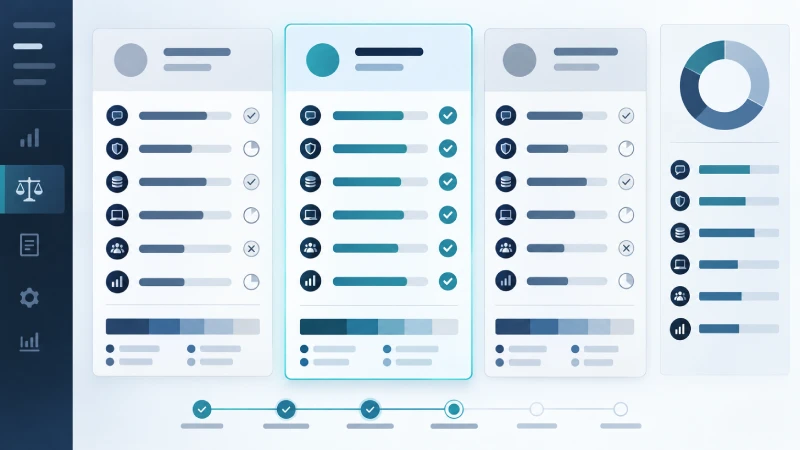
For eligible providers, the following illustrative model can support comparison.
| Evaluation criterion | Suggested weight |
|---|---|
| Project and subject-matter fit | 20% |
| Linguistic quality and QA | 25% |
| Security and AI governance | 20% |
| Technology and asset compatibility | 10% |
| Capacity and project management | 10% |
| Commercial transparency and asset terms | 10% |
| References or pilot evidence | 5% |
| Total | 100% |
Score each criterion from 1 to 5 using a common evidence standard, where 1 indicates inadequate evidence or capability and 5 indicates strong, verified suitability.
Calculate the weighted total by multiplying each score divided by five by its assigned weight.
These weights are an illustrative purchasing framework, not an ISO requirement or industry benchmark.
Adjust them to your actual project. For sensitive corporate records, security may deserve greater emphasis. For highly specialized technical documentation, linguistic competence and subject expertise may be the leading differentiators.
Record the evidence behind each score and identify unresolved risks.
The scorecard should support a defensible decision, not replace professional judgment.
13. Make the Selection and Agree on the First Delivery
Before committing, document why the chosen translation provider meets your project requirements.
Confirm the final scope, assigned responsibilities, quality review arrangements, delivery milestones, pricing terms, confidentiality provisions, and ownership of language assets.
For ongoing work, define how feedback will be recorded and how improvements will carry forward into future assignments.
The right translation company is not necessarily the provider with the most impressive presentation. It is the one that can demonstrate the expertise, processes, transparency, and operational fit your business requires.
The key takeaway: Choosing a professional translation company is a supplier-risk and capability decision, not simply a price comparison. Define the project, verify relevant evidence, protect confidential information and language assets, and select a provider whose documented capabilities match your business requirements.
FAQ
Is an ISO-certified translation company always the best choice?
No. Relevant certification can provide useful evidence about a provider's processes, but it does not guarantee suitability for every language pair or project. Evaluate certification scope alongside specialist competence, quality controls, security, delivery capability, and references.
Should I choose a translation agency or a freelance translator?
Both can be appropriate. An agency may offer coordinated project management, access to multiple resources, and integrated review processes. A freelance specialist may be suitable for a focused assignment with clearly defined requirements. Consider who will manage review, continuity, and accountability.
Do I need a translation test before hiring an agency?
Not necessarily. A representative pilot is especially useful for long-term, complex, or high-risk assignments. It should reflect your actual content and use consistent evaluation criteria. For smaller projects, relevant references and a clearly defined initial assignment may provide sufficient evidence.
Can my business retain its translation memory?
Potentially, but rights and access depend on the agreement. Specify ownership, permitted use, export formats, and handover obligations before signing. Technical access to a translation platform does not necessarily establish ownership of the underlying language assets.
Should I choose the translation company with the lowest price?
Only if the proposed service meets your requirements and the quotations are genuinely comparable. Differences in linguistic review, specialist expertise, security, formatting, delivery, and future asset access may materially affect the overall value.
Should a professional translation company disclose whether it uses AI?
Buyers should require appropriate disclosure, particularly when content is confidential, sensitive, or subject to specific contractual restrictions. Clarify which tools are used, how data is handled, what human oversight applies, and whether particular AI workflows can be restricted or prohibited.


