

When preparing an international product launch, translating technical documentation, or coordinating multilingual marketing campaigns, one question often determines the project schedule: When will the translation be ready?
The answer is not simply a matter of dividing the word count by a translator’s daily output.
Professional translation involves several interconnected activities, from file preparation and terminology management to translation, independent revision, formatting, quality assurance, and final approval. Each can influence the delivery date.
Understanding these dependencies helps businesses establish realistic deadlines, evaluate urgent translation requests, and avoid delays that could affect launches or operations.
This guide explains what determines translation turnaround time, illustrates how different projects may be scheduled, and provides a practical checklist for estimating delivery.
How Long Does Professional Translation Take?
Professional translation turnaround time depends on the content volume, language pair, subject complexity, available resources, file preparation, review requirements, and final delivery format. A short, editable business document may be completed considerably sooner than a multilingual technical manual requiring specialist revision, desktop publishing, and client approval.
There is no universally reliable number of words that every professional translator can translate per day.
Although some providers use daily productivity benchmarks for preliminary planning, actual output varies according to the assignment.
Research published in Translation Spaces found substantial variation in translation and post-editing productivity, demonstrating why average speed figures can be misleading.
For business planning, the more useful question is not “How many words can someone translate today?” but “What must happen before this material is ready for its intended use?”
A reliable estimate should reflect the complete delivery workflow, including dependencies and approval requirements.
What Does Translation Delivery Time Actually Include?
Two translation providers can estimate different completion dates for the same document because their definitions of delivery may differ.
One estimate might cover translated text only. Another may include independent linguistic revision, formatting, quality checks, and final files ready for publication.
When Does the Turnaround Clock Start?
The project clock does not necessarily begin when a buyer first sends an email or uploads a document.
A confirmed schedule usually depends on receiving the agreed source files, identifying the target languages, defining the deliverables, resolving major scope questions, and securing production resources.
A deadline should also specify whether it uses calendar hours or business days, the applicable timezone, and how weekends or public holidays are handled.
Translation Complete vs. Ready-to-Use Delivery
A linguistically completed document is not always ready for business use.
For example, a translated product brochure may still require layout adjustment, visual inspection, and client approval.
Similarly, translated software strings may need integration into an application before in-context testing can begin.
Before accepting a proposed delivery date, confirm whether it refers to translation completion, review-ready delivery, or final approved files.
Six Factors That Determine Translation Turnaround Time
1. Volume, Repetition, and New Content
Word count provides a useful starting point, but total words do not necessarily represent the amount of new linguistic work.
A document containing repeated specifications or previously approved translations may require a different workload from an equally long document consisting entirely of new, complex content.
A proper assessment distinguishes new segments, repeated material, reusable translations, and content requiring verification.
2. Language Pair and Resource Availability
Translation time depends partly on the availability of qualified linguists for the required language pair and subject matter.
A project may require specialists familiar with engineering, financial reporting, legal terminology, or a particular regional audience.
The availability of an appropriate translator and independent reviser can influence scheduling more than the language pair alone.
3. Subject-Matter Complexity
A general business announcement and a technical safety procedure require different levels of investigation and verification.
Complex material may involve unfamiliar terminology, ambiguous source passages, strict terminology requirements, or additional subject-matter review.
Higher-consequence content may also require more extensive quality controls before release.
4. Source Quality and Terminology Readiness
Poorly written or inconsistent source content creates clarification work.
Undefined abbreviations, contradictory specifications, and inconsistent product names may require questions to the client.
Providing approved terminology and clear reference materials early can prevent these interruptions.
5. File Format and Preparation
An editable Word document is generally easier to prepare than a scanned PDF containing tables, diagrams, and embedded text.
Other formats may require text extraction, file conversion, localization engineering, or reconstruction of the original layout.
These activities add work that a simple word-count estimate cannot capture.
6. Review Capacity and Scheduling Constraints
Even when translation progresses as planned, delivery may depend on reviewer availability, specialist approvals, engineering resources, and client feedback.
A completed translation waiting for approval is still an unfinished project if approval is part of the agreed scope.
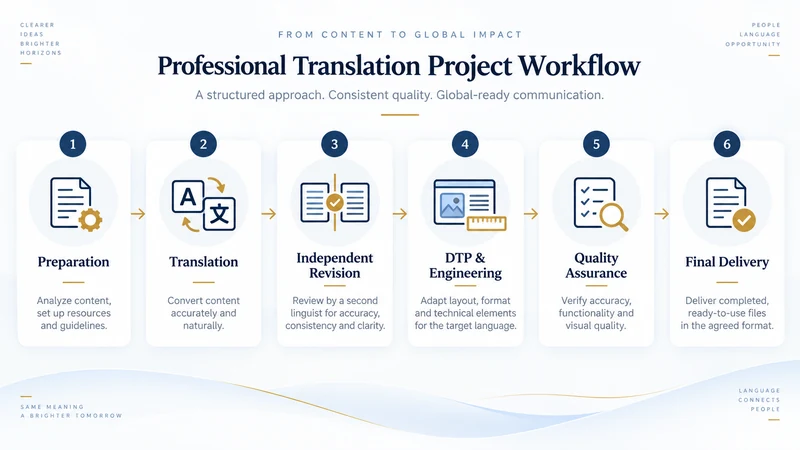
Where the Time Goes: The Professional Translation Workflow
Professional translation projects are best understood as connected production stages rather than a single writing task.
ISO 11669:2024 provides guidance on translation project specifications, communication, risk assessment, and workflows.
The actual workflow should be designed around the purpose and requirements of the content.
Intake, File Preparation, and Localization Engineering
The project begins with scope confirmation, content analysis, file inspection, resource planning, and terminology preparation.
For software or structured content, engineering may include extracting translatable strings while protecting variables, tags, placeholders, and other nontranslatable elements.
Problems discovered during preparation can affect the entire schedule.
Translation and Translator Self-Check
Qualified linguists produce the target-language content according to the approved instructions.
They also check their work, resolve terminology questions, and identify source ambiguities requiring clarification.
Productivity depends on the content and working conditions, not merely the number of words.
Independent Revision and Linguistic QA
Where independent revision is included in the agreed workflow, a second qualified linguist checks the translation against the source.
This differs from the original translator’s self-check and can identify meaning errors, omissions, and terminology inconsistencies.
ISO 17100:2015 establishes requirements for specified professional translation-service processes, including revision. Its scope does not cover raw machine translation output followed by post-editing.
DTP, Technical Testing, and Final Quality Checks
Translated material may require desktop publishing (DTP), document formatting, or technical integration.
Text expansion, font compatibility, line wrapping, and layout behavior can all affect final production.
The W3C’s guidance on text size in translation explains why translated content must be accommodated by flexible layouts.
For complex documents, multilingual desktop publishing should therefore be included in the schedule where needed.
Client Review, Changes, and Final Delivery
Client-side review may cover terminology, brand voice, product accuracy, or compliance requirements.
Feedback is incorporated, relevant corrections are checked, and the final deliverables are prepared.
These responsibilities should be agreed before production begins.
| Workflow stage | What affects timing | Can work overlap? |
|---|---|---|
| Project preparation | Source quality, files, terminology, staffing | Partially |
| Translation | Volume, complexity, linguist availability | Across independent workstreams |
| Independent revision | Reviewer availability and completed content | With staged handoffs |
| DTP and engineering | File structure, layout, integration | Partially |
| Final QA | Linguistic and technical requirements | Some checks can run concurrently |
| Client approval | Feedback and decision-making | Usually follows review-ready delivery |
Not every project requires every stage. The important point is to identify the required activities and their dependencies before confirming a deadline.
Illustrative Translation Timelines for Three Business Projects
The following scenarios demonstrate how professional translation turnaround may be planned.
These timelines are hypothetical examples, not industry averages, guaranteed delivery periods, or Textsprime service commitments. They assume that suitable resources are available, project requirements are agreed, and the source material remains stable.
Scenario 1: A Short, Editable Business Document
Consider a 900-word business brief requiring translation into one language.
With clear terminology, editable files, and available professionals, an illustrative schedule might allocate the first working day to translation and the second to independent revision and final QA.
Additional approvals, complex content, or resource constraints could extend that schedule.
Scenario 2: A Technical Manual with Formatting Requirements
Consider a 6,000-word industrial manual containing tables, operating instructions, and technical diagrams.
The project may require terminology preparation, specialist translation, revision, DTP, and final document inspection.
The document’s production requirements can influence the completion date as much as its linguistic volume.
Scenario 3: A Three-Language Software Release
Consider a software interface containing approximately 2,500 source words distributed across UI strings, requiring localization into three languages.
Translation and revision can be organized into parallel language workstreams.
However, the release may still depend on file integration, in-context linguistic testing, corrections, and final product approval.
| Hypothetical project | Illustrative schedule | Key assumptions |
|---|---|---|
| 900-word business brief, one language | Day 1: translation; Day 2: revision and QA | Final editable source and confirmed resources |
| 6,000-word technical manual, one language | Day 1: preparation; Days 2–5: translation and staged revision; Days 6–8: DTP and QA | Specialist availability, manageable formatting, prompt clarifications |
| 2,500-word software UI, three languages | Day 1: preparation; Days 2–4: parallel language work; Days 5–6: integration and testing; Day 7: approval | Stable string files, coordinated teams, available test build |
These examples use working days and assume the listed stages can be staffed as planned. Client delays, technical defects, additional review, or changes to the source may require a revised schedule.
For document-heavy projects, reviewing the requirements of professional document translation can help clarify which final production activities should be included.
Can Multiple Languages Be Translated in Parallel?
Yes. Multiple target languages can often be translated simultaneously, provided qualified resources and shared source materials are available.
A company translating a product manual into French, German, and Japanese does not necessarily need to complete French before beginning German.
After common preparation and terminology approval, the three language teams may work independently.
However, parallel translation does not mean every language will finish at the same moment.
What Can Happen Simultaneously?
Translation, language-specific revision, terminology queries, and selected engineering tasks may overlap.
Shared glossaries, reference materials, and centralized project coordination help maintain consistency across teams.
Why the Slowest Workflow May Determine the Deadline
A multilingual launch often depends on the last required language to complete its outstanding tasks.
One locale may need additional terminology clarification, layout changes, or specialist approval.
If all locales must launch together, that remaining work can determine the final release date.
Alternatively, businesses may approve staged delivery when different markets have independent launch schedules.
The scheduling principle is straightforward:
Total turnaround depends on the critical path of required activities—not the sum of every individual task’s duration.

How Translation Memory, Repetition, and AI Affect Delivery Time
Translation technology can improve workflow efficiency, but its contribution to delivery time depends on the content and implementation.
Translation memory ™ stores previously translated source segments and their target-language equivalents for potential reuse.
When a new project contains identical or similar segments, translators may be able to reuse approved wording rather than translate everything from the beginning.
However, an exact textual match is not automatically correct in every new context. Product changes, terminology updates, and different audiences may require verification.
Machine translation and AI-assisted drafting can also accelerate the creation of initial translations for suitable content.
Yet a faster draft does not necessarily produce a faster approved deliverable.
Post-editing, terminology checks, bilingual review, technical testing, and client approval may still be necessary.
A study by Silvia Terribile published in Translation Spaces found that post-editing was often—but not always—faster than human translation, with substantial variability across real projects.
Businesses should therefore evaluate total time to acceptable output, rather than measuring draft-generation speed alone.
For a deeper comparison of production approaches, see Human Translation vs AI Translation.
Rush Translation: How to Accelerate Delivery Without Losing Control
Urgent translation requests require more than asking a translator to work faster.
An effective rush workflow identifies activities that can be accelerated, dependencies that can be reduced, and quality controls that must remain intact.
Acceleration Methods That Reduce Waiting Time
Possible approaches include reserving qualified resources immediately, preparing terminology before the source is finalized, coordinating simultaneous language teams, and arranging staged handoffs between translators and revisers.
Buyers can also prioritize critical deliverables, allowing essential content to move forward before less urgent material.
These approaches require coordination and available capacity. They do not guarantee a particular delivery time.
Risks Introduced by Compressed Schedules
Aggressive deadlines can increase the likelihood of inconsistent terminology, overlooked ambiguities, fragmented reviewer feedback, or insufficient time for final-format checks.
Splitting a document among several translators may shorten production but introduce consistency challenges unless terminology and revision are carefully coordinated.
| Acceleration approach | Potential benefit | Risk or safeguard |
|---|---|---|
| Parallel language teams | Reduces sequential waiting | Maintain shared terminology |
| Staged translation handoffs | Starts downstream work earlier | Use controlled source versions |
| Translation-memory reuse | Reduces repeated work | Verify matches in context |
| Consolidated feedback | Limits avoidable revision cycles | Establish one approval authority |
| Skipping independent revision | Removes a production stage | Not acceptable where required by the agreed workflow |
| Omitting final-format QA | Reduces checking time | May leave layout or functional defects undiscovered |
Quality Controls That Should Not Be Removed
For safety-related instructions, important legal documents, regulated communications, and other high-consequence content, risk-critical linguistic checks and applicable approvals should remain part of the delivery plan.
Where independent revision is contractually required or forms part of an agreed ISO 17100-conforming service, it should not be silently removed.
When a deadline is genuinely impossible, reducing the scope, prioritizing deliverables, or negotiating staged delivery is more responsible than promising completion without necessary controls.
Urgency may also affect commercial terms. For a separate discussion of pricing, see Translation Services Cost: How Professional Pricing Works.
Four Ways Clients Can Make Translation Projects Faster
Some of the most effective scheduling improvements happen before translation begins.
1. Finalize Source Content Before Handoff
Provide an approved source version whenever possible.
Late changes can require retranslation, new revision checks, updated layouts, and repeated approvals across multiple languages.
If changes are unavoidable, use clear version control and identify exactly what has changed.
2. Provide an Approved Glossary Early
Share product names, technical terminology, preferred expressions, brand guidance, and relevant reference material.
Resolving terminology before production reduces the likelihood of repeated questions and inconsistent language decisions.
3. Supply Editable Files and Complete Assets
Original Word documents, structured content files, design sources, and reference screenshots can simplify preparation.
Avoid supplying flattened or scanned documents when editable originals are available.
Include fonts, linked images, and other production assets when final formatting is required.
4. Consolidate Feedback and Assign Ownership
Nominate a reviewer who can make or coordinate final decisions.
Collect stakeholder comments in one place, resolve conflicting requests internally, and return feedback within agreed review windows.
A well-organized approval process can prevent completed translations from remaining unnecessarily on hold.
Translation Turnaround Estimation Checklist
Before requesting or approving a professional translation timeline, confirm the following project details.
Content and Resource Requirements
- The final source material is available and approved.
- The source language and all target languages are identified.
- Regional language requirements are specified where relevant.
- The content volume and reusable translations have been assessed.
- Subject-matter complexity and intended use are understood.
- Editable files, reference materials, and relevant assets are available.
- Required terminology and style guidelines are provided.
Production, Approval, and Delivery Requirements
- Translation and independent revision requirements are defined.
- DTP, localization engineering, and final-format testing needs are identified.
- Qualified translation and review resources have been confirmed.
- Client reviewers and approval responsibilities are assigned.
- The requested deadline, timezone, and working-day assumptions are clear.
- Deliverable formats, milestones, and change-control procedures are agreed.
A useful turnaround estimate can be expressed as:
Shared preparation time + longest required dependent workflow + final integration and validation + approval time + appropriate contingency.
This is a project-planning framework, not a universal mathematical formula.
The appropriate contingency depends on uncertainty, project risk, resource availability, and the consequences of missing the deadline.
For recurring multilingual operations, reviewing completed projects can help establish more reliable internal planning assumptions than adopting generic productivity figures.
Questions to Ask Before Accepting a Translation Deadline
A credible professional translation estimate should be supported by a clear explanation of what will be delivered and how the work will be managed.
Before confirming a schedule, ask:
- Does the delivery date include independent revision and final QA?
- Which activities can run in parallel, and which depend on earlier stages?
- Who is responsible for answering terminology questions and approving changes?
- Can critical materials or individual languages be delivered in stages?
- What happens if source files change or the client review takes longer than planned?
- Will the final deliverables be ready for their intended use, or require additional production work?
The strongest estimate is not necessarily the earliest date offered. It is the date supported by a realistic workflow, available resources, clear assumptions, and appropriate quality controls.
Businesses managing complex multilingual deadlines may benefit from a file-based scheduling assessment before committing to a launch date. Textsprime’s professional language translation solutions provide a relevant starting point for discussing project scope, production requirements, and delivery expectations.
Ultimately, professional translation turnaround time should be evaluated against the entire path from approved source material to usable, quality-checked deliverables. A clearly defined workflow gives businesses a more dependable basis for planning than any universal words-per-day figure.
FAQ
Can 1,000 Words Be Translated in One Day?
Yes, a 1,000-word document may be feasible within one working day under suitable conditions. However, the language pair, complexity, resource availability, and required review determine whether final delivery is realistic within that period.
Can I Get a Professional Translation Within 24 Hours?
Some projects may qualify for 24-hour or faster delivery, depending on their scope and available resources. Confirm whether the timeframe includes independent revision, formatting, QA, and required approvals before treating it as a final delivery commitment.
Do Multiple Target Languages Take Longer?
Not necessarily in direct proportion to the number of languages. Separate language teams may work simultaneously, although resource availability, coordination, review, and integration can affect the final completion date.
Does Translation Memory Always Reduce Turnaround Time?
No. Translation memory is most useful when relevant, reliable translations can be reused. New content, poor-quality matches, changed terminology, or context-sensitive material may still require substantial linguistic work.
Does Translation Delivery Time Include Proofreading and Formatting?
Only when those activities are included in the agreed scope. Translation, independent revision, proofreading, DTP, engineering, and client approval are distinct activities. Ask the provider to specify exactly which are included in the confirmed delivery date.


